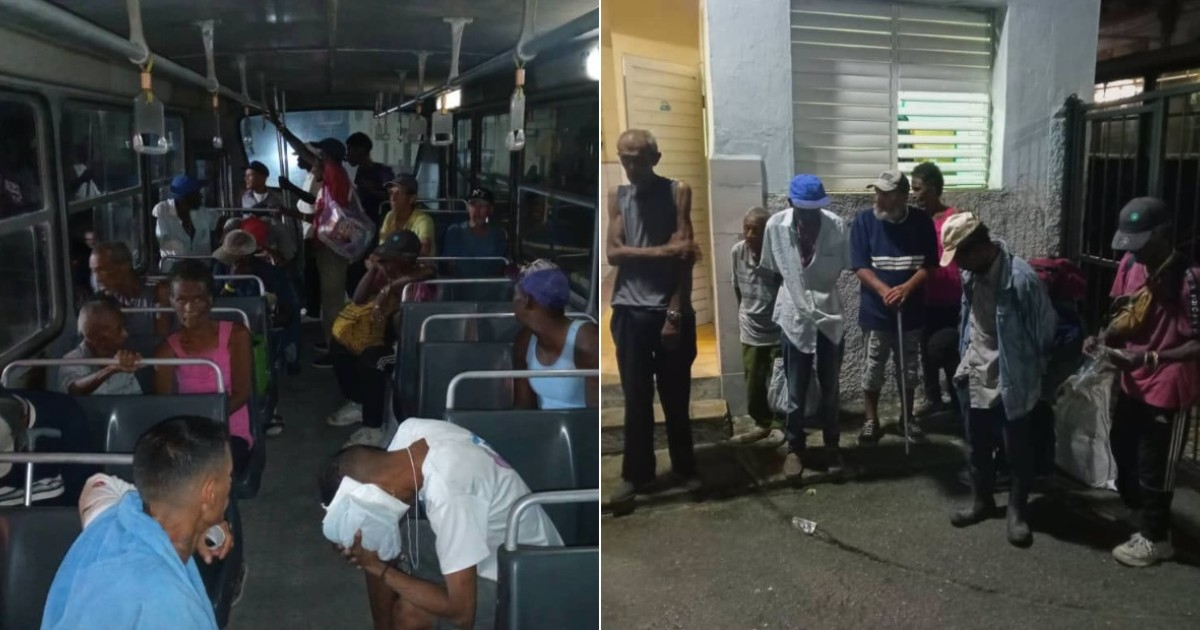
The Revolutionary National Police (PNR) and the government of the municipality of CentroHabana carried out an operation in the streets Galiano, Reina, Belascoaín, and Infanta in the capital to gather homeless individuals, in what the authorities referred to as an action of “sanitation” of the main roads, according to a publication by Habana Noticias, a media outlet close to the government and the police.
According to that post shared on social media, the operation identified dozens of homeless individuals —referred to as "vagrants" in official language— who "were carrying useless objects" and, according to the same source, "were affecting the image of the city."
The individuals collected were taken to what the publication described as "care facilities for people in those conditions," without specifying what these centers are or the conditions in which they are located.
Habana Noticias summarized the day with the phrase "clean streets, beautiful neighborhood, and people attended to as they should be," without specifying the exact date of the operation or the number of people relocated.
Among the homeless individuals gathered, there could be Cubans from other provinces who remain in Havana without housing or authorized residence, whom the authorities classify as "illegal" and expose to detentions and forced transfers back to their places of origin.
The operation this Tuesday is part of a wave of similar actions recorded in Havana over the past few weeks. In early November, a MININT operation in San Miguel del Padrón resulted in 71 people being detained, including Cubans from other provinces classified as “undocumented and illegal in the capital.”
Days later, journalist Yoani Sánchez, after nearly nine hours of detention at a police station in Cerro, reported having repeatedly heard the terms "illegal" and "deportation" and described forced transfers of individuals without registered addresses in Havana to their provinces of origin.
The activist Rolando Fidel Pérez Lora, known as "The Herald of Christ", was forcibly deported from Havana to Las Tunas last Friday, according to reports from activists.
These actions are based on Decree-Law 217 of 1997, which requires administrative authorization to reside in the capital and allows the repatriation of those who lack it to their provinces. Many of those affected are Cubans from the eastern provinces who migrate to Havana in search of a better life, fleeing even more precarious conditions.
The regime formalized a state protocol in April 2025 to manage homeless individuals through mixed teams of social workers, health personnel, and police, with an explicit emphasis on "returning them to their place of residence" for those wandering outside their province of origin.
The crisis of homeless individuals in Cuba reflects a historic social collapse. According to data from the Ministry of Labor and Social Security itself, the number of beggars has tripled between 2012 and 2023, rising from 1,100 to 3,690 registered individuals. By 2026, the situation is considerably worse: the Cuban Observatory of Human Rights estimated that 94% of Cubans surveyed live in extreme poverty, and those over 70 years old represent 44% of the homeless population.
This practice of rounding up homeless individuals before significant dates or events has documented precedents. In December 2019, Cuban police collected homeless people in Havana days before International Human Rights Day, accompanied by dogs and forcing them onto a bus. Activist Modesto Hernández then described it as a "farce" and warned that "the Government only pays attention to the homeless in the presence of a foreign dignitary or on significant dates."
Related videos:
Filed under: