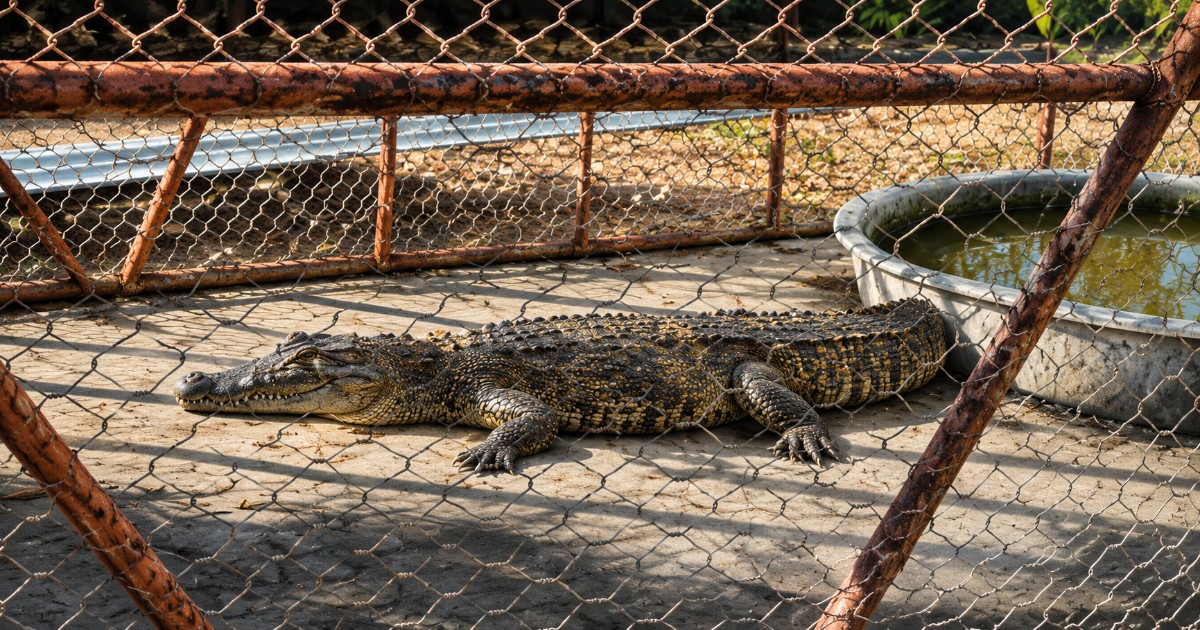
A crocodile was found in the yard of a home in the municipality of Sagua la Grande, in Villa Clara, during a joint operation by the Forest Rangers and the National Revolutionary Police (PNR), according to information released this Wednesday on social media.
The official profile Fuerza Pueblo reported on the discovery by highlighting the work of both institutions against the illegal collection of specimens from wildlife and flora.
"As a result of this work, a crocodile was recently spotted in the yard of a house in the municipality of Sagua la Grande, a case that highlights the importance of vigilance and cooperation among our forces," the publication noted.
The message was accompanied by a very low-quality photograph, although it allows us to see the reptile behind a metal mesh fence, on a concrete surface, and next to a container of water.
The information links the discovery to the authorities' actions against illegal wildlife collection, but it does not specify how the crocodile arrived at the residence, how long it had been there, or whether it was being kept in captivity.
It was also not reported whether the animal was removed from the location, what its fate would be, or if any actions were taken against anyone regarding the case.
"Caring for wildlife is everyone's responsibility. If you notice similar situations, do not hesitate to inform the authorities," concluded the spokesperson profile of the regime.
However, the post sparked reactions among Facebook users. Some celebrated the intervention of the park rangers and expressed their hope that the crocodile could return to a natural environment.
"Very good for the forest rangers. Let's hope the crocodile is returned to its natural habitat in the Ciénaga," wrote an internet user.
Others expressed concern about the animal's fate if it were taken to a zoo, given the reports about the conditions of some state facilities designated for the care of wildlife.
Several comments questioned the feeding and living conditions of the animals in those centers, while another user urged the authorities to also take action against the capture of wild birds that remain in captivity in private homes.
Meanwhile, recent buy-and-sell posts shared in Facebook groups have also raised concerns regarding the possession and trade of crocodiles in Cuba.
In one of those posts, a user was offering to sell a crocodile that was 84 centimeters long and displayed a photograph showing the animal next to a tape measure.
In another post, a person announced the sale of a 50-centimeter specimen for 50 dollars, accompanied by images of the small reptile and a contact phone number.
Although the limited information released about the crocodile found in Sagua la Grande does not allow us to determine whether it was kept as a pet, whether it was a victim of animal abuse, or whether its presence was related to the illegal trade of species, the sale listings for these reptiles on social media indicate that there are people willing to trade them in Cuba.
Additionally, there are testimonies regarding wild animals intended for religious practices, raising questions about their capture, trafficking, and the conditions in which these specimens are kept outside of their natural habitat.
In that regard, last September, a young woman from Matanzas showcased how she lived with a crocodile in her home, where she also cared for other rescued animals.
The Veterinary student Lorena Montes Peña then explained that the reptile had come into her hands after being rescued when it was supposedly going to be sold for use in religious rituals.
Despite her experience in taking care of it, she warned that she did not recommend others have a crocodile as a pet.
In the province of Villa Clara itself, a crocodile escaped in January from the municipal zoo of Caibarién through an opening in the perimeter fence, prompting an alert to the neighbors and a search operation.
Days later, images of remains identified as belonging to the animal were circulated, found in an area known as La Picadora. The news sparked complaints about the conditions of the zoos and contradictory accounts regarding what happened to the reptile.
Most recently, in September, an activist reported the disappearance of animals from the Colón Zoo in Matanzas, and claimed that a crocodile that had survived at the facility was stolen and consumed by unidentified individuals.
Related videos:
Filed under: