The Prime Minister of Antigua and Barbuda, Gaston Browne, publicly acknowledged that his government abandoned its intention to support the annual UN resolution against the US embargo on Cuba after receiving a call from the State Department, as revealed by the Jamaica Observer based on statements from the leader during his weekly radio program.
"I am going to make this public. We had decided to support Cuba in a recent resolution and changed our position because we received a call from the State Department warning us that they were advancing in negotiations and that if we supported Cuba, it would undermine the negotiations," Browne declared.
According to the prime minister, the instruction he gave to his ambassador to the UN was to abstain in the vote on October 28. However, the diplomat did not attend, and Antigua and Barbuda was officially recorded as absent, not as a formal abstention.
"Our instructions to the ambassador in New York were to abstain. I noticed that he did not present himself; I don't know what happened, but we changed our position because of certain things that were said, and we continue trying, although it's not something we have under control," Browne added.
The official linked the U.S. pressure with the difficulties faced by Antiguan citizens in obtaining U.S. visas, although he acknowledged not having absolute certainty about the reasons. He also speculated that Washington might be conditioning its stance on the citizenship by investment program of the island, which allows for citizenship to be obtained through qualified investments and which both the U.S. and the European Union consider a security risk.
Browne announced that his government agreed to suspend that program starting this Thursday, informing the EU in writing and requesting a transition period of three and a half years.
"After the official suspension, which is a gradual elimination over three and a half years but an agreement to suspend starting now, literally from November 12, we will write to you again to let you know that we have formally suspended our program because that is the reason they are using," he explained.
The case of Antigua and Barbuda adds to the broader rift that the Caribbean bloc experienced regarding Cuba during that vote.
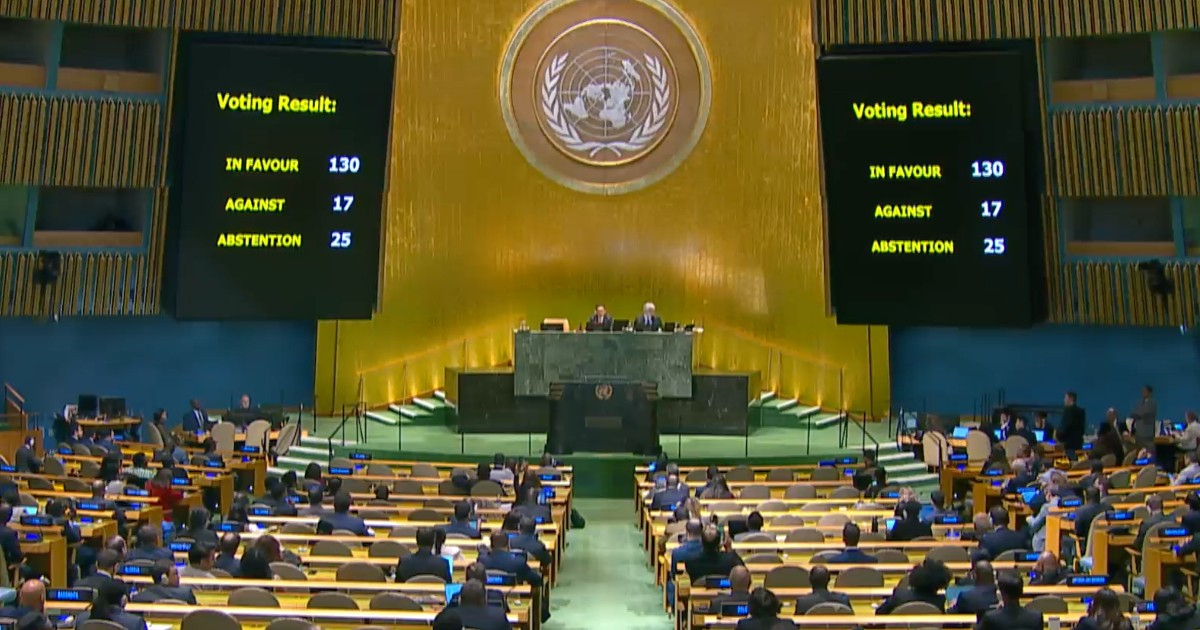
The resolution was approved with 130 votes in favor, 17 against, and 25 abstentions: the worst result for the Cuban regime since this initiative has been presented annually in the General Assembly since 1992. Support fell from 187 votes in 2024 and 165 in 2025, a total loss of 57 favorable votes over two years.
Within the Caribbean, Trinidad and Tobago was the only member of the Caribbean Community (CARICOM) that actively voted against, breaking more than three decades of support. Jamaica, Haiti, and Guyana abstained, while Dominica and Saint Lucia also appeared as absent alongside Antigua and Barbuda.
The Cuban Foreign Minister Bruno Rodríguez Parrilla had accused Secretary of State Marco Rubio of “pressuring and blackmailing” heads of state to change their votes, an accusation that Washington did not respond to directly. For his part, Deputy Secretary of State Christopher Landau publicly congratulated Trinidad and Tobago for their vote, describing it as support for “a democratic transition in Cuba.”
The Prime Minister of Trinidad and Tobago, Kamla Persad-Bissessar, defended her government's decision with a phrase that sums up the shift in stance of several Caribbean countries: “We cannot want to live in the light at home and remain silent when others live in the shadows of oppression and exploitation.”
Related videos:
Filed under: