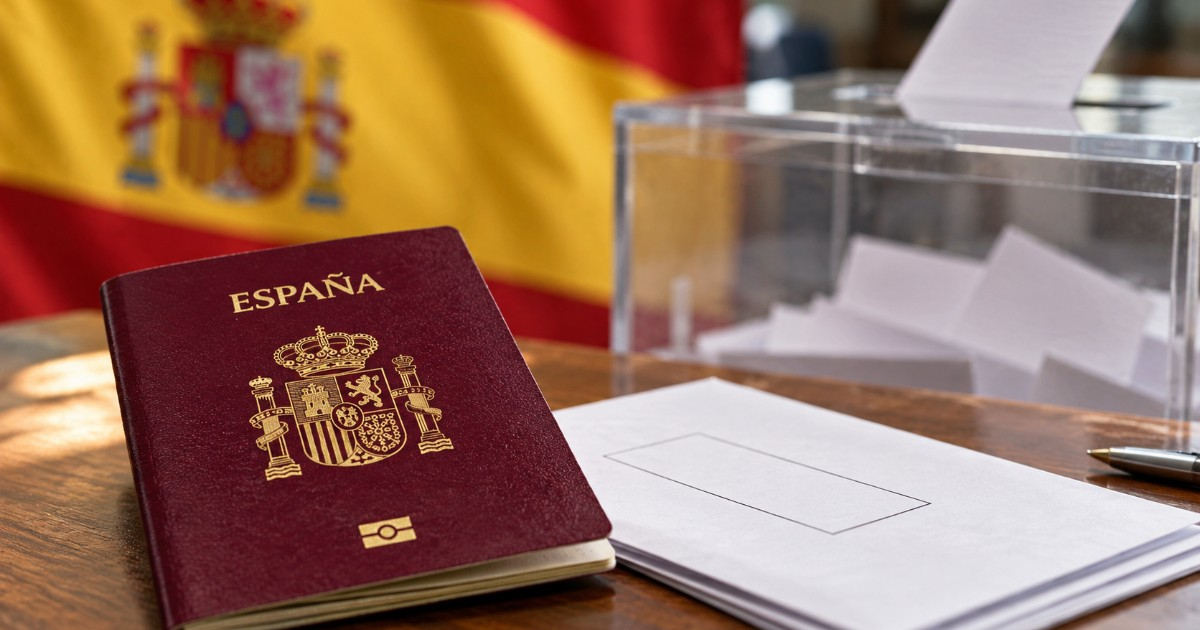
The Supreme Court reopened this Wednesday the debate on the voting rights of children of those who obtained Spanish nationality through the so-called grandchildren's law, by accepting a new appeal from Iustitia Europa against its own ruling from Monday, November 9, which had rejected the request to temporarily suspend that vote.
The decision leaves in suspense about 189,678 voters registered in the Resident Absentee Voter Census (CERA), including thousands of Cubans, just 17 days before the general elections on November 29.
The Fourth Section of the Administrative Litigation Chamber, through an order signed by the presiding judge Antonio Narváez Rodríguez, opened an extraordinary and non-extendable period for the parties to present their arguments: until Sunday, November 15 at 3:00 PM. The court did not set a date to resolve the merits of the case.
Admitting the appeal does not equate to suspending the vote. The Chamber is only reopening the examination of the request to extend the protective measures to the children of the naturalized citizens, without implying that it will change its previous stance.
The group in question consists of the adult children of those who obtained Spanish nationality under the provisions of the additional provision eight of the Law 20/2022, on Democratic Memory, registered in the CERA through section 1.b) of that same provision.
Cuba is one of the countries with the highest number of beneficiaries of this regulation: it is estimated that more than 350,000 Cubans have initiated procedures since October 2022, and the Consulate General of Spain in Havana received over 107,000 applications by the first half of 2025.
The organization Iustitia Europa, led by lawyer Luis María Pardo, submitted the motion for reconsideration on Tuesday, November 10 — one day after the order that rejected the suspension — arguing that the participation of this group could influence the electoral outcome and even the distribution of seats.
As an alternative to a total suspension, he proposed that the votes of those voters be received separately, safeguarded, and excluded from the tally until the affiliation and the process of naturalization of their parents could be individually verified. The Supreme Court responded in less than 24 hours.
This is the third judicial decision in three days regarding the same issue. On Monday, November 9, six judges rejected the extension of the suspension to the children, although the ruling included a dissenting opinion from Judge Antonio Jesús Fonseca-Herrero Raimundo.
The Supreme Court then argued that the request was submitted "more than halfway through the electoral period, one week before the start of the campaign," which was "contrary to the requirements stemming from the principles of legal certainty and electoral stability."
The State Attorney's Office had also opposed this, warning that individually identifying those affected would be "impossible to implement" and would cause a "serious logistical disruption and a procedural collapse" in the consular offices.
The parents —around 162,454 naturalized under the grandchildren's law— have already had their foreign voting rights suspended since September 10, 2026, except for 901 who proved their status as descendants of exiles. Their children, the so-called second generation, are now awaiting a new resolution.
It is important to clarify that the precautionary suspension does not annul Spanish nationality nor revoke previously issued passports: it only affects voting from abroad through the CERA. Cubans with Spanish nationality who reside and are registered in Spain can vote on November 29 without any restrictions. The in-person deposit of votes at the consulates is scheduled between November 21 and 26.
"Eighteen days before the elections, the battle to determine which electoral effects should be suspended remains ongoing. And the Supreme Court has given the parties an exceptional deadline to respond: until Sunday at three in the afternoon," summarized El Debate.
Related videos:
Filed under: