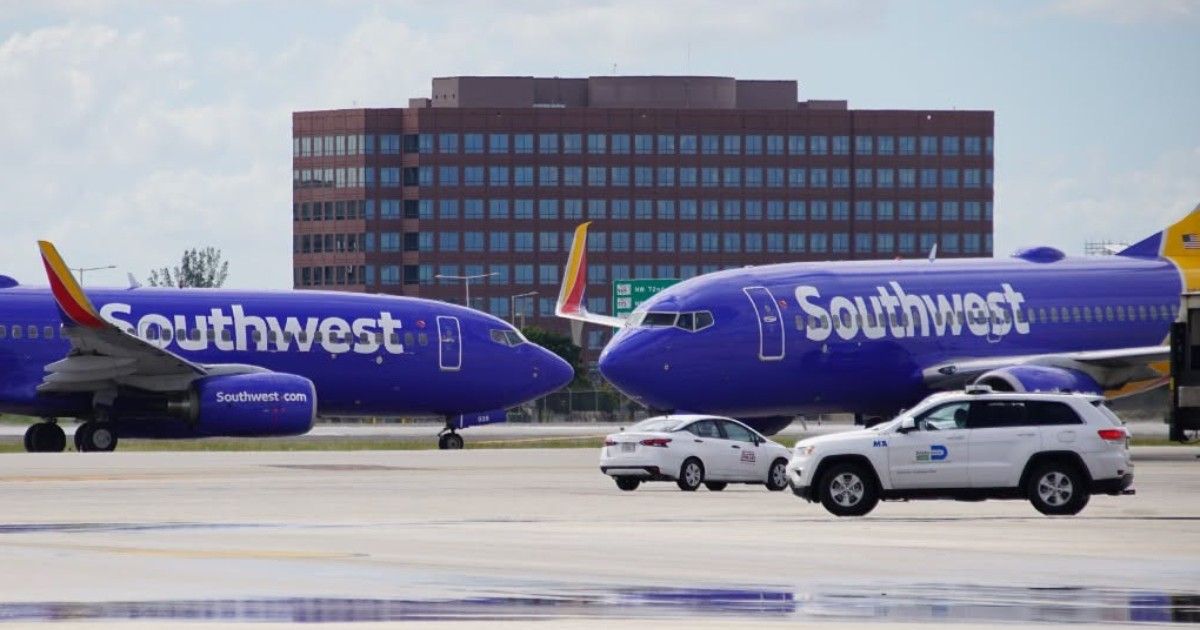
The Federal Aviation Administration (FAA) ordered on Friday the complete suspension of all outbound flights in the United States, citing "extraordinary circumstances and security reasons," marking the third such incident in a quarter of a century.
The measure came into effect at 3:54 p.m. Eastern Time and was caused by a temporary telecommunications disruption that left the controllers at the 22 regional air traffic control centers in the country without radio communication and, in some cases, without radar. Miami Airport requested patience from passengers.
The Secretary of Homeland Security, Markwayne Mullin, was emphatic in dismissing the idea of a terrorist attack: “This is not another 9/11 — I simply cannot repeat it enough”. People are making that assumption. This is a disruption in telecommunications. This is very different.
Mullin confirmed that President Donald Trump was informed and that the government was operating in "total crisis response mode", although he cautioned that the resolution would not be immediate: "This is not going to be resolved or turned around in an hour. This is going to take time".
According to the tracking platform FlightAware, around 7,000 flights were delayed or canceled. Aircraft already in the air were able to continue to their destinations; incoming international flights would be managed on a case-by-case basis.
This Friday's shutdown is only the third nationwide in the history of American aviation. The three episodes are due to completely different reasons.
9/11: the only total shutdown of airspace
The most serious precedent occurred on September 11, 2001. The FAA banned all civilian departures at 9:25 a.m. and twenty minutes later ordered approximately 4,546 aircraft that were still in flight to land. Airspace did not begin to reopen until September 13, after nearly two days of complete closure due to the attack on the Twin Towers in New York.
That is the fundamental difference with the subsequent episodes: in 2001, an immediate landing of the planes already in transit was ordered; in 2023 and 2026, only new departures were suspended.
A Cuban-American pilot flying to New York that day recalled the landing order that diverted him to New Orleans when he was about 100 miles south of the city. "Everyone was in disbelief, no one knew what was happening, until we went out to the terminal where there were some TV screens showing that a plane had crashed into a tower," he said.
2023: the collapse of the NOTAM system
The second episode occurred on January 11, 2023, when the system that distributes essential safety alerts to pilots collapsed after the accidental deletion of files by contracted personnel during overnight maintenance tasks.
The disruption lasted less than two hours, but its repercussions were significant: nearly 9,000 delays and over 1,300 cancellations in a single day, according to data from the Government Accountability Office (GAO).
2026: telecommunications down in 22 control centers
The incident this Friday simultaneously affected all regional air traffic control centers in the country, with radars and radio frequencies ceasing to function at the same time. An FAA controller described the situation to CNN in three words: "It's total chaos right now."
«A temporary interruption of telecommunications has occurred; as a precaution, all flights have been suspended. The status of all flights has been verified, and international ones will be handled on a case-by-case basis," said the FAA in a brief statement on its social media.
Authorities did not rule out any hypotheses, although preliminary reports from police officials indicated that it was not a cyberattack. Mullin also investigated whether the SMART artificial intelligence system—whose national expansion the FAA had announced three days earlier—was related to the disruptions, without confirming any connection.
The incident occurs in the context of aging infrastructure. A GAO report published in September 2026 warned that, out of the 138 FAA systems evaluated, 51 were deemed unsustainable and another 54 potentially unsustainable.
At the time of the ruling, the technological modernization initiative promoted by Congress—which approved $12.5 billion in July 2025—had only completed about half of the replacement of copper cables with fiber optics.
Related videos:
Filed under: