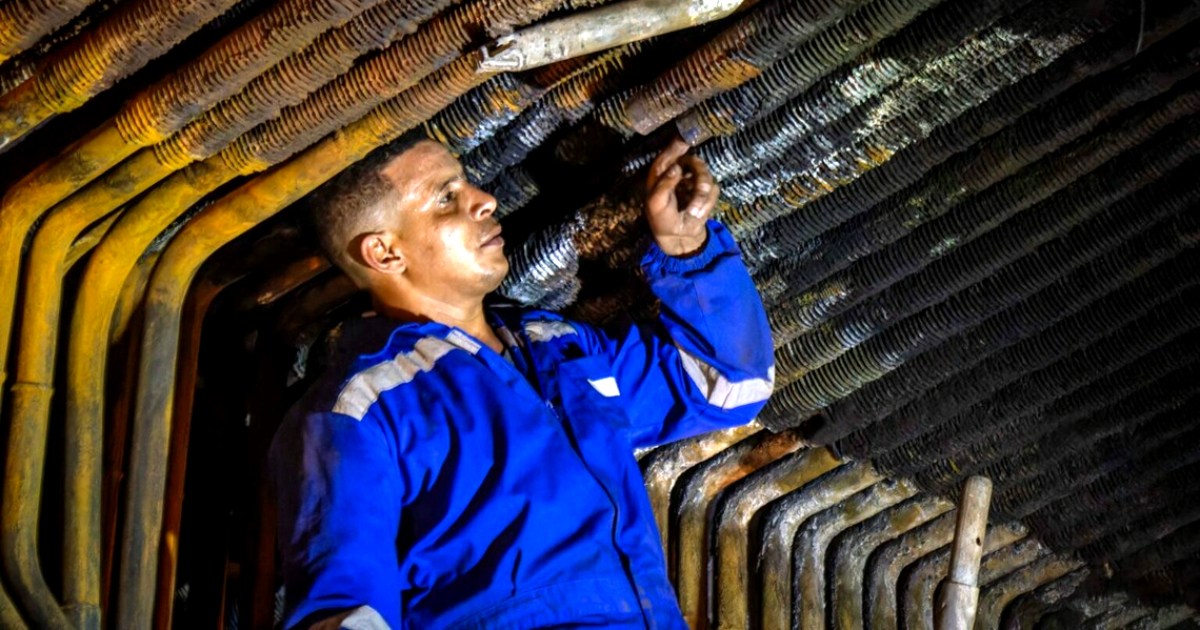
The Antonio Guiteras thermoelectric plant has recorded 28 outages from the National Electric System (SEN) in 2026 and is still awaiting major repairs that will take approximately six months.
However, the authorities continue to rely on partial interventions to restore it to operation as soon as possible, while they are now announcing that they will manufacture their economizer in Cuba, one of the most deteriorated components of the boiler.
The information, shared on his social networks by the journalist from Matanzas José Miguel Solís, is striking when compared to the statements made in July by the plant's management.
After the last breakdown, the inspection detected perforations in the economizer, the high-temperature reheater, and the nurse's area. The technical deputy Elmer García Romero reported approximately 180 corrective tasks and confirmed that the economizer shows the most significant wear. According to Solís, there are resources available for the current intervention, while plans are underway to manufacture a new one for future general maintenance.
The economizer utilizes the heat from the combustion gases to preheat the water that feeds the boiler. The holes in its tubes can cause leaks and necessitate stopping the unit. However, repairing those leaks does not necessarily address the widespread deterioration of the component.
In July, there were materials available, but it was decided to wait
On July 30, the director of Guiteras, Román Pérez Castañeda, acknowledged in an interview with the newspaper Girón that for more than a month they had materials available to massively replace elements of the economizer.
Why wasn't it done? Because stopping the unit during the summer would have worsened the blackouts, a decision that, as explained, was made jointly by the management of the plant, UNE, the Ministry of Energy and Mines, the Communist Party, and the Government.
The official also revealed that a study conducted with the participation of the University of Matanzas and CUJAE had determined that the economizer was showing widespread aging and had lost the necessary conditions to operate for extended periods.
Pérez Castañeda estimated that a limited intervention on that component would require about 20 days, while a complete major repair would take approximately six months. He also acknowledged deficiencies in other components and specialized services.
The statements from July do not indicate that comprehensive maintenance could be carried out at that time, but they do show that it was decided to postpone a significant replacement despite being aware of the equipment's deterioration.
National manufacturing is not a technological novelty either. In June 2025, Granma reported on the construction of an economizer for the Ernesto Guevara thermoelectric plant in Santa Cruz del Norte.
The question is what relationship exists between the materials available in July and the manufacturing announced now, and why a date has not yet been established to replace the component.
A SEN unable to do without the Guiteras
The national electrical situation explains the dilemma. On Friday, November 13, the UNE forecasted an availability of only 900 megawatts (MW) against a maximum demand of 2,800 MW, with an estimated impact of 1,930 MW.
At the exit of Guiteras, the shutdown of the Ernesto Guevara thermoelectric plant and the unavailability of Felton were added, among other breakdowns.
The crisis reached a significant extreme when the National Cargo Office ordered the preventive disconnection of Las Tunas to protect the stability of the SEN. The province was subsequently reconnected with only 15 MW, allocated for essential services and a very limited rotation of supply.
Although the departure of the Guiteras does not solely explain that decision, the episode reveals the fragility of a system that needs to drastically reduce consumption to avoid greater disturbances.
The official explanation has an immediate operational logic: removing the Guiteras for six months would worsen an energy crisis that already has millions of Cubans enduring prolonged blackouts.
However, keeping it operational through successive repairs does not guarantee its generation. The 28 outages this year demonstrate that the plant can be unexpectedly lost, while the cycles of shutdown and startup impose new thermal and mechanical stresses on already deteriorated components.
The paradox is evident: to avoid a prolonged shutdown for maintenance, a facility is kept operating despite breakdowns that cause continuous generation interruptions.
When will the SEN be able to do without the Guiteras for 180 days? What additional generation capacity is needed to achieve this, and what is the plan to get it?
Solar expansion can alleviate the daytime deficit, but without sufficient storage, it cannot replace thermal generation during the night. Simply manufacturing a new economizer is not enough; a capital repair requires intervention in other systems, availability of parts, specialists, and resources, as well as completing necessary tests before startup.
For now, the authorities are optimistic that the Guiteras can resume operations on Monday, November 16. What remains unclear is when they will be able to shut it down for the necessary repairs that have been overdue for years.
Related videos:
Filed under: