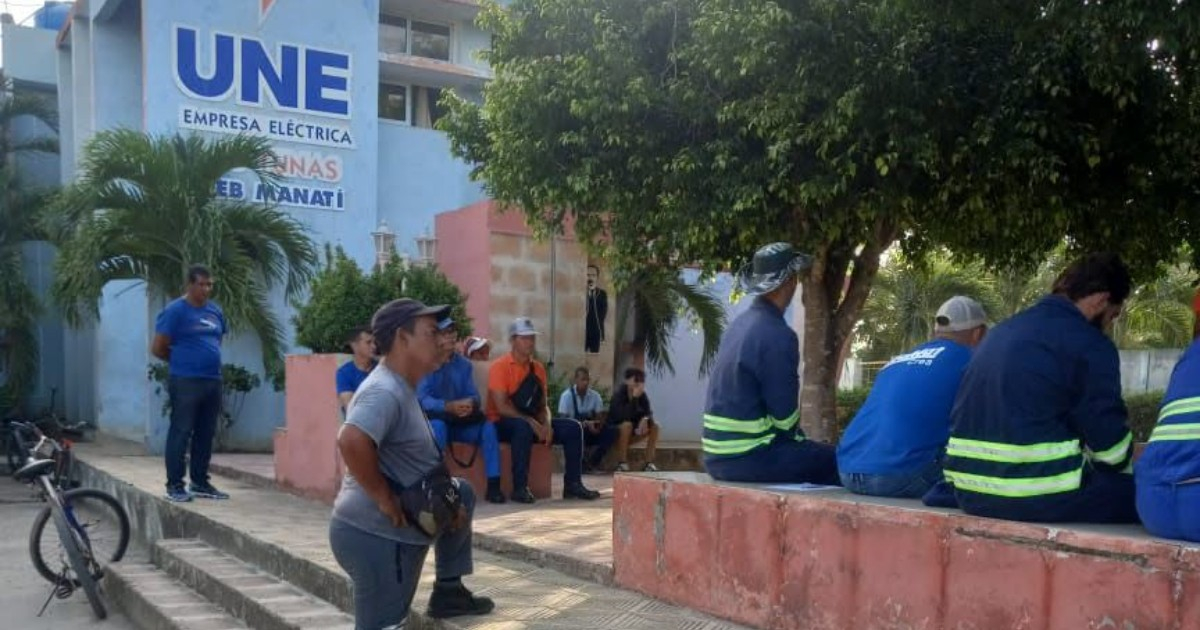
The province of Las Tunas was completely disconnected from the National Electric System (SEN) at noon this Friday, by order of the National Load Dispatch, as a measure to protect the stability of a grid that is operating on the brink of collapse. Hours later, according to a report from Empresa Eléctrica Las Tunas on Facebook, the province was reconnected, but with a capacity of only 15 megawatts (MW).
That figure is insufficient to ensure a normal supply: according to the company itself, it only suffices to "support essential services and establish a rotation of approximately two hours for the circuits of the capital city and the municipalities."
In the distribution of that minimal energy, the company prioritized the areas that experienced the most significant disruptions the previous day: Colombia, Becerra, and part of Jesús Menéndez.
The disconnection occurred in the context of the most severe electrical crisis recorded in November in Cuba. At six in the morning this Friday, the SEN had only 900 MW available against a demand of 2,142 MW, with 1,245 MW already without supply. For the peak demand evening hours, the Unión Eléctrica (UNE) forecasted a deficit of 1,900 MW and an estimated impact of 1,930 MW, which means that the system would only cover about 32% of the country's needs.
Three major thermoelectric power plants are out of service simultaneously. The Antonio Guiteras Thermoelectric Power Plant, the largest in the country, located in Matanzas, went offline in the national electricity system last Tuesday due to a leak in the economizer. The Felton plant in Holguín has been completely inoperable for three weeks, with one unit undergoing scheduled maintenance and the other one malfunctioning. And the Ernesto Guevara Thermoelectric Power Plant in Santa Cruz del Norte lost its last active block this Friday due to an oil leak in the turbine bearing, leaving all three of its units completely halted.
The weather adds to this situation: the high cloud cover recorded across much of the country this Friday limited the generation of photovoltaic solar parks, which under normal conditions contribute several hundred megawatts during daylight hours.
Las Tunas was not the only province isolated during the day. Granma was also completely disconnected from the SEN following a discharge in the 110 kV transmission line that connects it to Santiago de Cuba.
The national maximum impact has steadily escalated throughout the week: 1,764 MW on Sunday, 1,816 MW on Monday, 1,883 MW on Tuesday, 1,920 MW on Wednesday, and an estimated 1,930 MW for this Friday, a progression that reflects the accelerated deterioration of the system.
The Las Tunas Electric Company stated that it is "monitoring the operational conditions of the system and the availability of generation in the area, in order to organize the distribution of available energy," without providing a forecast for improvement in the coming hours.
Related videos:
Filed under: