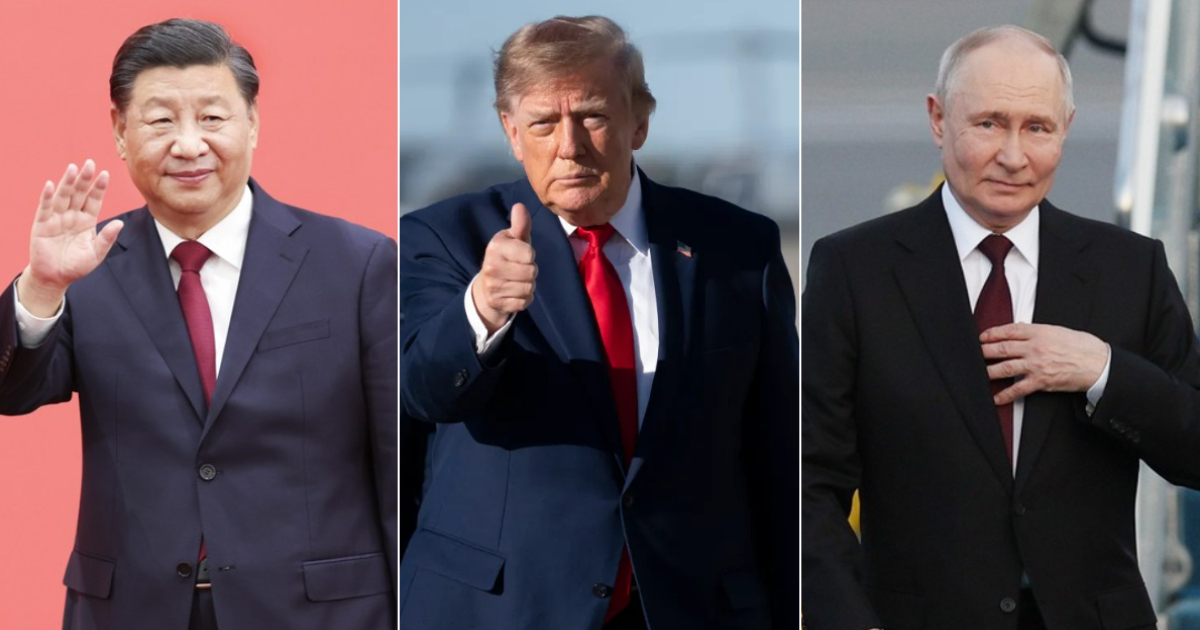
The White House confirmed this Saturday that President Donald Trump will hold the first trilateral summit in history next Thursday with the leaders of the three major nuclear powers: Trump, Chinese President Xi Jinping, and Russian President Vladimir Putin, on the sidelines of the Asia-Pacific Economic Cooperation (APEC) summit in Shenzhen, China.
The White House spokesperson, Olivia Wales, outlined the scope of the meeting: "President Trump will conclude his visit to China with a trilateral meeting between the President of the United States, the President of the People's Republic of China, and the President of the Russian Federation. The President has made it clear that, among other topics, he will address the global reduction of nuclear weapons, the proliferation of which—according to Trump—is extremely dangerous."
According to sources from the Trump administration interviewed by CNN Español, the central topics of the trilateral meeting will be nuclear arms control and the situation in Iran.
Ukraine will explicitly be off the agenda. A senior U.S. official justified the exclusion, stating, "There are other discussions underway in which we are addressing that issue, and China is not part of those talks, so it is not appropriate to discuss Ukraine in that meeting."
The expectations for concrete results are deliberately low. The same official described the meeting as "the starting point, the first conversation between these countries, at least at the leaders' level," and he was explicit: "We do not expect to reach any kind of agreement."
Another high-ranking source added that the Chinese arsenal is the factor that adds the most urgency to the dialogue: "Given that these three countries possess the largest arsenals —and China's is, by far, the fastest growing in the world, at an unprecedented rate globally— one can expect the initiation of a dialogue that could be productive for the future."
The nuclear context surrounding the summit is critical. The New START treaty—the last legally binding bilateral agreement between Washington and Moscow on strategic arsenals—expired on February 5 without a successor being signed, leaving both powers without formal restrictions for the first time in decades.
China, for its part, is experiencing the largest expansion of its arsenal in its history: from around 260 warheads in 2016 to approximately 620 in January 2026, with Pentagon projections indicating over 1,000 by 2030.
In addition to the trilateral meeting, Trump will hold a separate bilateral meeting with Xi—the third between the two leaders this year—but there will be no separate bilateral meeting with Putin.
The possibility of this trilateral summit was developed over weeks: the idea originated from a call between Trump and Putin on October 9, and on October 19, the American president publicly expressed his openness to it.
It was also confirmed that Elon Musk will accompany Trump on the trip to China, although he will not participate in the diplomatic negotiations. According to the White House correspondent David Alandete, Trump will also press Xi on access to China's rare earth minerals, identified as a central economic interest of Washington at this summit.
The Trump-Xi bilateral meeting will also take place under the shadow of the scandal involving Jensen Huang, who resigned as CEO of Nvidia last Wednesday after it was revealed that he had a relationship with Alice Huang, a Chinese businesswoman identified by U.S. intelligence as a suspected collaborator with Beijing.
High-ranking officials in the administration downplayed the case and assured that Trump would not bring it up with his Chinese counterpart.
Nuclear security experts consulted in the weeks prior expressed skepticism about the potential outcomes. Jon Wolfsthal, a nuclear policy researcher at Pax Sapiens, warned that "the chances of moving from a whim to a comprehensive and verifiable agreement are extremely low," although he acknowledged that "the nuclear threat is worsening" and that there is "a great need" for this type of dialogue.
Related videos:
Filed under: