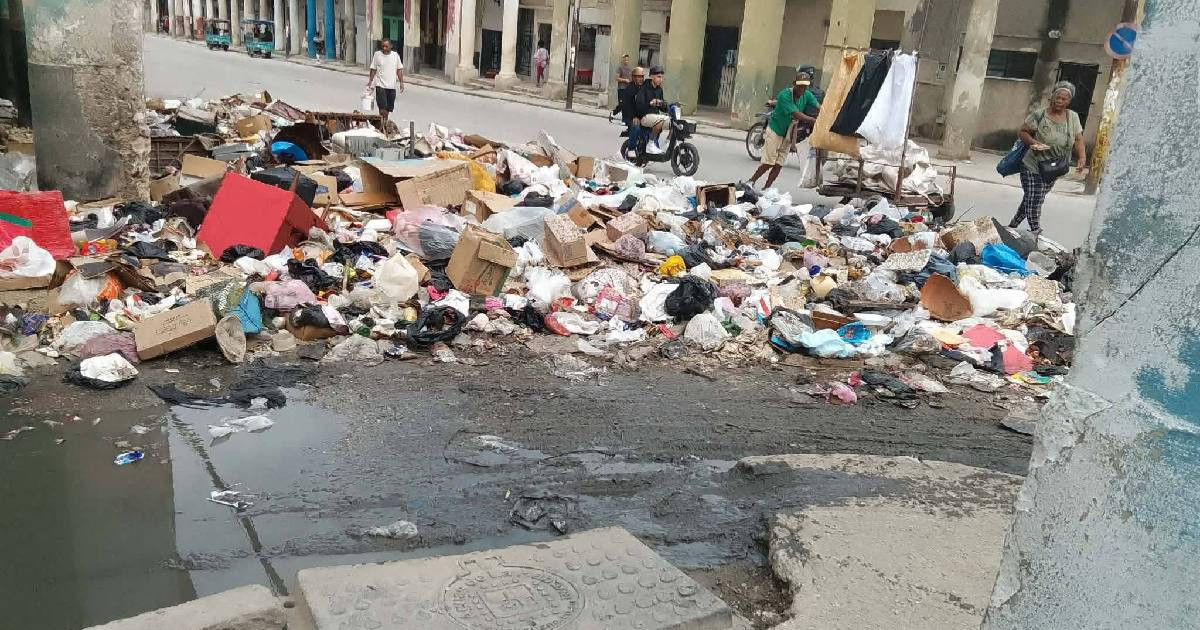
Neighbors from the corner of Monte and Fernandina, in the Cerro municipality, report the accumulation of garbage, stagnant water, and the proliferation of vectors, after exhausting all avenues of complaint with the authorities without any results.
Photographs shared this Saturday on the Facebook page "La Cuba real" show mounds of waste, cardboard boxes, plastic bags, debris, and organic waste on the sidewalks and part of the roadway. There are also puddles of dark water and dilapidated colonial buildings in the vicinity of an intersection where the trash remains uncollected.
"It is not just the garbage and everything it brings with it; it's that the water stagnates and the vectors increase by the thousands," warned the publication, which questioned the inaction of the leaders in the face of repeated complaints from residents.
A few days ago, a resident pointed out the roadways of Monte, Infanta, and Reina as some of the most affected by the trash piles at the corners and criticized the management of national and municipal authorities.
"What incapacity, apathy, and negligence from the national and municipal leaders! Epidemics threaten and linger over our heads just like Damocles' sword," he wrote.
Another user summarized the deterioration of the city with a powerful phrase: "We live inside a garbage cube." A resident of the Sevillano neighborhood expressed her outrage at the unsanitary conditions and stated that "if they think we can live among garbage and decay, they consider us animals."
The capital is sinking into a crisis regarding solid waste collection, due to the shortage and deterioration of collection trucks, a lack of diesel, and a shortage of workers, among other factors.
In February, the government announced a plan of 49 measures to address the problem, and in September, it introduced 20 trucks and over 240 containers manufactured in China, with an investment exceeding one million euros. However, the authorities themselves acknowledged that these resources "are not the definitive solution" for the sanitation issues in Cuba's largest city.
The accumulation of waste also promotes the proliferation of rodents and other vectors. Residents of Neptuno Street reported days ago the presence of mice "the size of cats", while residents of the area between Ayestarán and Infanta raised concerns about a rat infestation that was threatening homes and a nearby food production center.
As of October, Cuba had accumulated 15,859 cases of dengue, a figure 10.6 times higher than the average recorded during the same period over the past five years, according to the Global Dengue Observatory. In the previous year, the country ended with at least 81,909 official cases of dengue and chikungunya, along with 65 fatalities.
The Cerro municipality has also recorded community initiatives due to the lack of state response. In May, residents of the Casino Deportivo neighborhood organized their own community garbage collection, and in June, another accumulation of waste described as a "swamp" was documented in that area.
In October, the official newspaper Trabajadores proposed that Havana residents pay 100 pesos for each private trash collection, an alternative that would shift part of the cost of a public service that the authorities are unable to provide regularly onto the citizens.
Related videos:
Filed under: