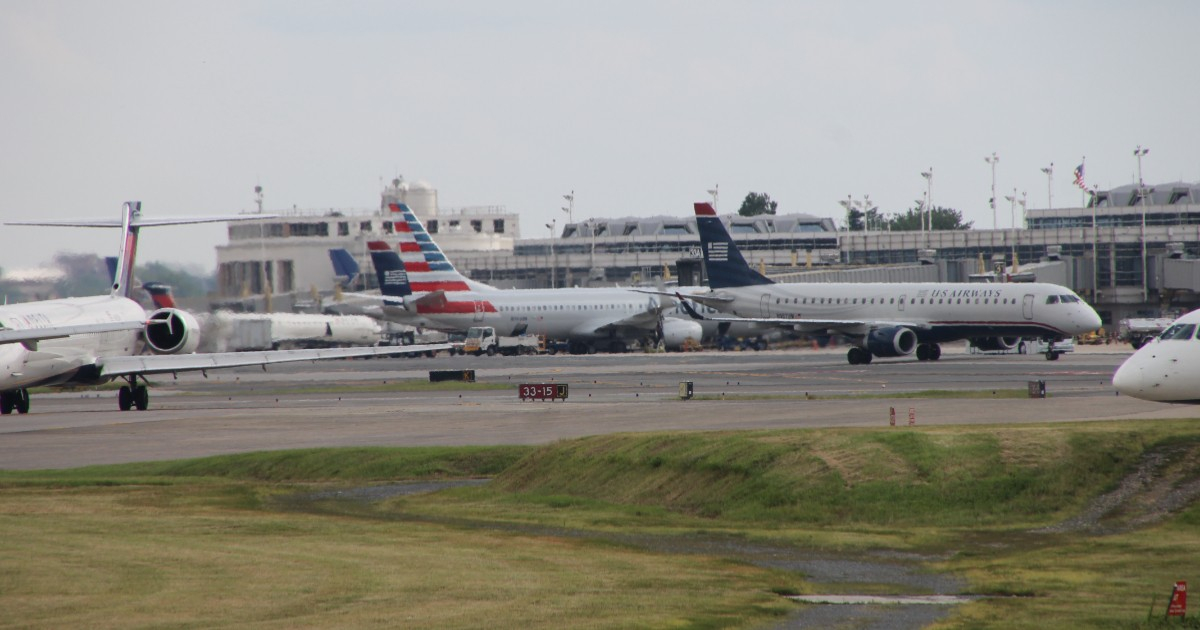
The U.S. airspace has reported over 1,454 canceled flights and 2,258 delays this Sunday, according to FlightAware data recorded at 9:18 AM Eastern Time, as airlines continue to struggle to restore operational normalcy after the largest air traffic shutdown in the country in decades.
The origin of the chaos was Friday, November 13, when the Federal Aviation Administration (FAA) ordered all outbound flights in the country to be halted for more than four and a half hours, following a communication failure that simultaneously affected all 22 regional air traffic control centers. By Saturday, there were 6,695 cancellations and 9,011 delays, figures that contrast with those from Sunday and reflect a partial improvement, although full normalcy has yet to be restored.
The Department of Transportation confirmed that the airspace is open and the operational systems are functioning, but warned that residual effects would continue throughout the day.
American Airlines reported that it continued to reposition aircraft, crews, and cargo to restore its operations, while Delta Air Lines maintains an official notice covering travel from November 13 to 15, allowing itinerary changes at no additional cost.
At Miami International Airport, the official board recorded cancellations this Sunday to Austin, Houston, Las Vegas, Los Angeles, and New York, as well as delays of several hours on various routes.
Connections between Miami and Cuba were also affected: American Airlines flight AA2705 to Havana, scheduled for 10:32 AM, was rescheduled to 1:45 PM, a delay of three hours and 13 minutes. The same service on Saturday had been directly canceled. Flight AA252 to Havana was pushed from 2:53 PM to 3:35 PM; World Atlantic 502 to Havana departed over two hours late, and World Atlantic 522 to Camagüey accumulated a delay of two hours and 18 minutes. Other services, such as flights AA017 and AA242 to Havana and AA1519 to Santiago de Cuba, departed almost on time.
The technical cause of the incident has been specified by the Secretary of Transportation, Sean Duffy: the failure occurred during the replacement of copper connections with fiber optic by the contractor L3Harris Technologies at a remote FAA facility. A router being replaced began flooding other devices on the network with over 1,000 connection attempts every four to five seconds, overloading equipment that included Cisco 600 series routers manufactured between 2001 and 2006.
"What we are trying to determine is whether there was incompetence, that is, whether it was a mistake by the user or by the L3Harris installer, or if they installed a defective router," Duffy said.
The Secretary of Homeland Security, Markwayne Mullin, dismissed any external threat: "We have found absolutely no evidence that this was a cyberattack or an artificial intelligence attack."
The incident on Friday is only the third national ground stop in the history of U.S. aviation, following September 11, 2001, and the system failure for pilot notifications in January 2023.
For Cubans and Cuban Americans, the chaos in the U.S. adds to a crisis in aviation in Cuba: ten airports on the island have notices of unavailability of Jet A-1 fuel until December 1, 2026, with over 1,700 canceled flights accumulated throughout the year and at least 11 airlines that have suspended or reduced operations to the island.
Duffy warned that the situation could repeat itself if Congress does not approve additional funds to modernize the infrastructure: “More incidents like this are going to occur. There will be more disruptions unless the American people and Congress tell us to build the new system.”
Related videos:
Filed under: