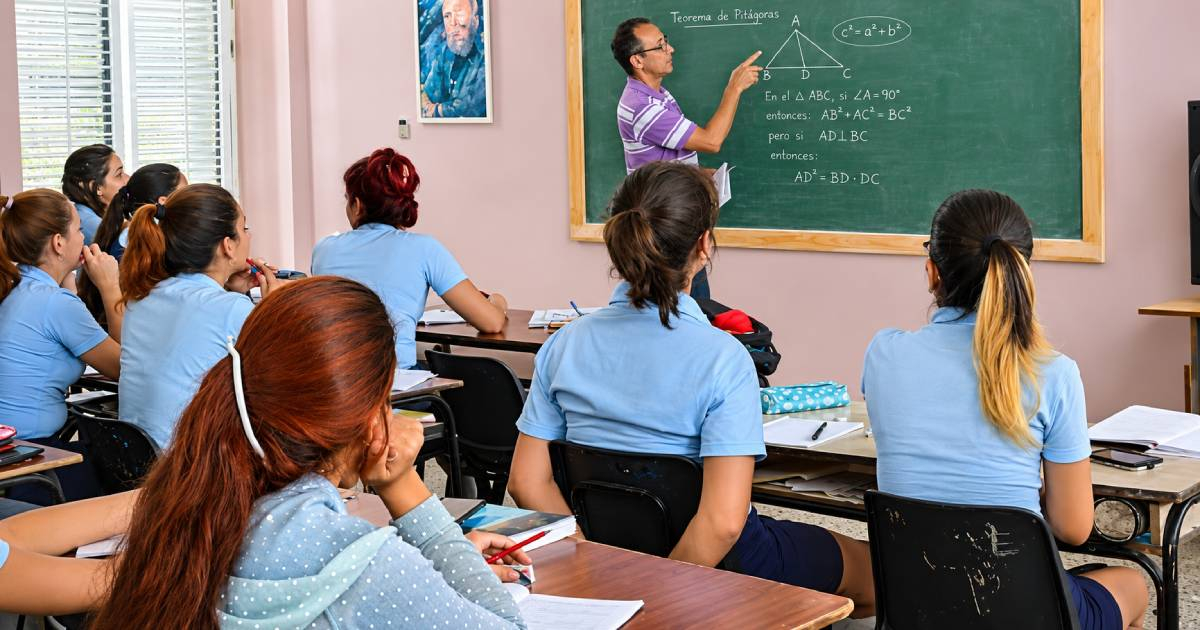
The government of Miguel Díaz-Canel will open the school system to private funding and private teachers, as reported by Minister Naima Trujillo to the EFE agency.
The Cuban regime is submitting a draft for a new Education Law for public consultation that, if approved in December by the National Assembly, will repeal the Comprehensive Education Reform of December 23, 1959.
The text consists of 10 titles and 243 articles. It was prepared with the participation of more than 25 central state administration organizations and entered into public consultation on October 21.
The reform comes as the regime itself acknowledges that the education system is facing its worst crisis in decades. The 2026-2027 school year began with only a 73% coverage of qualified teaching staff, according to official data. By 2024, authorities had already recognized nearly 24,000 vacant teaching positions, equivalent to 12.5% of the total.
Authorities transferred approximately 3,000 teachers from the eastern part of the country to Havana and turned to university students, retirees, and professionals from other sectors to fill the teacher shortage.
One of the changes in the draft bill is the legal recognition of the so-called “repasadores”, private tutors who operate outside the state system. Their activity had been expressly prohibited for active teachers by a ministerial resolution in 2022, but it was authorized under specific conditions in a from September 2026.
"By legalizing it, the dialogue between the school, the family, and the tutor is much more open," stated Naima Trujillo, who also acknowledged that these figures can serve as support in the absence of teachers in educational institutions.
In September, the Ministry of Education had already taken a first step in that direction by issuing Resolution 30/2026, which repealed the previous ban and authorized active teachers to request permission to provide private tutoring outside of school hours and without using educational premises.
The draft proposal also envisions that the funding for institutions will be supplemented by contributions from private actors and national and international cooperation, always under state supervision.
Another noteworthy aspect is that it enables training organizations to create foundations, interface companies, and small and medium enterprises to generate additional income in the education sector.
The measure reveals a fundamental contradiction for a regime that for decades has portrayed the state monopoly on education as an indispensable ideological banner.
The preliminary draft, however, maintains that the organization, regulation, and provision of the educational system constitute an "indefeasible" responsibility of the State, which retains authority over content, institutions, and authorizations.
The legalization of religious education can also deepen the social gap in access to knowledge and quality academic training.
Families that receive remittances will be able to afford extracurricular support, while parents who rely solely on state salaries are forced to guide their children down the path of self-directed learning.
The public system faces teacher salaries ranging from 6,130 to 7,735 Cuban pesos per month, which amounts to less than 12 dollars at the informal exchange rate.
Another striking provision is the incorporation of the "critical and ethical" use of artificial intelligence, blockchain, and augmented reality in management and education, within a system that does not guarantee stable electricity or connectivity.
If the National Assembly approves the draft of the new Education Law in December, it will repeal the educational norm that Fidel Castro promoted in the early days of the Revolution, which the regime turned into a symbol of its "achievements" for 67 years and now yields to the ruin of a system that cannot pay its teachers or keep the lights on in classrooms.
Related videos:
Filed under: