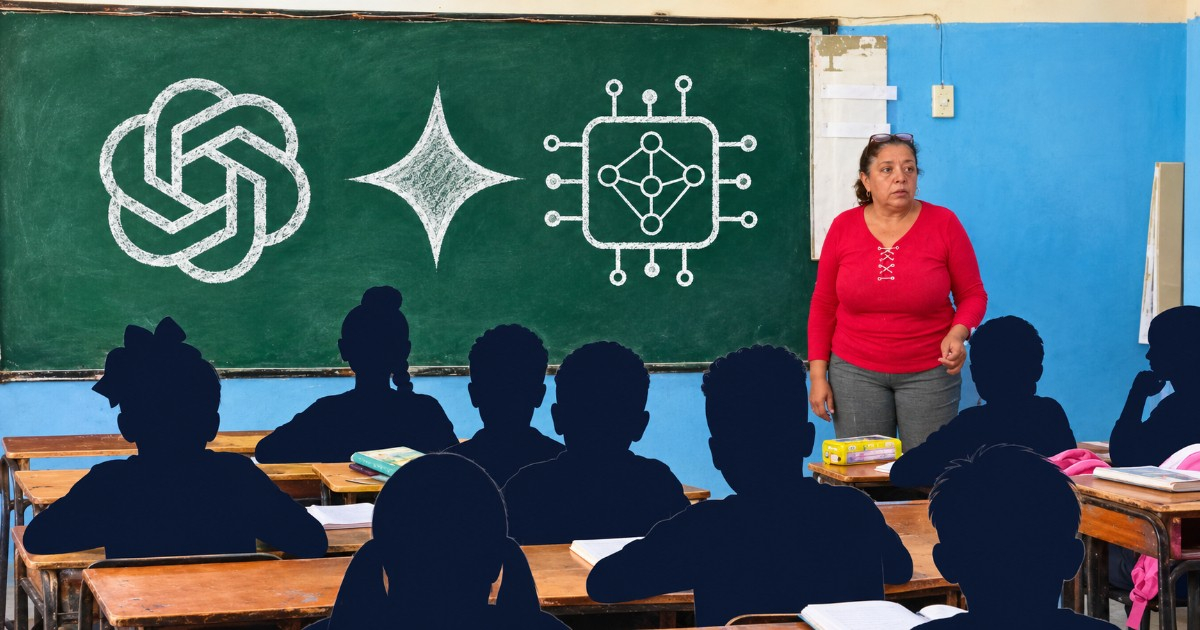
The Cuban regime is promoting a new Education Law that incorporates the "critical and ethical" use of artificial intelligence in classrooms, while the school system faces the most severe crisis in decades: 24,000 vacant teaching positions, power outages of over 20 hours a day, and fewer than 8% of households having internet access.
The draft law on education, in its nineteenth version and with 243 articles divided into ten titles, is currently undergoing public consultation and will be presented to the National Assembly in December for approval. The text would repeal Law No. 680 on Comprehensive Educational Reform from December 23, 1959, which has been in effect since the early days of Castro's regime.
The technological core of the document is its Article 224, which states that "the National Education System promotes the critical and ethical incorporation of disruptive technologies in educational management, including artificial intelligence, blockchain, augmented reality, and data analysis."
The stated objectives include enhancing institutional efficiency, reducing the digital divide, ensuring environmental sustainability, and complying with current cybersecurity regulations.
However, the text itself acknowledges in its Article 223 the contradiction that underlies all this ambition: the use of digital resources must be accompanied by "supports and alternatives that prevent the exclusion of students due to lack of connectivity, devices, or accessibility conditions".
The document does not establish deadlines, specific budgets, or compliance indicators for any of these technological provisions, and it does not mention at any point the energy crisis or the blackouts that are crippling the country.
The gap between legal texts and material reality is vast. Authorities have acknowledged the complexity of keeping classrooms open due to the economic and energy crisis. The 2026-2027 academic year began last September with only 73% teacher coverage and more than 380,000 students without a permanent teacher.
Salaries for teachers, set between 6,130 and 7,735 Cuban pesos per month—less than 12 dollars at the informal exchange rate—explain the exodus from the teaching profession. The Minister of Education herself, Naima Trujillo Barreto, acknowledged to EFE that "income is an important issue because sometimes it is true that we have mobility because salaries do not meet the needs of our professionals."
The draft proposal also introduces changes that reflect the exhaustion of the state model. For the first time, the State legally acknowledges the involvement of the private sector in educational funding, allowing educational organizations to generate supplementary income through foundations, interface companies, and small and medium enterprises.
Another development is the legalization of so-called "repasadores," private tutors whose activities had been expressly prohibited for active teachers in 2022. Trujillo Barreto defended the measure to EFE: "By legalizing it, the dialogue between the school, the family, and the repasador is much more open. We must continue to support those figures as well."
The process of developing the text spanned from 2023 to 2026, involving 410 specialists and 517 observations, of which 462 were incorporated into the final document.
UNESCO warned in May 2026 that Cuban education is "at risk," with more than 2,000 centers needing urgent support and over 400,000 students experiencing reduced hours. Weeks ago, the universities of Cambridge and Nottingham suspended their academic programs in Cuba due to the worsening crisis, further signaling the deterioration of the system to the international community.
Related videos:
Filed under: