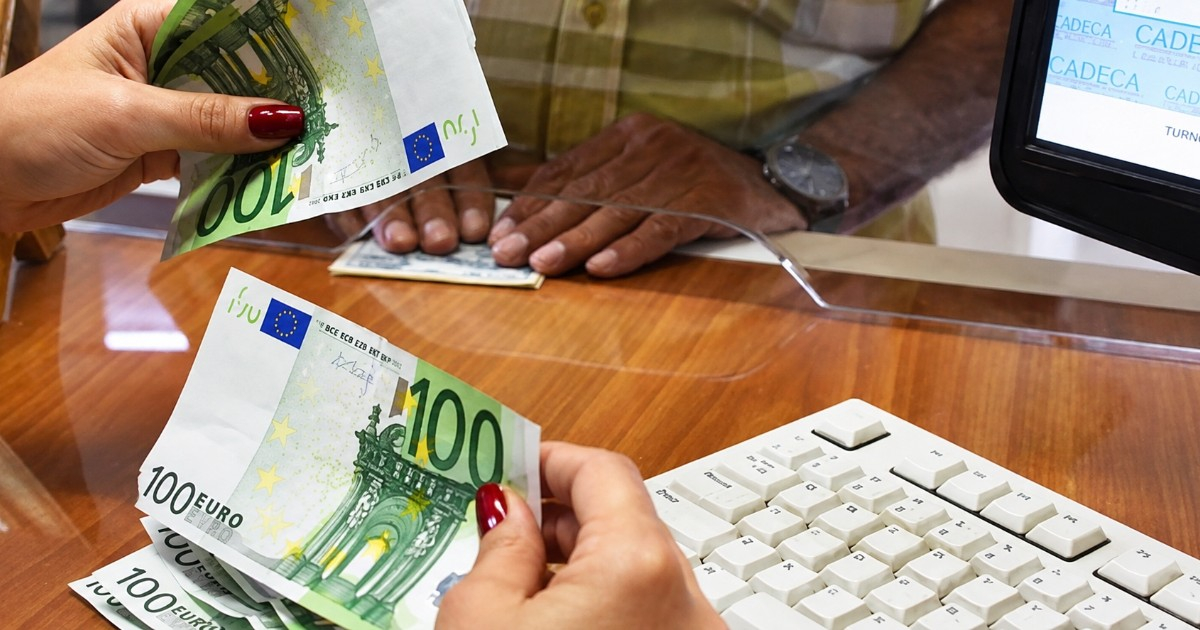
The Currency Exchange Houses of Cuba (Cadeca) have taken an unexpected turn in their currency policy: they have started buying dollars at prices nearly identical to those in the informal market, distancing themselves from the official rates of the Central Bank of Cuba (BCC).
The movement is particularly striking after years of government attacks on the mechanisms used to calculate the value of currencies outside the state system.
The Cuban economist Pavel Vidal Alejandro explained in an analysis published this Tuesday by elTOQUE that Cadeca began to implement the new exchange rate system on November 10.
Three days later, on November 13, the entity was buying dollars at 911 Cuban pesos (CUP), while the BCC reference rate was 825 CUP and the informal market rate calculated by elTOQUE was at 910 CUP.
The difference between Cadeca and the Central Bank reached 86 pesos per dollar, equivalent to 10.4% over the official rate. In contrast, Cadeca's buying price exceeded the informal reference rate by just one peso.
Until that moment, the state entity had been following the system introduced on December 18, 2025, when the so-called Segment III of the exchange market began operating with a floating official rate.
Both Cadeca and the banks set their quotations based on the value published by the Central Bank, applying relatively small margins.
However, the banks have not made the same move. According to Vidal, the Banco Popular de Ahorro (BPA) and the Banco de Crédito y Comercio (Bandec) maintain a margin of 2% compared to the BCC rate, while the Banco Metropolitano shows lower quotes.
The situation is also striking when compared to what is happening at the private exchange ADT 64 in Santa Clara, which on November 13 announced a buying rate of 915 CUP and a selling rate of 925 CUP per dollar.
The opening of ADT 64 in September had already shown that authorized operators could set prices closer to the informal market than to the official reference.
The business began operating as a pilot project under the authorization of the Central Bank, although its initial operations were marked by questions regarding the actual availability of foreign currency for sale.
The contradiction with the official discourse
The change at Cadeca is significant because for years, Cuban authorities and state media questioned the reference rate established by elTOQUE, attributing to it market distortions and alleged economic manipulation operations.
In November 2025, the Central Bank stated that this exchange rate could not be regarded as a valid reference because it conveyed distorted signals about the value of the currencies.
State television and other official media also accused the independent project of engaging in a supposed economic war against Cuba.
These points were examined in a analysis published in early November on banking reforms and the devaluation of the Cuban peso, which highlighted how the first authorized private exchange houses began to use prices close to those of the market that the Government had tried to discredit.
For Vidal, the new exchange rate of Cadeca is consistent with the idea that the informal market better reflects the real conditions of supply and demand for foreign currency in Cuba than the administratively set prices.
The economist recalled that this is not the first time something similar has happened. In August 2022, when Cadeca raised the exchange rate from 24 to 120 CUP per dollar, the new price was also close to the informal value at that time. A similar situation occurred with the launch of Segment III in December 2025.
However, Vidal warned that there is still no official explanation regarding the rules that Cadeca will use to update its prices daily.
Therefore, the coincidence observed in November does not allow us to conclude that the state entity has formally adopted the methodology of elTOQUE.
Will Cadeca be able to compete with the informal market?
The main question is not just how much Cadeca will pay for each dollar, but whether it will be able to sell enough foreign currency to the population and businesses that need it.
Vidal considers it unlikely that the entity will be able to displace the informal market on its own. To achieve this, it would need to ensure buying and selling operations without excessive restrictions, which is difficult in a country where banks and state institutions face issues with the availability of foreign currency.
If Cadeca buys dollars but cannot sell them in sufficient quantities, those who need foreign currency to import goods, travel, or protect their savings will continue to turn to the informal market.
The economist also noted that the business demand for foreign currency significantly exceeds the retail transactions that could be handled by Cadeca and the private exchange house ADT 64.
To attract a larger share of the market, it would be necessary to incorporate banks, facilitate international payments, and regain the trust of customers.
Liquidity difficulties, connectivity issues, restrictions on international transfers, and the lack of credibility in the banking system hinder the ability of financial institutions to compete with private operations.
The analysis recalled that, during the 1990s, Cadeca did manage to displace a significant portion of the informal market, but that was accompanied by fiscal measures, inflation control, and other economic reforms that have not been implemented with the same depth today.
The economist also warned that the pressures on the Cuban peso could push the exchange rate of the dollar above 1,000 CUP.
Meanwhile, the informal market registered a reference rate of 925 CUP per dollar on Tuesday, November 17, compared to the official rate of 832 CUP in Segment III.
Related videos:
Filed under: