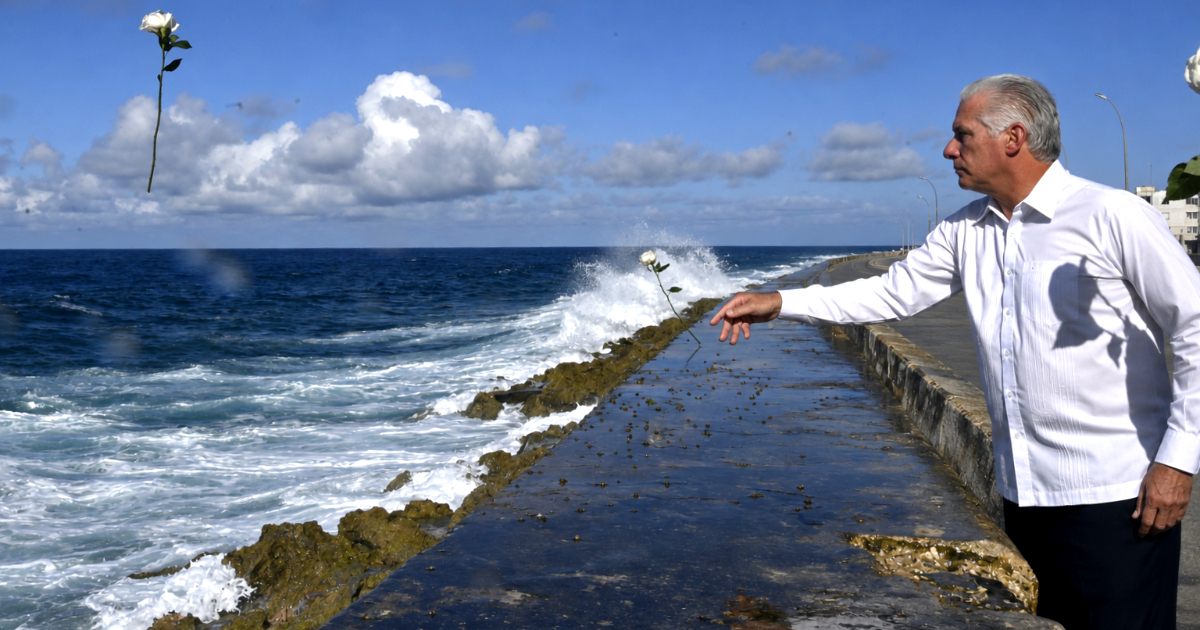
The Cuban leader Miguel Díaz-Canel wants the banking system to become a driver of economic transformations, regain the trust of citizens, and help restore the functions of money.
However, their statements come at a time when the Cuban peso is undergoing another phase of significant depreciation, and the informal market continues to set the exchange rates.
The leader expressed these aspirations during a visit to the Central Bank of Cuba (BCC) and several financial institutions, reported on November 4 by Granma under the title "The Cuban banking and financial sector must be the engine of the country's economic and social transformation."
During the meeting, the president of the BCC, Juana Lilia Delgado Portal, acknowledged issues with service quality, congestion for cash withdrawals, power outages, and connectivity failures. She also highlighted the opening of the financial system, credit access, and exchange markets as priorities.
But while the authorities announce reforms, the national currency continues to lose value and the gap between official rates and those of the informal market remains significant.
On November 7, the independent index of CiberCuba set the dollar at 933 Cuban pesos (CUP) and the euro at 1,010 CUP. On the same day, the official rate of Segment III of the BCC was 800 CUP per dollar and 892 per euro.
The deterioration has accelerated over the past few months. According to the Coins and Finance Observatory (OMFi) from elTOQUE, the informal dollar rose from 750 CUP at the end of September to 880 by the end of October, an increase of 17.3% in just one month. In November, the rates continued to rise, surpassing 900 pesos.
The evolution reflects a problem that no banking reform has managed to resolve: the shortage of foreign currency and a demand that far exceeds the available supply.
Private exchange houses: the market dictates its prices
In June, the Government announced 176 economic transformations, including the authorization of private banks, non-banking financial institutions, private exchange houses, and new remittance operators.
The change represents a significant break from decades of state monopoly, although its ability to stabilize the peso remains uncertain.
A revealing example emerged in September with the opening of ADT64, the first authorized private currency exchange, located in Santa Clara.
The establishment initially displayed a rate of 710 CUP for buying dollars and 730 for selling them, while the informal market hovered around 700 and the official rate was around 655.
Although initially only the purchase of foreign currency was noted, the figures indicated that the new private operator was guided by prices much closer to those in the street than to those set by the authorities.
The economist Pedro Monreal highlighted this contradiction and warned that the entry of private operators did not guarantee a decrease in the price of the dollar.
The Central Bank itself confirmed that it was using information from ADT64's operations to substantiate its official rate for Segment III.
The State was thus beginning to incorporate prices arising from private transactions in a market whose values it had tried to keep under administrative control.
Experience reveals a fundamental limit of reforms: authorizing new intermediaries can improve certain services, but it does not itself create the dollars and euros that the economy needs.
The unofficial rate that the Government tried to discredit
The twist becomes even more contradictory when recalling the prolonged official campaign against elTOQUE, the independent media outlet that publishes the Representative Rate of the Informal Market (TRMi).
For years, government officials and state-run media accused the project of artificially manipulating the value of the peso and engaging in an alleged economic warfare operation promoted from the United States.
In November 2025, the Central Bank publicly supported those accusations and stated that the rate from elTOQUE "cannot serve as a valid reference," because it transmitted distorted signals.
The offensive included accusations of currency trafficking and tax evasion, along with threats of criminal investigations and public exposure campaigns against members of the media. The spokesperson Humberto López even accused the independent media of “financial terrorism.”
However, economic research has provided evidence supporting the usefulness of its measurements.
In June 2025, economist Pavel Vidal analyzed a historical series of the informal market used by the Ministry of Economy during an official presentation.
When comparing it with the data from elTOQUE, a 95% correlation was found between the variations of both series during the period of 2021-2023. There were differences in the absolute quotes, but their trajectories were remarkably similar.
The methodology of elTOQUE, based on the statistical processing of buy and sell advertisements, was also examined in a study published in the academic journal Applied Economics.
These findings do not mean that all actual transactions occur at the published prices, nor that the statistical references are infallible. However, they challenge the official thesis that the depreciation of the peso is essentially the result of informational manipulation.
The initial quotes of ADT64 provide further evidence: when an authorized operator needs to attract foreign currency, their prices can approach those of the informal market that the government has attempted to delegitimize.
The problem is not who publishes the rate
The recent increase in the dollar has economic explanations that go far beyond the spread of quotes.
A report from OMFi published on November 5 indicates that in addition to the traditional demand for foreign currency, there is increasing pressure from businesses to import fuels, solar panels, equipment, and other supplies.
The observatory suggests that part of that demand could be financed with pesos accumulated in corporate accounts, increasing competition for a supply of foreign currency that remains limited. This is a factor whose impact cannot yet be fully quantified.
This is compounded by low national production, fiscal imbalances, partial dollarization, and a loss of confidence in the peso as a savings instrument.
In such conditions, the opening of private banks and currency exchange houses does not replace the need for a monetary policy capable of stabilizing prices and ensuring a sufficient supply of foreign currency.
The paradox of Díaz-Canel's speech lies precisely there: the government demands a modern and reliable banking system, yet continues to neglect the economic imbalances that fuel monetary depreciation.
And while it attempts to regain control of the foreign exchange market through private operators, the evolution of the exchange rates confirms an uncomfortable reality for the authorities: the price of the dollar is not determined by the medium that publishes it, but by the conditions of supply, demand, and confidence in an economy that still struggles to find stability.
Related videos:
Filed under: