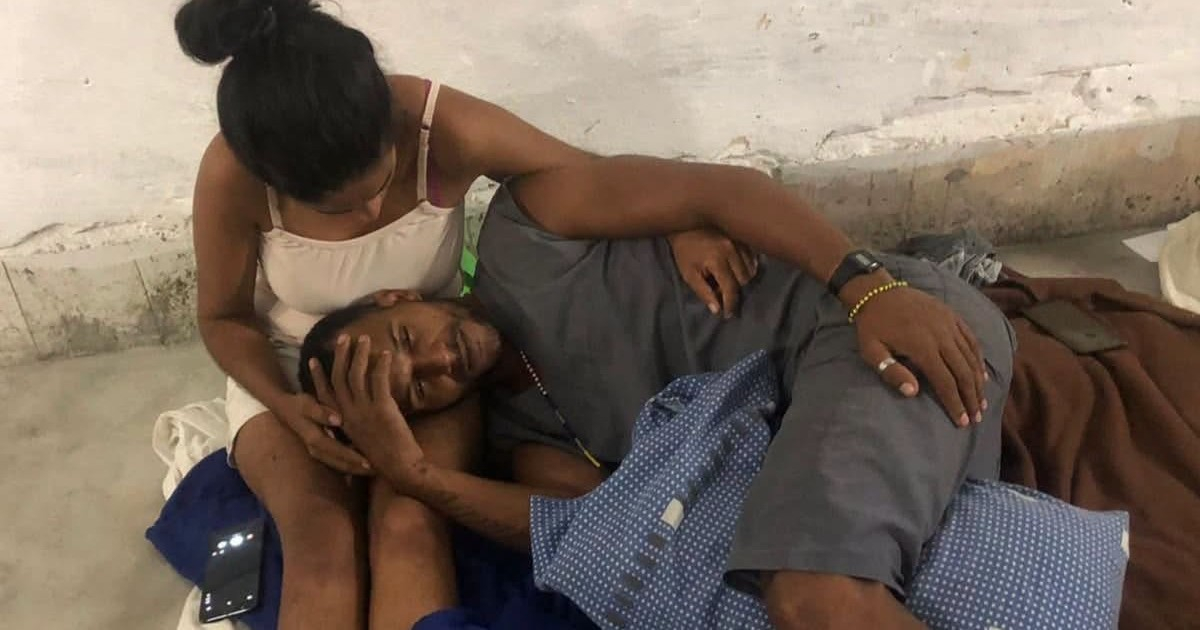
This Monday marks six years since the beginning of the barracking of the San Isidro Movement (MSI), and curator and activist Anamely Ramos commemorated the date with a post on Facebook in which she recalls those days alongside an unpublished photograph of herself holding Maykel Castillo Pérez, better known as “El Osorbo” or Maykel Obsorbo, during the protest in 2020. The rapper and activist remains imprisoned in Cuba today.
"Today marks six years since the San Isidro barracks incident. People don’t talk about it much anymore, but for those of us who experienced it, a thousand years could pass, and we will never forget. It’s not even a conventional memory; it’s something we feel in our bodies, somatized," wrote Ramos.
The encampment began on November 16, 2020, at the headquarters of the MSI, located at 955 Damas Street in Old Havana, in solidarity with the rapper Denis Solís, who was sentenced to eight months in prison for "contempt" in a summary trial lasting less than 72 hours. On November 18 of that year, nine members of the movement started a hunger strike, including Luis Manuel Otero Alcántara and Osorbo himself.
The police evacuated the headquarters on November 26, 2020, which the following day triggered the 27N demonstration: over 300 artists and intellectuals gathered in front of the Ministry of Culture demanding freedom of expression, marking the largest public cultural protest in Cuba in decades.
"In this photo, I have Maykel on my lap. Trying to take care of him, though not really succeeding much. A sort of impossible race. He is always beyond any attempts we make to prevent him from taking the brunt, once again," the activist wrote, recalling Osorbo's words to her at that time: "Don't worry Ana, I can always carry more."
"It's not just a life, the life of someone you love; it's a whole part of a country. It is the breakdown of a country. The most stubborn injustice, and also the one that repeatedly lurks behind everyone's misery. We are all together, yet we are not. There is always someone or 'someones' who bear the brunt, who end up holding the collective thread until it breaks. The rest is propaganda," Ramos wrote this Monday.
Six years later, Otero Alcántara arrived exiled in Miami in July 2026 after serving his five-year sentence, with the condition of permanently leaving Cuba. "I was expelled from Cuba," he stated upon arrival. Osorbo, on the other hand, remains imprisoned. He was arrested in May 2021 and sentenced in June 2022 to nine years in prison for contempt, assault, public disorder, and defamation of state institutions.
So far in 2026, the regime has transferred him twice without notifying his family: first to the Kilo 8 maximum security prison in Pinar del Río, and then to Guanajay in Artemisa. In October, activists reported a violent crackdown at that prison involving more than 30 personnel, including members of the Special Brigade and Security State agents.
In April, regime agents offered him the choice between exile or remaining imprisoned until 2030; he would have accepted the departure, but he was never released.
In June 2026, the Inter-American Commission on Human Rights concluded that Cuba violated Osorbo's rights during his detention and judicial process, and recommended overturning the conviction and releasing him immediately. In July, the United States approved a humanitarian parole for him, but the Cuban regime has not allowed his departure. If he were to serve his full sentence, Maykel Osorbo would not be released from prison until May 2030.
Related videos:
Filed under: