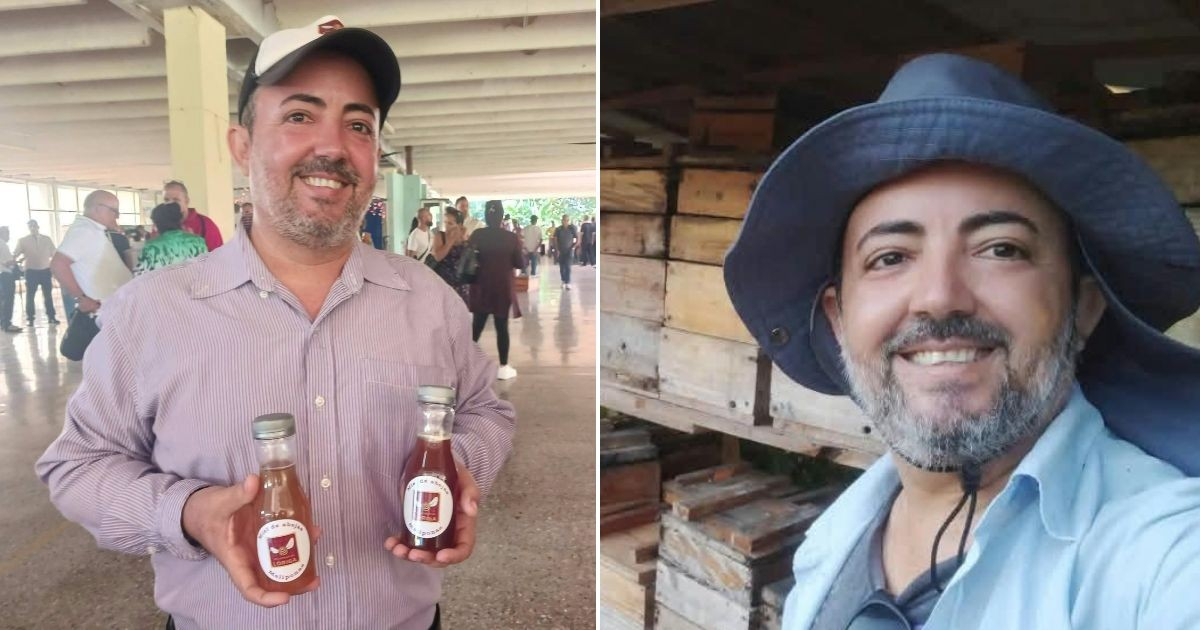
Walberto Lóriga Peña grew up among hives and bee stings on a farm in San Nicolás, Mayabeque, and at 46 years old, that childhood fascination has transformed into a scientific career and an enterprise that started with a single hive and now boasts 400.
His story was featured by the Diario Mayabeque in a report that describes how a child interested in animals and nature ended up dedicating a significant part of his life to the study and raising of bees.
Walberto first encountered the Apis mellifera, the common bee that was abundant on the family farm. Since he was young, he decided that he would study a career related to living beings, and when the time came, he chose Veterinary Medicine.
During his studies at the Agrarian University of Havana, Fructuoso Rodríguez Pérez discovered the work of several professors with the Melipona beecheii, known in Cuba as the earth bee, a stingless species that produces honey with characteristics different from that of common bees.
The interest in these insects ultimately defined his academic training. He became a tenured professor, researcher, and doctor in Sciences, and participated in the development of the Manual de Meliponicultura en Cuba, a work dedicated to the knowledge and management of stingless bees.
“It’s something that has brought me a lot of joy,” he confessed when talking about the book.
From one hive to 400
Twelve years ago, they began to intensively raise melipona bees. Starting with just one hive, they expanded their operations to the 400 hives that currently make up MeliponariosLóriga, the venture they develop alongside agronomist Henry González.
In their farm in San Nicolás, they practice a technique known as migratory meliponiculture, which involves moving the hives to locations where the bees can take advantage of specific flowering periods.
Between March and August, for example, they move part of the hives to Playa Caimito when the mangroves are in bloom. There, they establish a temporary meliponary to take advantage of the available nectar.
The goal is to produce monofloral honey, primarily obtained from the nectar of a specific plant species, as well as bee bread, a food made from the pollen collected by insects.
They also cultivate and propagate honey-bearing plants that provide nectar, pollen, and resins to the colonies.
According to the report, Walberto has managed to obtain about six kilograms of honey per hive per year, a yield that he compares to international references of approximately three kilograms in the same period.
Although he no longer teaches at the Agrarian University of Havana, he continues to share knowledge through social media and maintains his outreach work to help other Cuban producers improve the breeding of meliponas.
The dream of exporting its honey
The growth of MeliponariosLóriga has led its founder to set a new goal: to market its products in international markets.
In April 2026, thanks to his connection with the Italian Agency for Development Cooperation, he participated in the Macfrut agri-food fair held in Rimini, Italy, where he was able to present his initiative to participants from other countries.
However, he acknowledges that turning that interest into effective exports will not be easy.
The export process is complex. There are barriers here and in potential markets. There is also a lack of standards for Melipona honey because the laboratories that function as regulatory authorities have set up their analyses based on honey from Apis mellifera, and these are different species,” he explained.
The producer noted that melipona honey can reach high prices in certain markets. As a reference, he mentioned values of at least 60 dollars per liter and between 200 and 300 dollars per kilogram.
His venture also promotes pollination, the conservation of nectar-producing plants, and the transmission of knowledge to youth, women, and children, with the aim of expanding production and learning opportunities related to these bees.
Walberto's career had received international recognition prior to this new report. In May 2025, the Cuban News Agency reported that he received the International Ruta Meli Award in the Outstanding Scientist category for his research on melipona bees.
The breeding of meliponas has a history of scientific interest in Cuba. In 2018, a report on the bee Melipona beecheii highlighted the island's role in the conservation of this stingless species, whose honey is produced in much smaller quantities than that of common bees, but can fetch higher prices.
Walberto's interest in exporting aligns with efforts to open international markets for small Cuban producers.
In August 2026, Villa Clara called on mipymes producing honey, coffee, and processed fruits to participate in a program to support exports to Europe and North America.
Related videos:
Filed under: