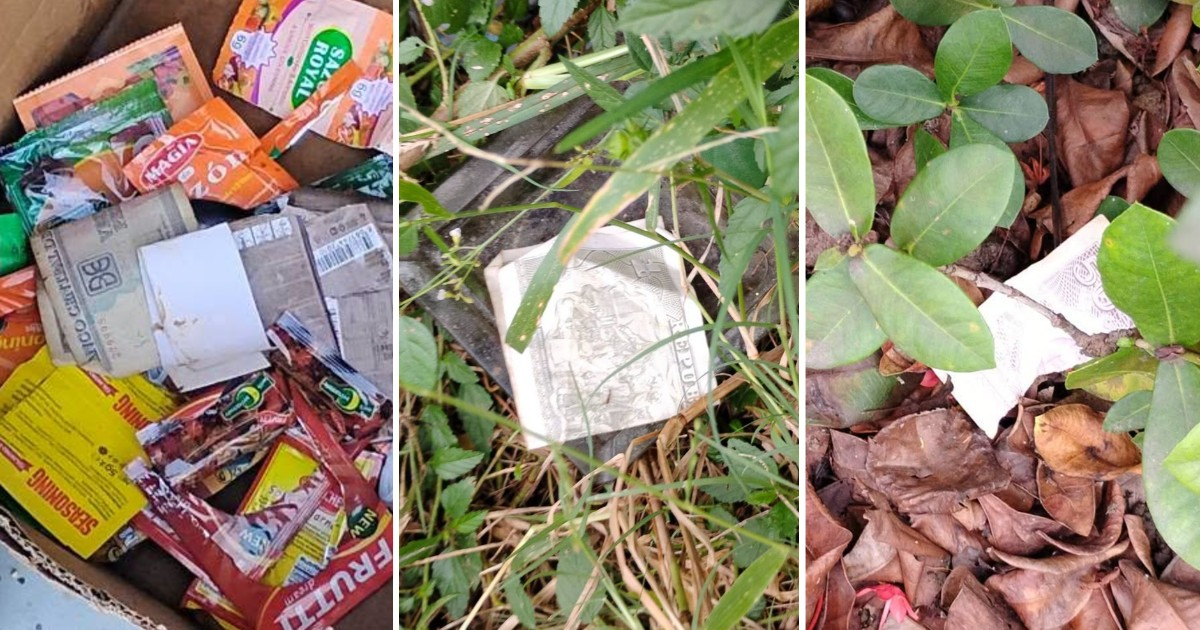
The rejection of low-denomination bills has spread across Cuba to the extent that businesses and private vendors refuse to accept even 50 Cuban peso bills, an illegal practice that leaves retirees, the elderly, and low-income individuals unable to make purchases. State journalist Orlys Rodríguez Shaw documented this in an opinion piece titled "Alcohol en los ojos" that depicts everyday scenes in a country where official money is no longer accepted for purchases.
Rodríguez Shaw recounted in the first person how a café accepted 1,000 and 200 peso bills without issue, but refused to accept the same 4,200 pesos when presented in five peso bills. "They wouldn't accept $5 bills. They called me an abuser," he wrote. The owner of the establishment eventually told him not to return.
Rodríguez Shaw recounted that a cart driver in Mayarí tore the five peso bills handed to him by an elderly woman as payment. He saw a 20 bill thrown in the trash and another 50 bill torn in half on the same path. A diver rummaging through the refuse overlooked a one peso bill on the ground. On a tricycle, no one stopped to pick up the 200 bill that blew away from a passenger: the driver said that "200 was nothing."
"How difficult it is to assert our rights! How hard it is not to be affected by the transfers or the small bills: of $1, $5, $10, $20, and even $50!" he stated.
Several Cubans recounted that they have experienced the same thing. "One day I went to buy cookies for my baby and they wouldn’t accept 20-peso bills, and I even told them it was for my baby," said a Cuban mother.
A resident abroad recounted: "I visited Cuba last year. As soon as I arrived in my hometown, I exchanged 200 dollars for MN (national currency) at a private house. They gave me some 1000, 500, 200, and other bills of 50, 20, and 10. Next to that house, there’s a mipyme (which belongs to that residence), where I bought some basic food items and drinks. When I went to pay, I wanted to use the smaller bills, but the cashier refused to accept them. I explained that I had just exchanged my dollars at that same house and that those bills came from there. She told me that her business had nothing to do with her brother's (who exchanged the money for me) and that she wouldn't accept those bills. Look at what Cuba has come to, folks!"
"What should I do with this money if I don't have any other? I can't buy what I need. I won't buy food because they won't accept these bills? This is the last straw. It's time for them to stop turning a blind eye and see what truly affects the people; we can't keep covering the sun with a finger," demanded another person.
The most extreme case occurred on July 2, when retired journalist Arturo Chang, 74 years old, attempted to buy ten loaves of bread at the private establishment "24.7" in Santa Clara with 200 five-peso bills that the bank had given him as part of his monthly pension of 3,653 pesos. The employees refused the payment, arguing that the business was private and that the owner could decide which bills to accept. After more than three hours of negotiations, when the sale was finally authorized, the bread was already sold out, and Chang returned home without lunch.
In October, a small to medium-sized enterprise limited payments to 500 pesos when a customer tried to buy rice using 50 peso bills. “With 50 peso bills, they only accept 500 pesos”, the affected customer reported. In Holguín, a business rejected 300 pesos in 20 peso bills for a purchase of 18,000 pesos.
The Bank of Credit and Commerce (BANDEC) described these practices as a "flagrant violation of citizens' rights" and warned in August that no establishment can impose which denominations it accepts. The Central Bank of Cuba states that all banknotes in circulation have "full releasing power." However, the warnings have not stopped the phenomenon.
Since the Monetary Reorganization of January 2021, inflation has eroded the practical value of low denominations: by the close of this Tuesday, the dollar was trading at 925 pesos in the informal market, compared to the official rate of 24 pesos that year, representing a depreciation of over 3,700% in five years. A five peso bill is now worth less than a cent. The government responded by issuing bills of up to 10,000 and 20,000 pesos in September, the highest denominations in Cuba's monetary history, which has further reinforced the commercial disregard for smaller bills.
Related videos:
Filed under: