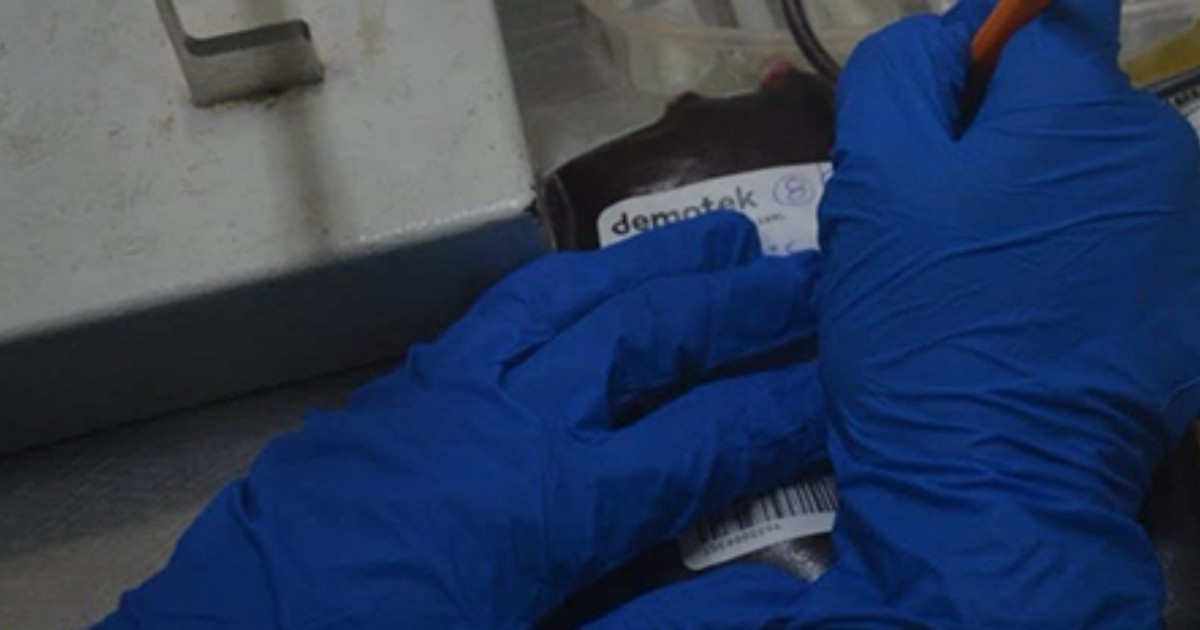
A Cuban woman identified as Niurka Landin reported on Facebook the desperate situation her mother is facing, who is suffering from cancer and has been hospitalized for a month in a Santa Clara, while the Provincial Blood Bank systematically denies her the transfusions she needs to survive.
In her social media post, Landin recounts that her mother’s hemoglobin is "at rock bottom" and that she paid for up to four bags of O negative blood altogether without them reaching the patient: only one was administered. The next day, she paid for two more bags, and the bank claimed it "wasn't the right blood" or "was another blood type."
“I don’t usually publish these things, but I am more than tired of it,” wrote Landin, who directly accuses the bank of selling blood bags—especially those of type O negative, the rarest because it is the universal donor—and then making excuses such as claiming they are infected or do not match the order.
"The same doctors at the hospital say it's outrageous what they're experiencing, people with hemoglobin at 3 and the most absurd thing is that they're bleeding," she noted.
In addition to the frustration of not receiving the paid bags, there is another obstacle: the donors who have mobilized to help her mother must wait three months before they can donate again, which further exacerbates the shortage.
What is happening with that country? It's one shame after another, and the irony is, you complain and it's all in vain (...) It's a disgrace in that country where the priority is no longer saving a person's life but saving its economy, he added.
A user recounted that his nephew had to threaten the blood bank to release the already paid-for blood. One person recalled having paid 20,000 pesos for A+ blood — the most common type — eight months ago at the same hospital, and that “it never showed up unless you forked over” that money. Another person shared that he buried his aunt five days ago at the Iván Portuondo Hospital in San Antonio de los Baños, Artemisa, after a week in which the ICU ran out of oxygen.
Last August, the director of the Provincial Blood Bank of Villa Clara, Idamis Fernández Jure, stated that the province "has controlled the demand for the vital liquid to provide immediate response to those arriving at emergency services."
In July, the family of an 80-year-old grandmother in Ciego de Ávila had to turn to Facebook to find three A+ blood donors because the system could not provide them. In May, the family of a patient with esophageal cancer in Villa Clara reported four trips to the Celestino Hernández Robau Oncological Hospital without obtaining a diagnostic CT scan.
The massive exodus of young people —the main donor group— has led to a 29% reduction in voluntary blood donations between 2020 and 2023, according to the National Office of Statistics and Information. Meanwhile, the Cuban government officially admitted that it will export blood plasma to the international market through AICA Laboratories, with a signed agreement with Brazil, while Cuban donors receive only a small snack and a soft drink as compensation.
Related videos:
Filed under: