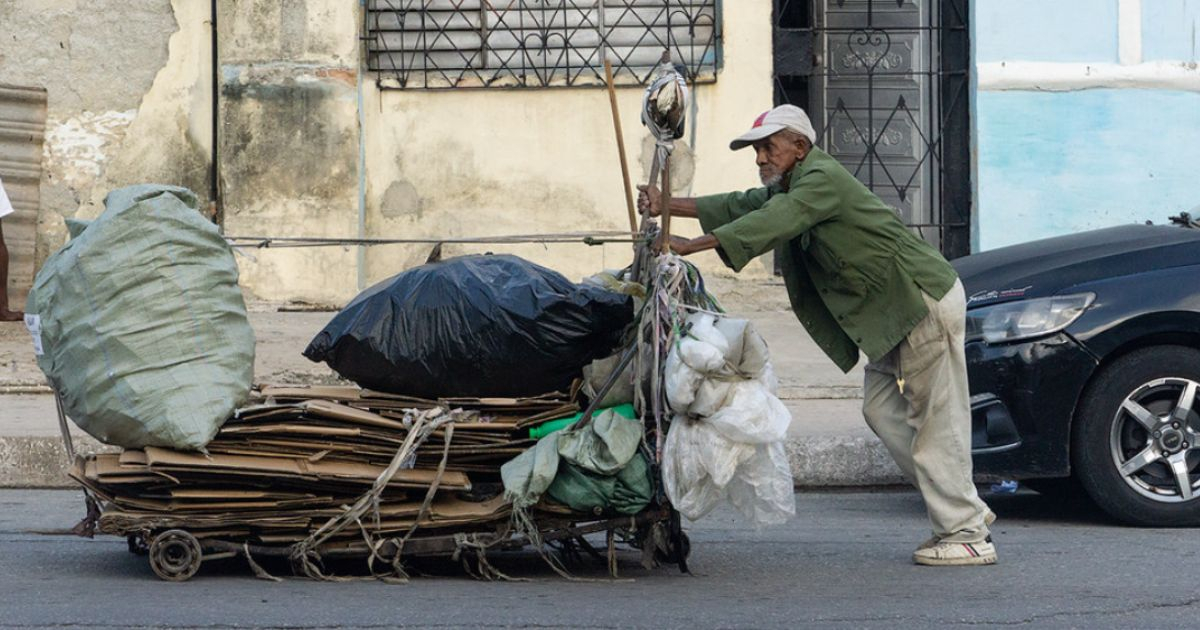
The economist Omar Everleny Pérez, former professor at the University of Havana, certified this Tuesday in IPS Cuba that 2026 will be "one of the worst years for the Cuban economy, for society, and especially for families," with a GDP contraction of 10.2% in constant prices, the second steepest decline since 2008.
Only the 11% drop in 2020, during the height of the pandemic, exceeds that setback.
ECLAC projects a similar figure of 10.3%, which would position Cuba as the worst-performing economy in all of Latin America and the Caribbean this year. Everleny himself warns that the actual decline could exceed 15% if the loss of industrial capacity and the collapse of tourism are taken into account.
To understand what that number means in the pocket of a Cuban family, a comparison suffices: the average state salary was around 7,354 pesos in August, equivalent to about eight dollars at the informal exchange rate. A carton of 30 eggs costs between 3,000 and 3,600 pesos at sales points in the country, almost half of that monthly salary.
The year-on-year inflation rate at the end of September reached 28.44%, with food prices skyrocketing by 42.66% compared to the previous year. The dollar in the informal market, which hovered around 40 pesos in January 2021, climbed to 935 pesos by mid-November, with forecasts predicting it could exceed 1,000 pesos before the end of the year.
The supply booklet, which for decades ensured a subsidized basic basket, has practically ceased to exist. "One could say it has become extinct," stated Everleny, who notes that the 176 measures approved by the regime in June contemplate concentrating it in the future only on vulnerable sectors.
The failure of that package is precisely one of the key points of the assessment. The decrees did not start to be published in the Official Gazette until September, and the results are almost imperceptible.
As of the end of October, only one private exchange house was operating in the entire country, despite the fact that the private sector had submitted more than 30 proposals. Over 3,500 new SMEs have been approved, but "very few have been established, reflecting the bureaucracy that hinders these reforms," wrote the economist.
The energy crisis acts as the factor that paralyzes everything else. Generation deficits fluctuated throughout the year between 900 MW and peaks above 3,000 MW, well above the 1,000 MW threshold that was previously sufficient to declare a critical situation.
In Villa Clara, families have gone more than 72 hours without electricity or drinking water following an outage that began on November 11, affecting 2.68 million Cubans with water cuts attributed more than 60% to power outages.
Tourism, the sector to which the regime allocated more than 29% of its total investment between 2011 and 2025, plummeted to 0.6 million visitors in 2026, down from 2.4 million in 2023. The sugar harvest came to a standstill due to a lack of fuel; the latest crops do not exceed 100,000 tons in a country that used to produce between seven and eight million in the 1980s.
"Under any circumstances, this decline is devastating amidst a systematic downturn over the past few years," concluded Everleny, who warns that the energy crisis, the demographic collapse, macroeconomic imbalances, and a model that has yet to fully reform make the current situation "very concerning and bleak." The accumulated drop in GDP since 2019 has already surpassed 23%, a contraction that is beginning to approach the magnitude of the Special Period, but based on an already much weaker economy.
Related videos:
Filed under: