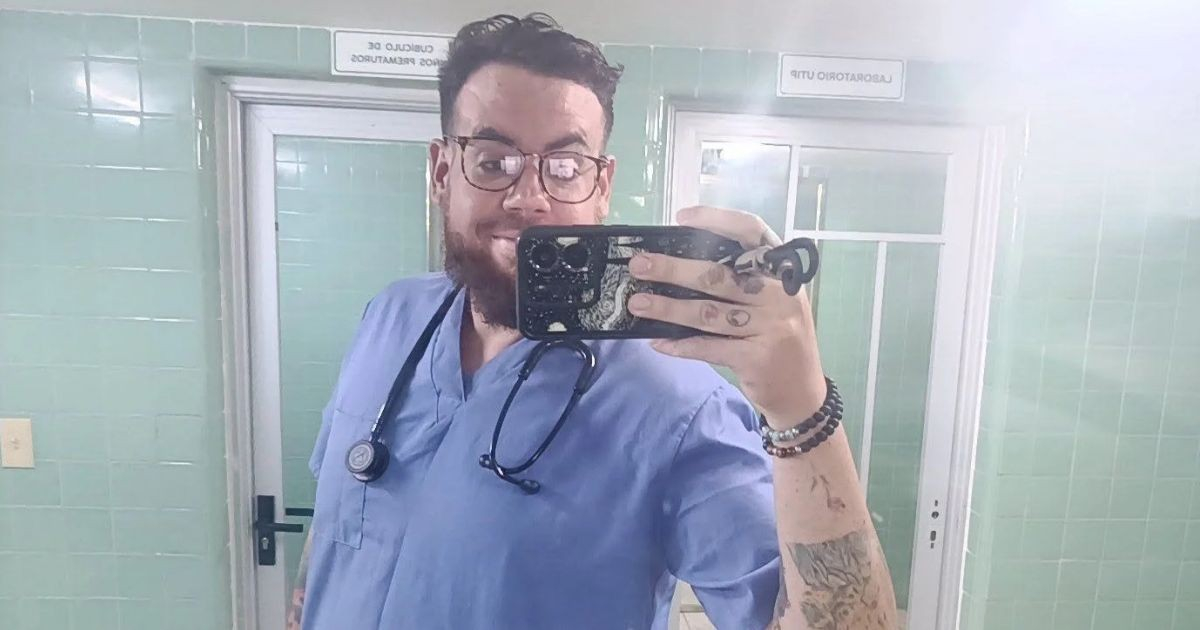
The Cuban doctor Daniel del Toro González, a specialist at the Pediatric Hospital of Las Tunas, responded to those who criticize him for selling food combos while continuing to practice medicine.
The professional explained that he has been in this business for three years because his salary as a doctor does not allow him to support his family adequately, although he insists that he remains deeply committed to his vocation.
In a post made this Tuesday on Facebook, Del Toro González responded to the negative comments he received after promoting his food offers, a business activity he undertakes to supplement his income.
Some users questioned his involvement in that business, while others pointed out that he also depended on "those from over there," as the doctor himself expressed.
The doctor responded with a reflection on the challenges faced by Cuban professionals in surviving on state salaries.
"Yes, they are right. I am also trying to live. But perhaps what some do not realize is that this was never my initial idea," she wrote.
The pediatrician recalled that he studied medicine because he wanted to dedicate himself to that profession, and that after years of preparation and work, he encountered a very different reality than he had imagined.
"I studied Medicine because I wanted to be a doctor," he said, before acknowledging that he still loves his profession.
However, he pointed out that the problem is not a lack of vocation, but rather the inability to sustain oneself financially with what one earns from their work.
“In this country, medicine is not enough to live on it with dignity,” he lamented.
To explain why he needs additional income, the doctor spoke about his family situation and used his mother as an example, who has dedicated approximately four decades of her life to state work.
"I have a mother who has dedicated around 40 years of her life to state work, 40 years of effort so that, in the end, the reward for so many years can be summed up in seeing her salary turned into a packet of chicken," she wrote.
She also mentioned her sister, who is still studying, and the responsibility she feels to contribute to the family's support.
The specialist assured that his experience is not exceptional. As he explained, thousands of doctors, teachers, engineers, and workers from other sectors have had to seek alternative sources of income because their professional earnings are insufficient to meet their household needs.
While some have chosen to emigrate, others remain in Cuba and have had to learn new trades or start businesses to survive.
Del Toro González clarified that his business activity does not mean he has abandoned medicine. He continues to take shifts and attend to his patients while managing his food sales.
"And while I do this, I continue working on what I truly love," he said, explaining that he still hasn't been able to turn his back on his calling.
The post ended on a humorous note: after addressing his critics, the doctor reminded his followers that they could send him private messages to order the food combos he sells.
The pediatrician had previously highlighted the contradiction between the incomes of healthcare professionals and the cost of living in Cuba.
In August, he demonstrated through a simple comparison that his monthly salary was not enough to buy a ten-pound package of chicken, a bottle of oil, and a dozen eggs.
The doctor used a basic salary of 8,500 Cuban pesos (CUP) as a reference for a first-level specialist. According to the prices he mentioned at the time, chicken cost 6,500 CUP and oil another 4,000, making the total for both products 10,500 CUP, an amount exceeding his entire salary.
On that occasion, he summarized his frustration with another phrase: "Utopia has always been thinking that we would be able to live on our salaries."
A month later, he used the price of a corn fritter to explain how inflation had reduced the purchasing power of his work.
He recalled that before the Tarea Ordenamiento, a fried snack could cost one peso, and that later its price had risen to 30, while his salary had barely increased sixfold.
In October, he responded to those who criticized him for denouncing the conditions of the Cuban healthcare system and explained why many colleagues had left hospitals to work in small and medium-sized enterprises, businesses, and other higher-paying activities.
He then stated that practicing medicine in Cuba has almost become a luxury, due to the scarcity of resources, low salaries, and the overwhelming workload faced by those who continue to work in healthcare facilities.
Their case, far from being unique, reflects the reality of many professionals.
At the beginning of November, a report by the American network CBS revealed that Dr. Alejandro Chong, head of an Intensive Care Unit at the William Soler Pediatric Hospital in Havana, was earning more income selling food than by running that hospital service.
The situation described by both professionals reflects how the pursuit of additional income has become a necessity even for doctors with significant responsibilities in patient care.
Related videos:
Filed under: