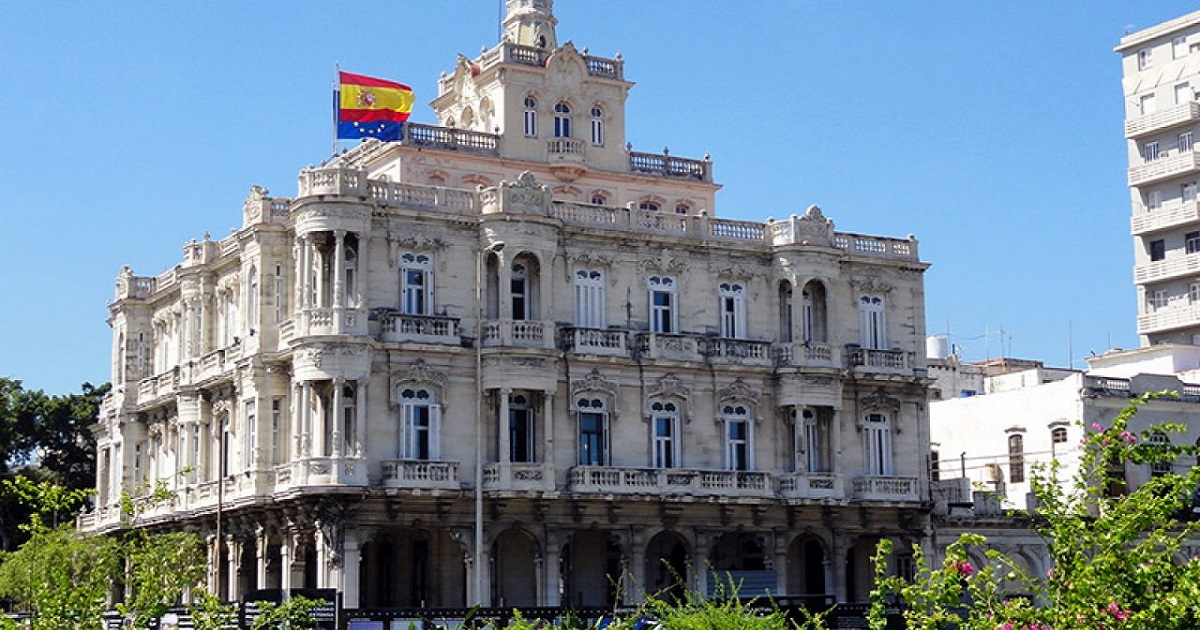
Spanish citizens residing in Cuba who are registered in the Electoral Census of Absent Residents (CERA) will have six days to cast their vote for the general elections on November 29: from this Saturday the 21st until Thursday the 26th, the Consulate General of Spain in Havana will be open for in-person voting, reported the specialized portal Herqles.
The polling place is the Palacio de Velasco, located at Zulueta 2, corner of Cárcel, in Old Havana, which houses the consulate. The hours of operation are from 9:00 a.m. to 5:00 p.m. on all designated days.
Those who prefer voting by mail must ensure that their envelope arrives at the consulate office by Tuesday the 24th at the latest.
Cuba ranks fifth in the world in the number of CERA voters for this election, with 169,290 registered according to the National Institute of Statistics of Spain, only behind Argentina, France, the United States, and Mexico. Approximately 99% of those registered are Cuban-Spanish, mostly descendants of Spaniards who obtained nationality in recent years.
One important point to remember: since the electoral reform of 2022, the requested vote has been abolished. This means that voters no longer need to request a ballot for each election; the necessary documentation—envelopes, certificates, and ballots—will be automatically sent to the address registered with the consulate. Ballots can also be downloaded from the INE website.
To vote in person, it is sufficient to show up at the Palacio de Velasco with a valid passport or ID card.
For absentee voting, you must place the ballot in the corresponding envelope along with one of the registration certificates and a photocopy of your identification document, and send it by certified mail before the deadline on Tuesday, the 24th.
The complaint about transportation: a real odyssey
In this context, a Spaniard residing in Havana reported on Monday in La Gaceta that, for the first time, no Spanish organization has contacted him to offer free transportation to the polling place, something that, according to his testimony, had happened in previous elections.
The citizen, who requested anonymity, explained that in the past various Spanish "societies" organized trips and encouraged voting for the PSOE, and that he and his circle took advantage of those transfers to freely vote for other parties. "We always pretend to play along and say yes, we are thrilled to vote for the PSOE," he admitted.
The complaint about transportation reflects an objective reality: getting around in Havana is a daily struggle. "You have no idea how difficult transportation is in Havana," emphasized the complainant.
That logistical barrier is one of the factors that explains the historically low participation from Cuba: in the general elections of July 2023, only 1,184 people, out of a registered census of 152,192, voted in person; less than 0.8%.
The complainant also made more serious accusations, claiming that "they are going to directly falsify the voting" and that "if you see more than 5,000 votes in Cuba, that is fraud."
La Gaceta did not provide evidence to support those accusations, and the Consulate did not respond to them. The Central Electoral Board does have control mechanisms in place: parties can appoint representatives to witness consular operations and inspect the custody of the ballot boxes, and the final count is the responsibility of the Provincial Electoral Boards in Spain, not the consulate.
The Hispanic-Cuban vote also comes marked by the judicial controversy surrounding the so-called "grandchildren's law."
The Supreme Court has suspended the overseas voting for approximately 162,454 individuals who were naturalized directly under that regulation, although on Wednesday it definitively rejected Vox's appeal to extend the suspension to the children of those naturalized, around 189,678 voters who will be able to vote on Sunday the 29th.
Related videos:
Filed under: