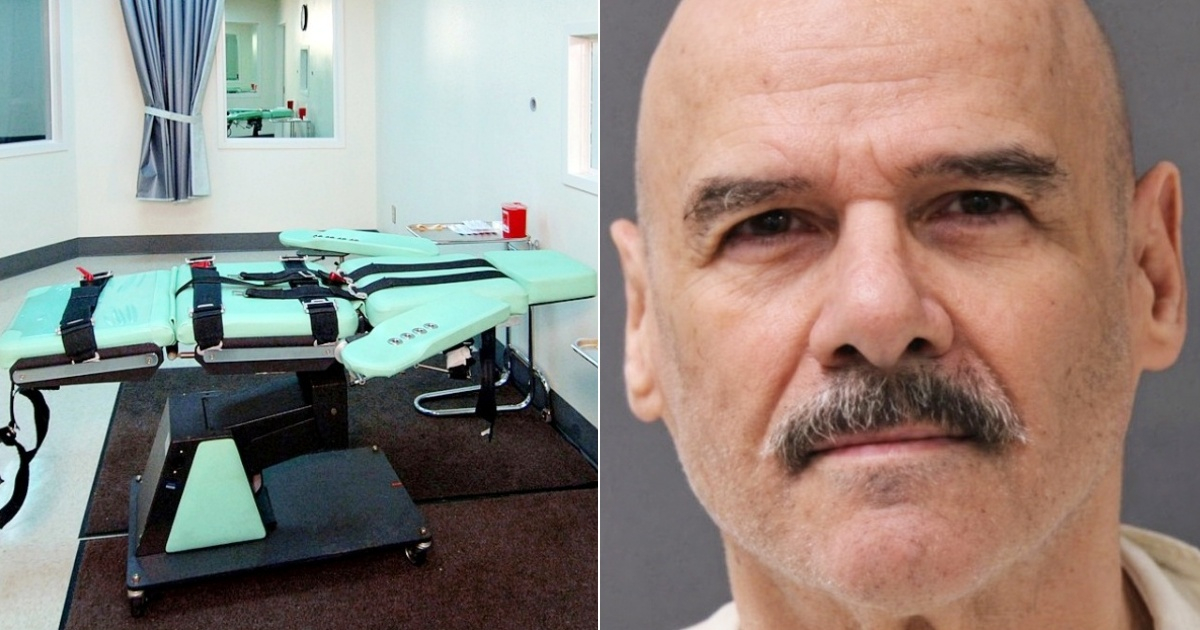
The Cuban Reinaldo Dennes, 70 years old, cried out in pain, twisted against the straps that held him to a gurney, and pleaded for an end to his suffering during his execution by lethal injection on Thursday, November 19, in Huntsville, Texas.
His spiritual advisor, Reverend Jeff Hood, reported that the procedure had failed and described it as "torture," while prison authorities claimed that all protocols were followed.
Hood, who stayed by the condemned man's side during his final minutes of life, told Newsweek that Dennes continued to speak and complained of intense pain for several minutes after the administration of the lethal drug began.
According to his testimony, the Cuban begged: “Please, kill me, kill me.”
More than an hour in the execution chamber
The execution was delayed due to the difficulties that the prison staff encountered in placing the two intravenous lines necessary to administer the pentobarbital, the sedative used by Texas to carry out the death penalty.
According to the timeline provided by the Texas Department of Criminal Justice (TDCJ) to Associated Press, Dennes was secured to the gurney at 6:04 PM local time.
The first attempts to cannulate veins in the hands and arms were unsuccessful. Finally, the officials managed to place an intravenous line on the left side of the neck at 6:20 PM and another in the left foot at 6:38 PM.
The witnesses entered the chamber before Dennes spoke his final words, around 6:52 PM.
In his final statement, recorded by the prison authorities, he expressed gratitude to his family and loved ones for the years he had spent with them and spoke of his faith in God.
The administration of the medication began shortly thereafter.
The procedure concluded at 19:07, and a doctor certified his death at 19:08. In total, 63 minutes passed from when he was strapped to the gurney until the end of the procedure, and 64 minutes until the official declaration of his death.
The journalist Michael Graczyk from Associated Press also witnessed Dennes's cries, who specifically complained of intense pain in his right leg, describing it as a cramp and expressing that he did not believe it was normal.
Approximately 16 minutes passed between the start of the injection and her death.
"My leg is on fire": the Reverend's account
Hood explained to Newsweek that he began to suspect something was wrong when he was not allowed to enter the execution chamber at the scheduled time.
Upon entering, he noticed signs of multiple attempts to place catheters in the condemned man's arms, in addition to the lines installed in his neck and foot.
The reverend approached Dennes's head and placed his left hand on the Cuban's shoulder. When he asked if he was Jeff, he assured him that he would stay by his side throughout the entire procedure.
According to Hood, almost immediately after the administration of the drugs began, Dennes started to shake his legs, lift his chest, and struggle against the straps that held his arms.
The condemned man repeatedly shouted that his leg was burning and warned that something was not working properly.
The reverend assured that the Cuban also asked God to put an end to his suffering.
Hood, who has accompanied numerous death row inmates, stated that people typically lose consciousness within about 30 seconds after receiving the medication.
In this case, he assured that Dennes continued speaking for more than four minutes.
The pastor described the experience as the worst execution he had ever witnessed.
He stated that the movements of the body were so violent that, by keeping a hand on the shoulder of the condemned, he felt as if he were holding onto a wild horse.
Texas denies irregularities and rules out investigating
The spokesperson for the TDCJ, Amanda Hernández, rejected allegations that the execution had been unsuccessful.
He assured that the staff followed the established procedures and that the intravenous lines were placed in the most viable veins available.
According to the official version, Dennes expressed pain before the administration of pentobarbital began and complained about areas of his body where the needles had not been inserted.
Hernández suggested that the convicted individual may have exaggerated or feigned his suffering.
He also told AP that the authorities did not plan to conduct any further investigation into what had happened.
The spokesperson stated that the pentobarbital used was not expired, although they did not specify its expiration date.
The doctor Paul Wax, executive director of the American College of Medical Toxicology, stated to AP that he could not find an explanation for how an injection administered in the left foot or the left side of the neck could cause pain in the right leg.
The lawyer Dale Baich, who has represented death row inmates and witnessed 17 executions, questioned the authorities' attribution of the screams to a medical episode, stating that they did not provide medical evidence to support that interpretation.
Graczyk pointed out that the witnesses could not directly observe the intravenous lines or visually determine the exact moment when the medication began to flow.
It has not been independently determined what caused the expressions of pain from the condemned.
The reverend calls for dismissals and a moratorium
After the execution, Hood held the Texas prison system officials accountable. In statements reported by Newsweek, he called for the dismissal of Bobby Lumpkin, the executive director of the TDCJ, for what occurred in the execution chamber.
The pastor also called on the elected governor of Texas, Gina Hinojosa, to promote the suspension of executions when she takes office in January.
The Democrat defeated the Republican Greg Abbott in the elections on November 3.
The organization Reprieve US joined the calls for a moratorium. Its executive director, Maya Foa, stated that what happened with Dennes should intensify scrutiny of the methods used to administer the death penalty in the United States.
The controversy over pentobarbital
The proceedings against Dennes took place amid a renewed debate over the use of pentobarbital in U.S. executions, especially after another death row inmate survived the administration of the same drug.
On September 30, Christa Pike survived an attempted execution by lethal injection in Tennessee after receiving two doses of pentobarbital. Her lawyers reported that the drug may not have properly entered her bloodstream.
Pike was transferred to a hospital in critical condition. On October 10, she was discharged and returned to prison, where she continued to receive medical care, according to her legal representatives.
The crime for which he was convicted
Reinaldo Dennes had been sentenced to death for the murder of the wholesale diamond dealer Janos Szucs, which occurred in Houston on January 24, 1996, during a robbery in which a security guard was also injured.
The judicial investigation established that Dennes was involved in the planning and execution of the robbery, during which diamonds valued at approximately 3.6 million dollars and a significant amount of cash went missing.
The Cuban spent almost three decades on death row before his sentence was carried out.
According to the official record of the Texas Department of Criminal Justice, Dennes was the ninth person executed in that state during 2026 and the 605th since Texas resumed executions in 1982.
Related videos:
Filed under: