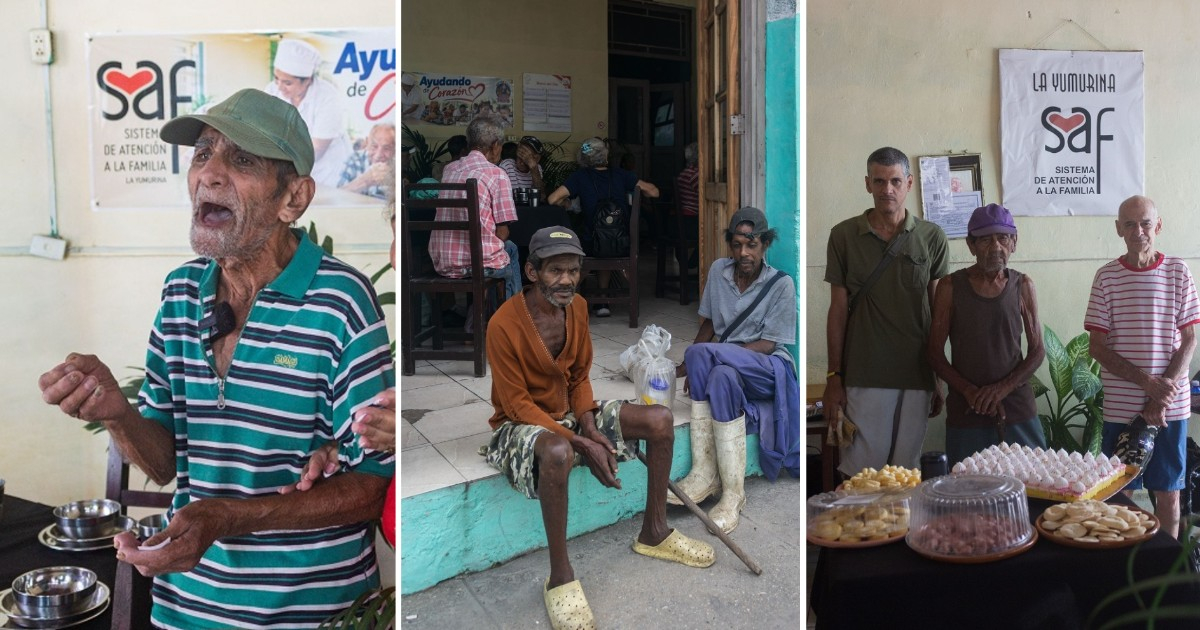
The official newspaper Girón, from Matanzas, highlighted this Friday the involvement of a small and medium-sized enterprise (mipyme) in the management of the La Yumurina cafeteria, part of the Family Care System (SAF), an experience that reflects the challenges faced by the Cuban state to sustain the subsidized feeding of vulnerable individuals with its own resources.
The establishment, located in the city of Matanzas, serves 50 elderly individuals and receives support from the mipyme Supertodo, which is responsible for managing the cafeteria, acquiring complementary food, and helping to cover the service costs. According to the report, the involvement of the private business has allowed for the inclusion of products that were previously unavailable in the dining hall.
One of its beneficiaries is Diosdado Pared, 83 years old, a former worker in the gastronomy sector and an internationalist veteran. His wife is ill, and both face economic difficulties, exacerbated by the high cost of medication. A single blister pack of pain relief tablets for his partner costs him 1,200 Cuban pesos. Pared had to wait several months to complete the procedures for access to the SAF, although he received food before his application was finally approved.
Beneficiaries pay 26 pesos daily for lunch and dinner, at a rate of 13 pesos for each service. The state budget contributes another seven pesos per portion, but the actual production cost is higher. As explained by Girón, that difference must be covered by the mipyme responsible for the management or, when such a contract does not exist, by the Gastronomy Company.
The manager of Supertodo, Mildrey Aguilera Villalobos, explained that the business supplies daily the main dish, side dishes, salads, dessert, and bread that complement the nutrition of the elderly. The company also aims to expand the operation of the cafeteria to generate income to offset the losses from the subsidized service.
The case of La Yumurina is part of the opening of the SAF dining facilities to private businesses, authorized by the Cuban government in August 2026 through and Resolution 14/2026 of the Ministry of Domestic Trade (MINCIN).
However, in the municipality of Matanzas, only La Yumurina has finalized a management contract with a small and medium-sized enterprise. The other 13 establishments remain open for bidding, as reported by the director of the municipal Gastronomy Company, Osmaury Perera Suárez.
In total, the 14 dining facilities of the SAF in the municipality serve 396 beneficiaries, while 38 non-state management entities collaborate in the supply of products such as charcoal, root vegetables, and salads.
Private participation does not eliminate state subsidies, but it highlights the importance of the resources provided by independent businesses to maintain these services.
The difficulties are not exclusive to Matanzas. In Havana, the small business Mi Reina Café, responsible for the SAF Loipa, reported that the state food quota covers just 10% of the needs of its 12 beneficiaries.
Another dining hall of the SAF, located in Boyeros, had been cooking with firewood for five months due to a lack of fuel, while a state-run establishment in the capital had only served chicken once since its opening.
The official medium itself acknowledges that the coverage is insufficient
Beyond highlighting the results of La Yumurina, Girón's report exposes the limited coverage of the program in the face of an aging population.
According to the published figures, the municipality of Matanzas has 17,454 inhabitants aged 70 or older, while the SAF serves 396 people. Although not all seniors meet the criteria for assistance, the newspaper itself questions whether this coverage is sufficient.
The municipal mayor, Michel León Rodríguez, acknowledged that there are ongoing issues with the operation of the cafeterias, difficulties in expanding management experiences, and material limitations.
“We are not at the desired point,” admitted the official.
The official report also acknowledges that there are seniors who do not qualify for assistance because they have family members legally responsible for their care, even though the salaries and pensions of these relatives do not always suffice to ensure they have adequate food.
The SAF was established in 1998 to provide subsidized food to elderly individuals without family support, people with disabilities, and vulnerable families. By 2026, it had over 76,000 beneficiaries nationwide. Cuba has one of the oldest populations in Latin America, and Matanzas is one of the provinces with the highest proportion of elderly residents.
Related videos:
Filed under: