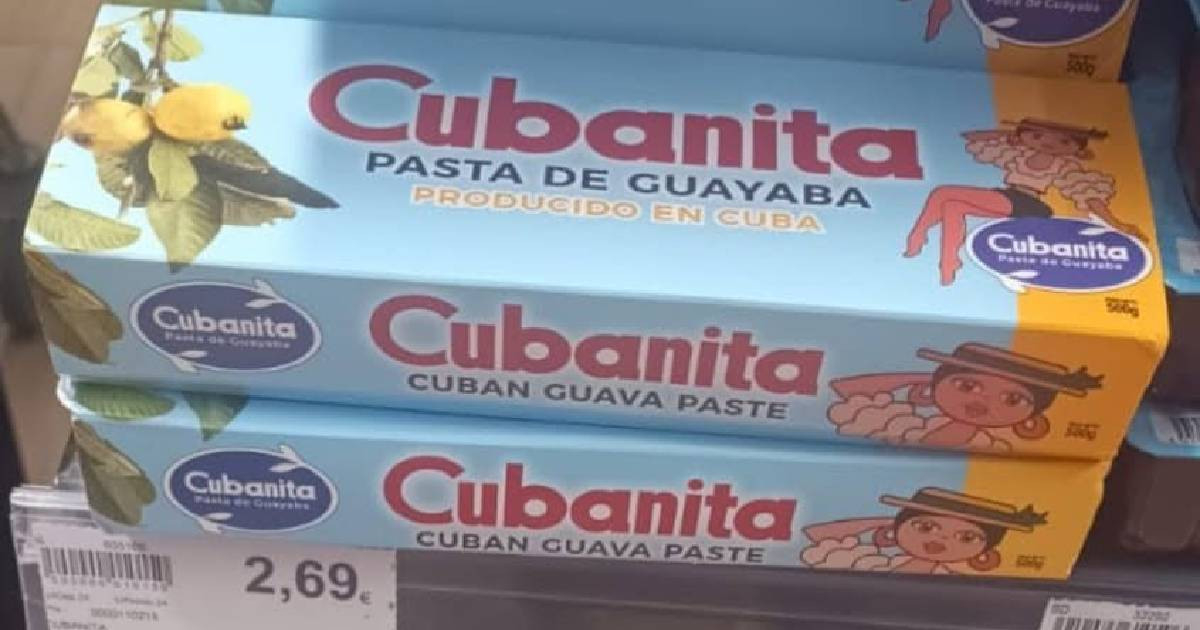
A bar of Cuban guava paste, produced in Cuba and sold at a SPAR supermarket in Spain for 2.69 euros, sparked outrage among Cubans when it became known that its equivalent in pesos represents almost 84% of the monthly minimum wage on the island.
The product photograph, weighing 500 grams and labeled Produced in Cuba, was shared on Friday on Facebook. Its creator, identified as Héctor Luis, raised concerns about the availability of resources to manufacture and export the candy to European markets while Cuban consumers face shortages and prohibitive prices.
At the informal exchange rate of approximately 1,000 pesos per euro, the selling price in Spain is equivalent to about 2,700 CUP, compared to a monthly minimum wage of 3,210 pesos.
The brand Cubanita is associated with the Agroindustrial Company Victoria de Girón, located in Jagüey Grande, Matanzas, which exports processed fruit products to Europe, the Middle East, and the Caribbean.
In Cuba, however, buying a guava bar represents a significant expense. In August, the same product, although of artisanal quality and aimed at the national market, was sold for 600 pesos in Matanzas, almost 20% of the monthly minimum wage. Since then, consumer reports indicate even higher prices in different provinces.
The comments on the publication reflected this disparity. In the Alcides Pino neighborhood of Holguín, a smaller bar costs around 800 pesos; in Old Havana, it hovers around 1,000, while the informal market reports prices of 950 pesos, and in Camagüey, a user claimed to have seen it for 1,600.
"They are already selling them for 900 and a thousand pesos in Cuba. How long will this go on??? I’ve even forgotten the taste," wrote one of the participants in the debate.
Another user summarized the difficulties families face in accessing a product that has traditionally been part of children's diets. "It's a luxury to give a child a homemade guava paste sandwich for a snack. Foreigners are luckier than Cubans," he commented.
The controversy also extended to the marketing of Cuban products at airport facilities. Several users questioned how certain items, which are supposedly nonexistent or difficult to find within the Island, can be found in the commercial areas after customs, where they are sold at high prices.
"Let nothing surprise you, everything produced here is in those markets," wrote a participant.
"Our goods are exported while we are left in misery!" Hector Luis concluded in his post, a phrase that encapsulates the discontent expressed by numerous users regarding the gap between the products Cuba sells abroad and what its own citizens can afford.
The difficulty in purchasing sweets has even led some Cuban women to craft their own guava bars, a viable alternative given the prices the product reaches in national markets.
The rising cost of food occurs in a context of significant deterioration in purchasing power. The official year-on-year inflation reached 32.70% in October, while food and non-alcoholic beverages saw an increase of 50.72% during the same period.
Economists estimate that a person needs around 96,000 pesos per month to cover their basic needs, which is about 30 times the current minimum wage. Additionally, a survey conducted in May revealed that 33.9% of Cuban households had at least one member who went to bed hungry.
Related videos:
Filed under: