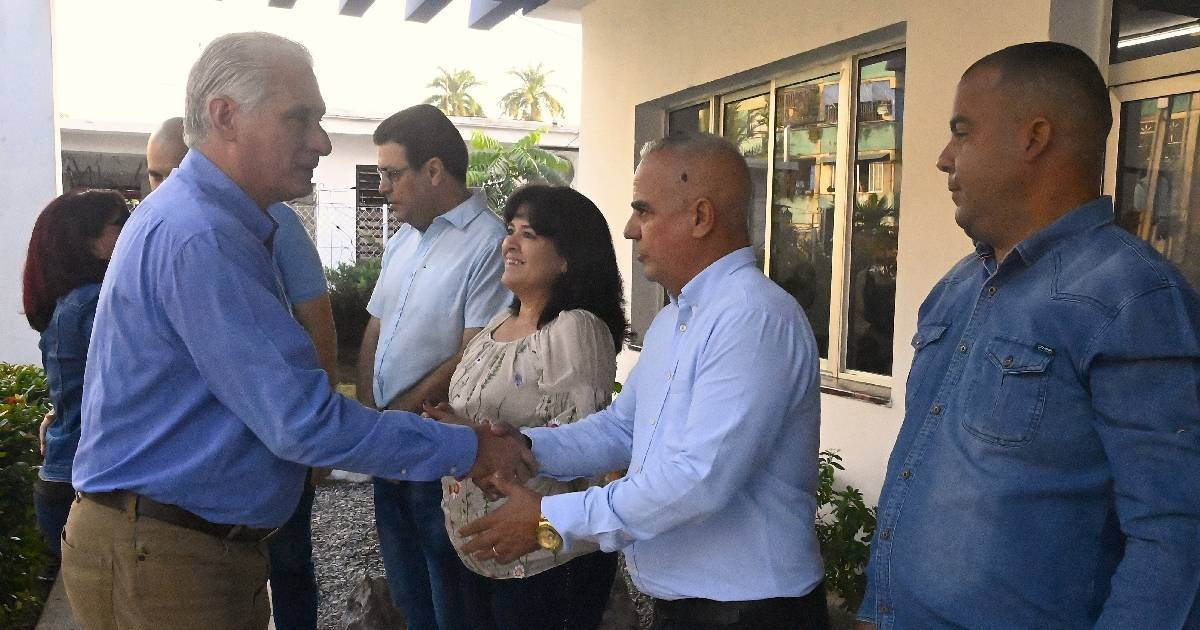
Miguel Díaz-Canel acknowledged this Tuesday, during a visit to Pinar del Río, that the 176 Economic and Social Transformations promoted by the Cuban regime have not yet produced the results that the population expects, and he called on Cubans to "come out to fight for and defend them."
The leader met with authorities and activists from the Communist Party in the province to assess the progress of the economic reforms, approved by the National Assembly in an extraordinary session on June 18 and 19, 2026, and presented as the largest package of structural changes since the Special Period.
"We are already implementing the transformations; and this process, of course, needs to move faster, be more coherent, and above all, start providing us with a group of results, which is what the population expects," stated Díaz-Canel to those present.
Far from announcing concrete advancements, the leader acknowledged that there are still sectors with doubts and uncertainty, and instructed the Party officials to return to those areas: "Now we need to go to the places where there is more doubt, where there is more uncertainty," to the sectors with less understanding, "and explain again, and re-invite."
The most striking call was the one directed directly to the citizens: "We need the population, for the most part, to understand the Transformations, be willing to participate as part of those Transformations, and go out to combat and defend them."
Díaz-Canel identified that the main concerns of Cubans revolve around whether the process will preserve the social services of the system, and he responded with a slogan: "The transformation aims to achieve socialist construction amid the situation we are facing."
The leader also emphasized that changes will not come on their own: "Transformations are not achieved through inertia, bureaucracy, or decree; they are achieved through work; they are achieved through innovation; and they are achieved through popular participation and control."
The visit to Pinar del Río occurs in a context of acute crisis. The Prime Minister Manuel Marrero Cruz acknowledged in October that the reforms had not improved the quality of life of the population and projected that the noticeable effects would not be felt until 2027.
The visited province contains over 36,000 idle agricultural hectares and an additional 17,000 poorly utilized out of a total of 416,000 hectares, according to data from mid-November.
At the national level, the situation is equally serious: a study by Food Monitor Program based on surveys conducted in 2024 revealed that 96.91% of participants had lost access to food. In its 2025 National Food Security Survey, the organization found that 33.9% of respondents reported that a member of their household had gone to bed hungry at least once in the 30 days prior to the survey. The official year-on-year inflation rate reached 32.70% in October 2026.
Díaz-Canel himself acknowledged a few days ago on a radio program that Cubans are expecting "fewer blackouts and more food," and admitted that only nine out of the 23 complaints received in the previous broadcast had been addressed.
In the meeting this Tuesday, Roberto Morales Ojeda, a member of the Political Bureau and Secretary of Organization of the Central Committee of the PCC, also participated, emphasizing the unity around the Party as an essential condition for progress. Meanwhile, the provincial first secretary, Yamilé Ramos Cordero, presented a detailed assessment of the advancements and shortcomings of Pinar del Río in implementing the measures.
Of the 176 approved transformations, 172 already had approved policies and procedures, with 231 legal norms produced, although the gap between the legal framework and tangible results remains the main political vulnerability of the regime.
Related videos:
Filed under: