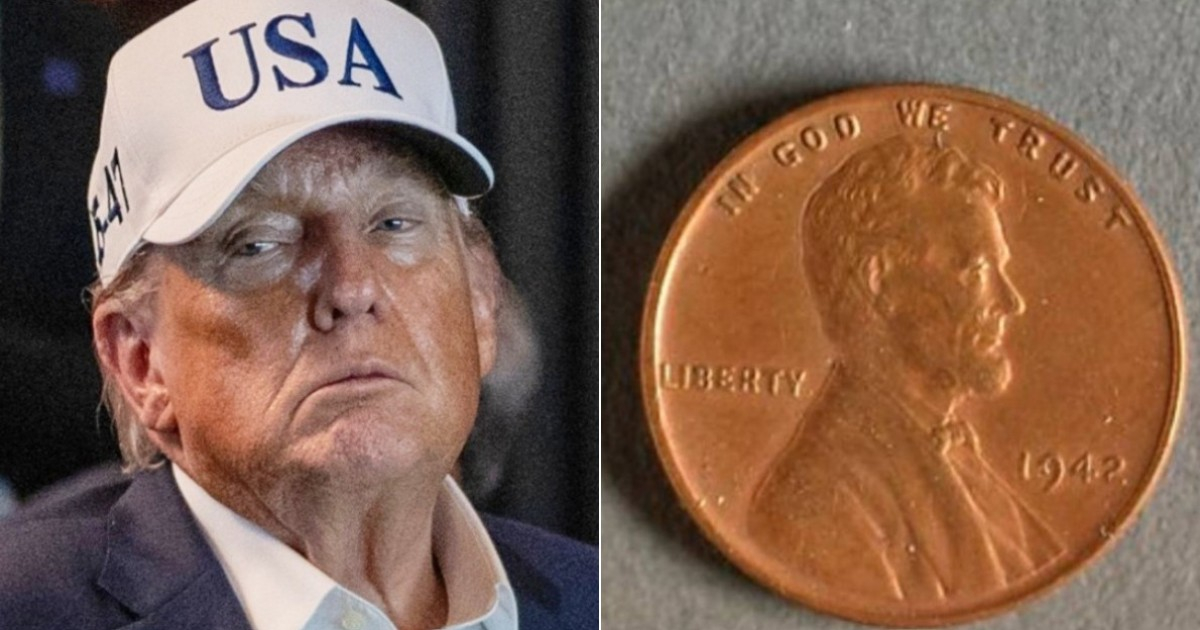
President Donald Trump signed the law known as Common Cents Act (H.R. 10167) on Friday, formally and permanently ending the production of the penny in the United States, after nearly 250 years of continuous minting since 1793.
The measure was approved by both chambers of Congress with no recorded opposition: both the House of Representatives and the Senate supported it through a voice vote, reflecting the broad bipartisan consensus surrounding the initiative.
The central argument of the law is economic: producing every cent cost nearly four cents, which resulted in millions in losses for the public treasury.
In 2024, the minting of approximately 3.2 billion cents resulted in losses exceeding 85 million dollars.
The author of the project in the House, Republican representative Lisa McClain (Michigan), was straightforward in celebrating the approval: "This legislation will save 85 million dollars a year by permanently ending the production of pennies; it's common sense!"
The White House estimated that the immediate annual savings from halting production amounts to 56 million dollars, according to data from the Department of the Treasury.
The law legally formalizes an interruption that had already become a reality in practice: the government had stopped minting cents for general circulation in November 2025, nine months after Trump ordered Treasury Secretary Scott Bessent to halt production.
On that occasion, Trump was emphatic on his social media: "For too long, the United States has minted one-cent coins that literally cost us more than two cents. This is a waste!"
That Trump order to eliminate the penny required legislative support, as the constitutional authority to mint or withdraw coins belongs to Congress, not the Executive.
Despite the end of its production, the approximately 114 billion cents that are currently in circulation remain legal tender "for all debts, public charges, taxes, and fees," according to the text of the law.
The Federal Reserve will continue to recirculate those coins as long as possible, and the Mint may continue producing pennies in limited quantities intended for collectors.
For cash transactions where there is no exact change, the law establishes a rounding system to the nearest multiple of five cents; payments made by card or electronic means will continue to be settled to the exact cent.
The regulation also paves the way for a reform in the composition of the five-cent nickel —which is set to become the lowest denomination coin in circulation— authorizing the Treasury to explore the use of zinc instead of the current copper-nickel alloy, with the goal of reducing its manufacturing cost, which exceeded 13 cents per unit in fiscal year 2025.
The penny has a history of nearly 250 years: Congress passed the Coinage Act in 1792, and the Mint began producing pennies the following year.
The first known design was created by Benjamin Franklin in 1787 and included a sundial. Throughout the centuries, the coin adopted multiple faces, until in 1909 the image of Abraham Lincoln was incorporated to commemorate the centenary of his birth. The most recent design, the Union Shield, was issued in 2010.
The United States is not the first country to take this step: Canada eliminated its penny in 2013, Australia did so in 1992, and New Zealand in 1989, all without significant adverse effects on their economies.
Related videos:
Filed under: