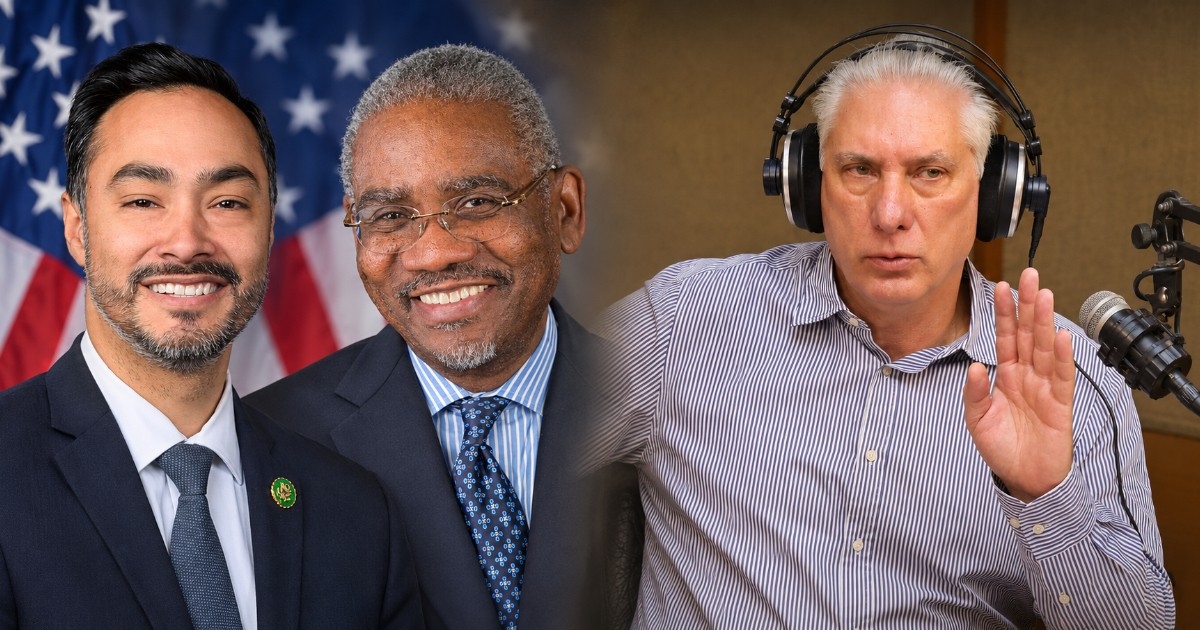
U.S. Democratic congress members Gregory Meeks and Joaquin Castro sent a letter to Miguel Díaz-Canel demanding the release of more than 200 political prisoners, questioning the sanctions imposed by the Trump Administration, and advocating for diplomatic engagement with the Cuban Government.
Lawmakers explicitly recognize that the releases would strengthen the political position of those in the U.S. Congress who advocate for rapprochement with Havana and the expansion of economic opportunities between the two countries.
The letter, dated November 18 and to which CiberCuba has obtained access, refers to political prisoners whose cases have been addressed in the recent exchanges between Washington and Havana.
Meeks is the highest-ranking Democrat on the House Foreign Affairs Committee, while Castro holds the same position on the Western Hemisphere Subcommittee.
After the Democratic victory in the legislative elections on November 3, both could attain the presidencies currently held by Republicans Brian Mast and María Elvira Salazar, respectively, when the next Congress convenes in January 2027.
The letter outlines the priorities of both lawmakers regarding Cuba: negotiations with Havana, opposition to the tightening of sanctions, and support for the economic opening announced by Cuban authorities.
A request without specific deadlines or consequences for a refusal
Meeks and Castro believe that the release of over 200 political prisoners would represent a significant humanitarian act and an important step toward a more constructive relationship between the two countries.
“We have always believed that human rights are central to our policy towards Cuba,” they state in the letter.
Congress members denounce arbitrary detentions, restrictions on freedom of expression and peaceful assembly, and the lack of adequate guarantees for due process on the island.
However, in the letter, they do not use the term dictatorship, do not mention the protests of July 11, 2021, nor do they identify any political prisoners by name.
“We urge you to authorize their swift release under conditions that allow them to reunite with their families and rebuild their lives in freedom in Cuba,” they wrote.
The petition thus stipulates that those released from prison may remain in their country, but it does not set specific deadlines, monitoring mechanisms, or consequences in case Díaz-Canel disregards the request.
The more than 200 political prisoners mentioned in the letter represent only a part of those incarcerated for political reasons in Cuba, as human rights organizations have documented more than 1,300 political prisoners on the island.
Among the emblematic cases is that of the rapper Maykel "Osorbo" Castillo Pérez, co-author of the song Patria y Vida, sentenced to nine years in prison in June 2022.
Congress members question the sanctions imposed by the United States
Meeks and Castro reaffirm their historical support for diplomatic engagement with Havana and argue that U.S. sanctions have hindered progress on human rights issues.
“We believe that decades of sanctions have not achieved these goals and that only diplomacy can help address these concerns while promoting the interests and well-being of both peoples,” they assure.
Lawmakers also recall their opposition in Congress to the tightening of sanctions advocated by the Trump Administration, measures that, in their view, have made life more difficult for Cubans.
Although they advocate for diplomacy as an alternative to economic pressure, the signatories do not specify what measures they would promote in Congress if the Cuban authorities keep political prisoners incarcerated or continue to restrict the fundamental freedoms that they themselves claim.
A favorable assessment of the economic reforms in Havana
The letter dedicates several paragraphs to positively assess the economic reforms announced by the Cuban government in recent months.
"We recognize the significant economic reforms that your Government has announced in recent months, which come amid significant external pressure," they note.
Congress members believe that expanding opportunities for private businesses, allowing them more direct participation in international trade, and opening avenues for new investments represent significant advances for the transformation of the Cuban economy.
"Fully implemented, these measures could expand opportunities for Cubans and strengthen national sovereignty through greater prosperity, productive capacity, and integration into international markets," they assert.
Its favorable assessment refers to the measures announced and conditions its potential benefits on their full implementation.
The letter does not examine the restrictions that the private sector still faces nor does it establish indicators to evaluate the actual impact of the reforms.
Meeks and Castro also highlight the discrepancies between Washington and Havana regarding the origin of that economic opening.
While the Trump Administration attributes part of the reforms to its pressure campaign, the Cuban Government maintains that they are responses to internal decisions and the country’s own economic needs.
“Our governments do not need to agree on what motivated these measures to recognize their potential value or seek new advances,” wrote the congressmen.
The releases would strengthen the advocates of rapprochement
In addition to humanitarian arguments, Meeks and Castro openly discuss the political implications that the release of prisoners would have for those advocating a policy of rapprochement with Havana from Washington.
Lawmakers believe that bilateral talks appear to have reached a standstill, and that the release of prisoners could help break this deadlock, while also addressing a concern shared by various political sectors in the United States.
In one of the most explicit passages of the letter, both acknowledge that a favorable decision from Díaz-Canel would politically benefit the supporters of his diplomatic strategy.
"Would demonstrate confidence in the future of Cuba and would strengthen the position of those in Congress who believe that engagement and the expansion of economic opportunities offer a better path for the Cuban and American peoples," they expressed.
The congress members describe the potential release of political prisoners as a sovereign act that corresponds to the Cuban government and would align with international law.
"Although no single measure can resolve the long-standing differences between our countries, this could greatly contribute to building trust and creating political space for significant advancements that alleviate the humanitarian crisis affecting 9 million Cubans daily," they concluded.
Related videos:
Filed under: