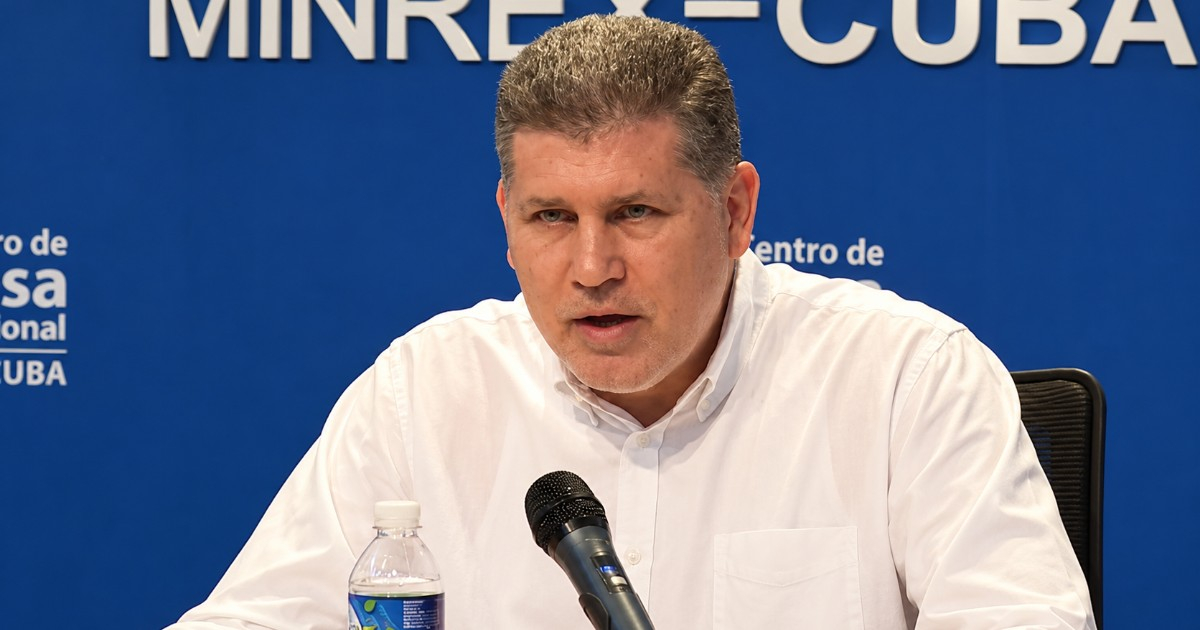
The Vice President of the Council of Ministers and head of the Ministry of Foreign Trade and Foreign Investment, Óscar Pérez-Oliva Fraga, inaugurated the 42nd edition of the International Fair of Havana (FIHAV 2026) this Tuesday with the announcement of a new foreign investment law and the promise that "Cuba's doors are open to the world."
The opening ceremony was held virtually, under the slogan "Cuba open to the world," which the official himself justified as a response to the "complex scenario" the island is experiencing due to the tightening of the U.S. embargo and the energy crisis that leaves millions of Cubans facing daily blackouts lasting over 20 hours.
Cuba Económica states that the main announcement of the day was the preparation of the new legislation to attract foreign capital, which is scheduled to be presented to the National Assembly of People's Power in December.
According to Pérez-Oliva, the initiative aims for "a more agile and transparent regulatory framework" that provides "greater guarantees and legal security to investors," in words reported by the official media outlet Juventud Rebelde.
The new law is part of the package of 176 economic and social transformations approved by the National Assembly in June 2026, which expands space for the private sector, foreign investment, and economic decentralization.
Among the reforms already initiated this year are the direct hiring of workers by mixed companies, the opening of bank accounts abroad, and the possibility of investing in the real estate sector, including heritage zones, as well as in tourism, banking, and foreign trade.
The regime also presented for this edition of FIHAV a portfolio of 426 foreign investment projects valued at over 30 billion dollars, spread across 13 sectors and all provinces of the country.
Pérez-Oliva dedicated a significant portion of his speech to blaming the U.S. embargo for the difficulties that forced the fair to be held predominantly in a virtual format, describing the executive orders signed by Donald Trump in January and May of 2026 as “an act of ruthless economic aggression” that restricts Cuban foreign trade and banking transactions.
The first of those executive orders established a mechanism for imposing additional tariffs on countries that supply oil to Cuba; the second expanded the sanctions to include the possibility of penalizing foreign companies and financial entities that operate with the island.
The official did not mention that the Cuban energy crisis has structural roots in 67 years of economic management by the regime, exacerbated by the interruption of Venezuelan crude oil supplies following the capture of Nicolás Maduro in January 2026, and that the modification of the foreign investment law approved in September has not managed to reverse the economic deterioration, something that Díaz-Canel himself acknowledged days ago.
FIHAV 2026 will run until Thursday, November 26, when the only in-person day will take place at the Palacio de Convenciones in Havana, featuring the updated presentation of the business opportunities portfolio, an investment round, and a meeting with Cuban entrepreneurs living abroad.
"Foreign investment is repositioning itself with more flexible schemes and aims to consolidate new alliances, including in the technological sphere and renewable energies," stated Pérez-Oliva, in a speech that contrasts with the reality of an economy that has not grown for years and a population facing shortages of food, medicine, and electricity.
Related videos:
Filed under: