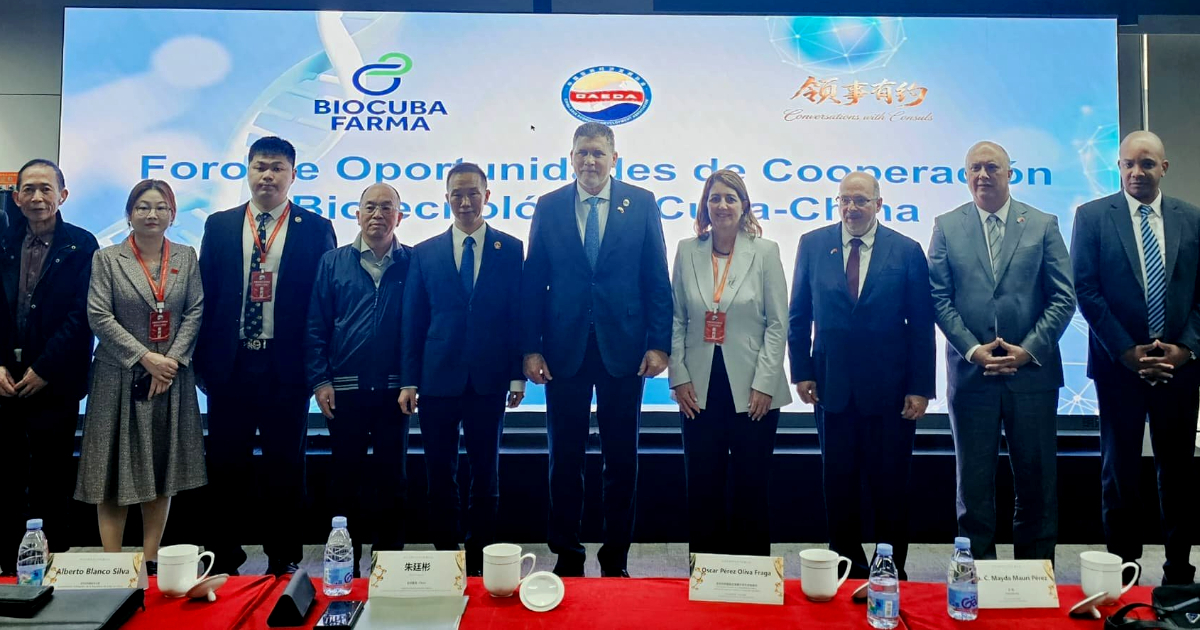
The Cuban Vice Prime Minister Óscar Pérez-Oliva Fraga presented the supposed "economic and social transformation" of the regime to Chinese businessmen during a trade and investment forum held on Thursday, November 12, in Beijing, as part of a tour that had begun days earlier in Shanghai. The meeting concluded without any announcement of new specific investment commitments or funding figures.
The event, called the China-Cuba Cooperation Forum on Trade and Investment, was organized by the China Council for the Promotion of International Trade (CCPIT) — a Chinese state agency — and the Cuban embassy in China. Representatives from over 170 companies from both countries participated, with more than 200 attendees in total, according to the official statement from CCPIT published by the Chinese financial portal 10jqka.
The Chancellor Bruno Rodríguez Parrilla, who traveled to China as a special envoy of the Communist Party and the Cuban government, was also present. Pérez-Oliva took the floor to discuss the "business opportunities" that, according to the regime, the island offers in sectors such as agriculture, logistics, tourism, new energies, and biomedicine.
The president of CCPIT, Ren Hongbin, took the opportunity of the forum to invite Cuba to participate in the 5th International Supply Chain Exhibition and the 19th China-Latin America Business Summit, both invitations made without any accompanying financial commitments.
The contrast between what the regime "sells" in Beijing and the reality of the island is hard to ignore.
Tourism —one of the sectors presented as attractive to investors— is in collapse: the Prime Minister Manuel Marrero Cruz himself acknowledged in July that 73% of Cuban hotels were closed and about 25,000 workers were in a state of "availability." By the end of October, Cuba had only fulfilled 28.8% of its annual tourism plan, with just 506,074 visitors out of a goal of 1,757,480.
Meliá, Iberostar, and Barceló ceased their management of their Cuban properties between June and July 2026. Major Canadian airlines suspended their flights to the island starting in February due to a shortage of Jet A-1 fuel, resulting in a 75.6% decline in Canadian tourism between January and August.
In the energy sector—another area discussed at the forum—the situation is equally serious. This Sunday, the Electric Union reported an availability of only 970 MW against a demand of 2,800 MW, resulting in a deficit of 1,830 MW. The blackouts exceed 20 hours daily in several provinces, and the grid has collapsed at least eight times this year.
The forum was held days after Washington imposed sanctions on two Chinese companies —CEIEC and Beijing H&C Technologies— for supplying surveillance technology and military components to the Cuban Armed Forces.
Beijing rejected the measures and promised "all necessary measures", but the episode illustrates the caution with which China manages its support for Havana: the tangible backing accumulated to date is limited to 80 million dollars in emergency aid, 60,000 tons of rice, and 49 photovoltaic parks with a total capacity of 120 MW.
China has not compromised oil supply or renegotiation of the bilateral debt.
Pérez-OLiva's tour also included the signing, in Shanghai, of three bio-pharmaceutical cooperation agreements between BioCubaFarma and unnamed Chinese partners, with no amounts or timelines disclosed. The regime also announced the future opening of an eleventh joint research and development center, again without a confirmed date.
Related videos:
Filed under: