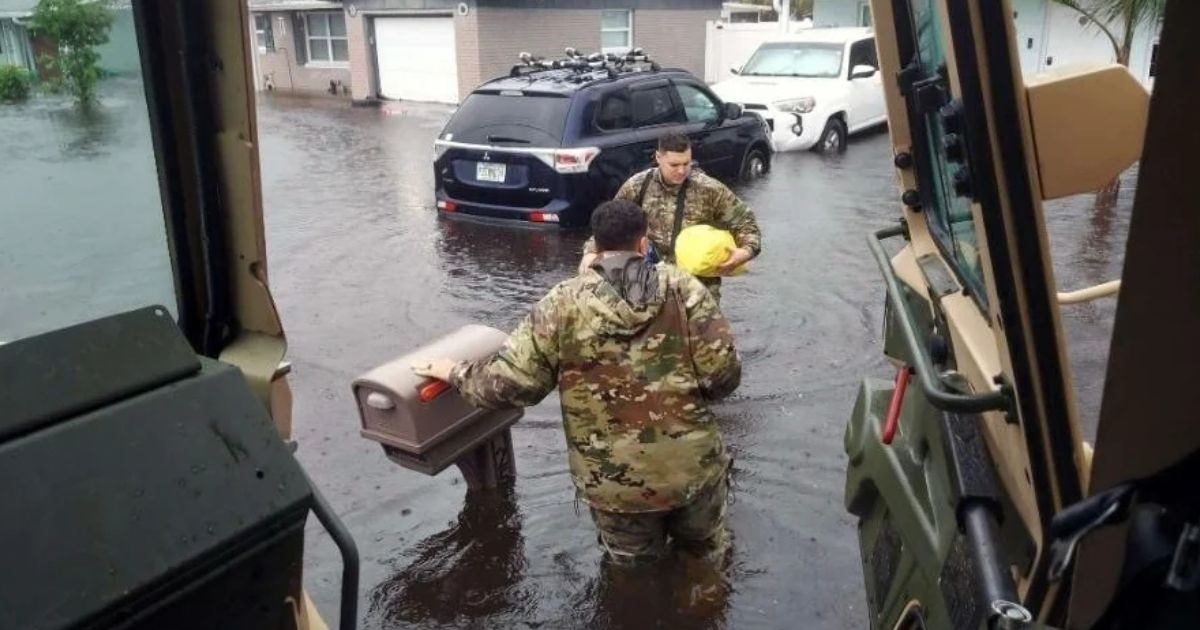
The President of the United States, Donald Trump, approved a major disaster declaration for Florida following the historic floods that have been affecting the state since October 31, a decision that will allow those affected, including Cubans who meet the eligibility requirements, to apply for federal financial assistance.
The Federal Emergency Management Agency (FEMA) confirmed the measure in a statement released this Tuesday, in which it outlined the authorized assistance types and the territories that will have access to the resources.
According to the network FOX 35 Orlando, the declaration will initially allow residents of six counties to apply for individual assistance: Brevard, Indian River, Martin, Okeechobee, Palm Beach, and St. Lucie.
FEMA specified that other territories could be incorporated as damage assessments progress.
How will the measure benefit the affected Cubans?
Cuban residents in designated counties who have suffered damage to their homes, lost personal property, or had to leave their homes may apply for federal assistance, provided they meet the conditions set by FEMA.
Among the available assistance are grants for temporary housing, payment for the rent of another residence, essential home repairs, and replacement of certain personal belongings damaged by the floods.
They will also be able to access, based on their eligibility, low-interest loans to cover material losses not covered by insurance and other recovery programs.
Assistance is not limited to homeowners. Tenants can also qualify for certain benefits, such as help with temporary housing and the replacement of essential belongings.
However, presidential approval does not entail the automatic disbursement of funds, nor does it guarantee compensation for all the losses incurred.
What immigration requirements must Cubans meet?
According to the FEMA eligibility requirements, U.S. citizens, non-citizen nationals of the United States, and foreigners belonging to certain immigration categories can access federal economic assistance programs.
In the case of Cubans, this includes those who have obtained U.S. citizenship, legal permanent residents, beneficiaries of approved asylum, refugees, and certain individuals classified as Cuban-Haitian Entrants.
Those who have received a temporary residency permit for humanitarian reasons for at least one year and meet the other required conditions may also be eligible.
Individuals with pending asylum applications or temporary residency permits should verify if their specific immigration situation fits into any of the accepted categories.
There is, moreover, an important alternative for families with mixed immigration status.
A parent, guardian, or caregiver who does not personally meet the immigration requirements can request assistance on behalf of a child under 18 years old who lives with them and meets the eligibility criteria, including having a valid Social Security number.
Certain forms of non-monetary emergency assistance, such as shelter, food, water, and emergency medical care, may be available regardless of immigration status.
How to apply for FEMA assistance?
The insured parties must first file a claim with their insurance company. Subsequently, they may request federal assistance for needs and losses that are not covered.
Requests can be submitted through the official portal DisasterAssistance.gov, via the FEMA mobile app, or by calling 1-800-621-3362, where assistance is also available in Spanish.
It is advisable to have on hand the corresponding Social Security number, identification documents, information about the affected property, insurance policies, photographs of the damages, and receipts for expenses resulting from the flooding.
For certain assistance, FEMA must verify that the damaged property was the applicant's primary residence at the time of the disaster.
The declaration also authorizes federal resources for state and local authorities and certain nonprofit organizations, aimed at debris removal and the implementation of emergency protective measures.
This public assistance modality will initially be available in Brevard, Hardee, Indian River, Martin, Okeechobee, and Palm Beach.
A long-awaited aid in Florida
The presidential approval responds to the request for a major disaster declaration submitted on November 9 by the authorities of Florida, at the request of Governor Ron DeSantis.
So far, the affected families have been waiting for federal authorization that would allow them to access individual assistance programs.
FEMA announced this week the allocation of nearly 400 million dollars to Florida to fund 144 recovery and disaster prevention projects.
However, that allocation was intended for public assistance programs and risk mitigation, and did not authorize individual financial aid for those affected by the recent floods.
Related videos:
Filed under: