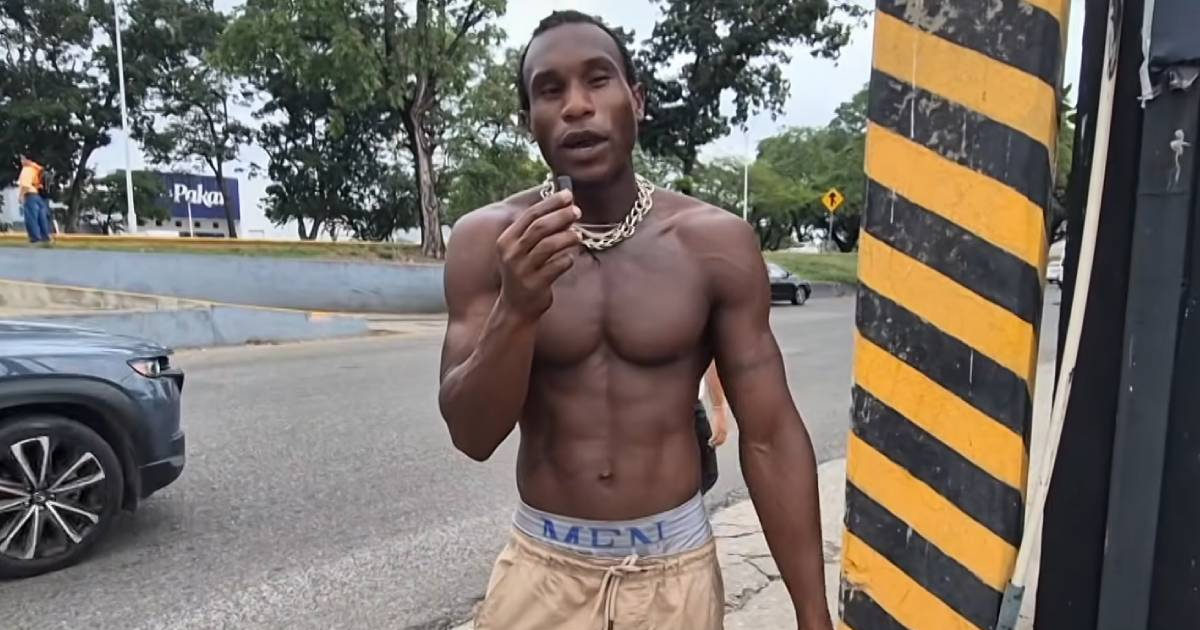
A young man from Havana who worked as a model and entertainer in Miami became a trending topic on social media in Villahermosa, in the Mexican state of Tabasco, this week after images of him walking the streets of the city caught the attention of residents due to his height and physical build. His name is Lisbany, and his story was featured by Uno TV in an interview that quickly circulated across various platforms.
Lisbany recounted that he emigrated to Florida, where he made a living modeling for clothing stores and entertaining in nightclubs. About six months ago, he was arrested in an immigration raid and deported to Mexico, without having chosen Tabasco as his destination.
Since then, she has been living in the Casa Blanca neighborhood of Villahermosa, in a borrowed room, and travels around the city daily in search of food, water, and job opportunities. She has not been able to resume her modeling career in the Tabascan capital.
La historia de Lisbany refleja las consecuencias reales de las deportaciones desde Estados Unidos. Sigue los últimos desarrollos en nuestra sección de para estar al tanto de todo lo que afecta a los cubanos y otros migrantes.
The attention he attracts from passersby is constant. Lisbany himself described the situation casually: “Women take pictures of me with hidden cameras in their cars; I can walk by and see them taking photos from the car, and it draws a lot of attention.”
Due to the lack of opportunities in Villahermosa, the young man from Havana is considering moving to Tulum or Playa del Carmen, tourist destinations where he believes he can find a more receptive market for his profile as a model.
His case illustrates a large-scale migration crisis affecting thousands of Cubans. According to the report “They abandon us here to die” from Human Rights Watch, published in May, between January 20, 2025, and March 9, 2026, the United States deported approximately 4,353 Cubans to Mexico, the largest nationality among nearly 13,000 people from third countries sent there.
By that same date, activists estimated that around 3,000 Cubans were stranded in Villahermosa and about 800 in Tapachula, Chiapas, without documents, work permits, or a clear path to regularization.
The limbo in which these deportees find themselves is rooted in a structural cause: the Cuban regime refuses to accept certain immigrants, particularly those with criminal records, which prevents their direct repatriation. At the same time, with a deportation order in effect, their return to the United States is barred.
The story of Lisbany contrasts in age and virality with other documented profiles in Villahermosa, such as that of Rafael Enrique Migolla, a 73-year-old Cuban deported in October 2025 after living in Miami since 1991, or Julio Borrell, who spent 46 years in Miami before being sent to Tapachula. They all share the same scenario: a country they did not choose, without a support network and with an unclear horizon.
Human Rights Watch also noted that none of the more than 40 Cubans interviewed for their report received protection interviews before being transferred to Mexico, a detail that the organization presented to the Supreme Court of the United States last Monday.
Related videos:
Filed under: