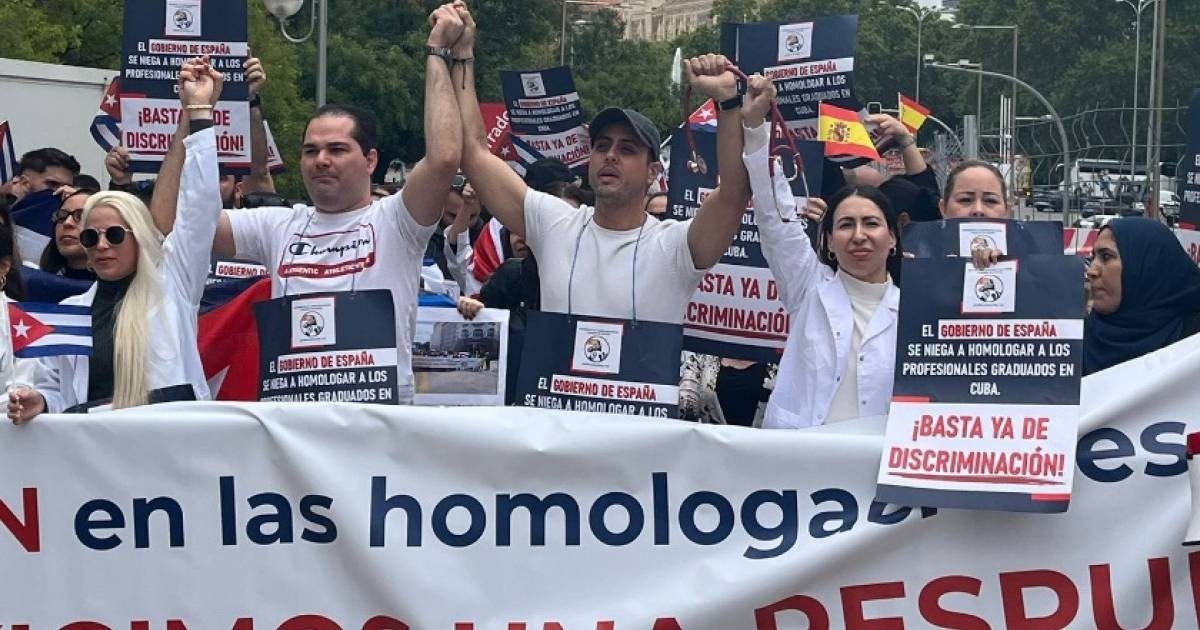
The Cuban Medical Association in Spain (AMCUBE) is celebrating its first scientific congress this Saturday in Madrid, a historic gathering for a group that has been caught for years between Spanish bureaucracy and the political repression of the Cuban regime.
The I Congress of Cuban Doctors in Spain and the I Ibero-American Symposium will take place at the CTO Group headquarters and will bring together approximately 150 professionals under the motto "Cuban doctors, united by science, committed to life, and in love with freedom."
The event is endorsed by the scientific approval of the Madrid Medical Association and supported by the Spanish Society of General Practitioners and Family Physicians (SEMG), with whom AMCUBE signed a collaboration agreement at the beginning of November.
Guillermo Ponce Morales, president of AMCUBE, leads an organization that was founded to represent Cuban emigrant doctors and has evolved from street protests to academic institutionalization.
The heart of the program is a colloquium dedicated to the three obstacles that most hinder this group: the recognition of degrees, professional licensing, and the acknowledgment of medical specialties.
According to EFE, around 2,000 Cuban doctors have been experiencing delays of over three years in their accreditation processes, while Spanish regulations set a maximum timeframe of six months. The Cuban Accreditation Movement in Spain raises that number to at least 3,000 professionals awaiting validation.
The situation worsened since October 22, 2026, when the Ministry of Science, Innovation, and Universities suspended the acceptance of new applications for the homologation of foreign degrees, with the portal still closed to new requests.
The Spanish bureaucracy is compounded by the political blockade from Havana. The regime systematically denies the certificate of professional non-disqualification to doctors who left official missions or emigrated without authorization, preventing them from registering even though they already have their qualifications recognized. In June 2025, around 3,000 Cuban doctors with validated degrees were unable to practice for this reason.
The Madrid Medical Association responded in October 2024 with a temporary registration through a responsible declaration, initially not requiring the Cuban certificate, a measure that opened a partial escape route for the group.
The paradox is striking: Spain is projected to have a deficit of 4,899 family doctors by 2026, with 485 vacancies just in Madrid and 669,000 residents without an assigned doctor, while thousands of trained Cuban professionals wait for years to practice.
On the other side of the Atlantic, Cuba is experiencing an unprecedented health crisis. The country lost 3,729 doctors in just one year, according to the 2025 Health Statistical Yearbook, which recorded 71,635 professionals compared to 75,364 the previous year.
On Monday, the Director-General of the WHO, Tedros Adhanom Ghebreyesus, declared in Havana that life expectancy in Cuba fell from 78.8 years in 2020 to 74.4 years in 2025, marking the first decrease since 1950.
During the congress, awards will be presented to the College of Physicians of Madrid, the Secretary of Universities, and the Ministry of Health of the Community of Madrid for their support of the community. The submitted works will be evaluated by a Scientific Committee chaired by Dayana Roso and published in the scientific journal RICID.
Professionals interested in participating can formalize their registration on the AMCUBE website, where the official call for the event is also available.
Related videos:
Filed under: