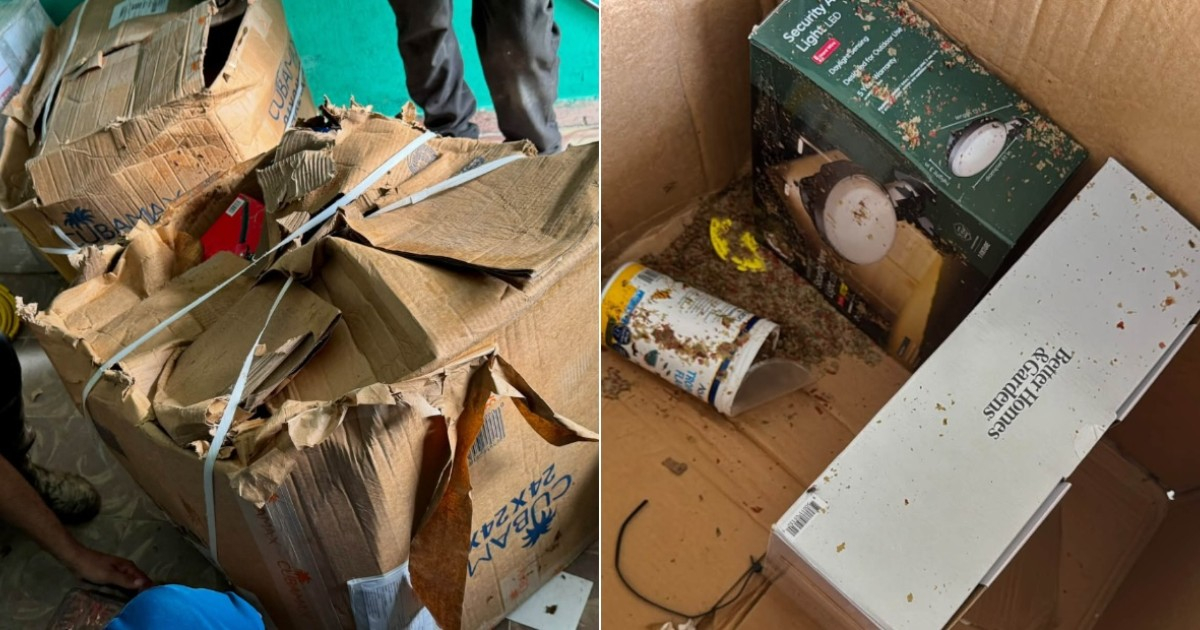
A Cuban resident in Bayamo, Granma province, made a formal and public complaint this Wednesday after receiving packages sent by her husband from the United States through CubaMax in deplorable conditions: crushed, broken, and wet packaging, and, as she reported, missing valuable items.
Maile Thalía Berges Rosales documented the condition of the shipments with photographs taken at the pickup location, where completely destroyed boxes are visible, showing signs of severe moisture, potential damage from rodents, and products in a state of decomposition within the packaging.
"When a person pays for a service, the least they expect is for their belongings to arrive in good condition and complete. What I received was everything but that," the complainant wrote at the beginning of her claim.
According to the account, the boxes arrived "extremely damaged, crushed, broken, open, and wet," and based on the information provided at the pickup point, they were transported in a vehicle without protection against the weather conditions.
Upon reviewing the content, he also found that valuable items were missing and that numerous products had been contaminated by internal spills.
The workers at the pickup point allowed him to document everything, but they made it clear that they were not responsible: their role was solely to receive and deliver the packages, and that the issue pertained to the warehouses.
The claim does not directly target CubaMax as the sole responsible party; rather, it calls for an investigation to determine at which link in the chain—storage, transportation, or handling—the damages and shortages occurred. The agency itself has a vested interest in ensuring that packages arrive on time, complete, and undamaged, as their clients' trust and their reputation depend on it. "As a client, I should not have to bear the consequences of poor handling, storage, or transportation of goods for which a service was paid," she pointed out.
This type of deterioration largely stems from the structural logistical crisis that Cuba is experiencing. Correos de Cuba acknowledged in July 2026 that the lack of fuel is paralyzing the transportation of international packages from Havana to the provinces, with delays of up to four months. During this time, shipments remain in warehouses without proper conditions, exposed to humidity, rodents, and lack of security.
In September 2026, a case was reported of medications damaged by rats after three months in storage at Correos de Cuba, and in October of the same year, more than 4,000 packages intended for Sancti Spíritus remained held in Havana without being delivered.
Private agencies like CubaMax hire Cuban state-owned companies for internal distribution on the island. This structure means that, although the customer pays the agency, storage and provincial transportation depend on state entities with limited resources, complicating the assignment of responsibilities when damages or shortages occur.
Berges Rosales demands seven concrete actions: an investigation into the complete route of the packages, identification of the warehouse and responsible personnel, clarification of the transportation conditions, an investigation into the missing items, determination of responsibilities, financial compensation, and a formal written response.
"It is unacceptable for a person to pay for a transportation service and receive their belongings destroyed, wet, and with valuable items missing, without anyone assuming responsibility," he concluded.
Related videos:
Filed under: