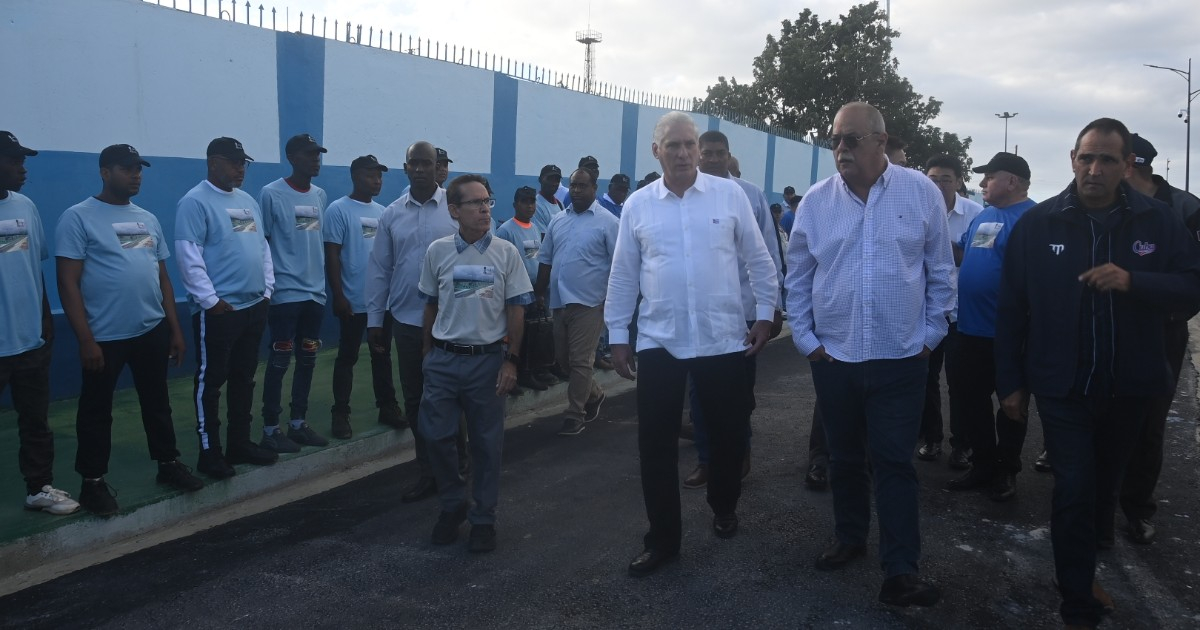
Miguel Díaz-Canel inaugurated this Thursday the "Habana 220" Battery Energy Storage System, located near the Technological University of Havana (CUJAE), with a capacity of 50 MW installed using technology and collaboration from the People's Republic of China.
The launch comes almost a month late: the Cuban government had set October 30, 2026, as the service start date, but as of November 24, the system was still in the testing phase without an officially confirmed date, accumulating at least 27 days of delay from the original schedule.
According to the official account of the Presidency of Cuba on the social network X, the system "will allow for regulating the frequency of the National Electric System and freeing up the capacity of the solar parks installed in the country."
The installation, known as BESS Habana 220, is the second of four battery storage systems of 50 MW that Cuba is developing since August 2025 as part of its energy transition program, with a planned combined capacity of 200 MW.
The first of these systems, located at the El Cotorro substation —also in Havana— began testing in March 2026 and became operational in July of that year, when it was used to stabilize the frequency of the western electrical system following the total blackout on July 10, which left approximately 9.6 million people without electricity.
The other two systems of the program are planned for Cueto (Holguín) and Bayamo (Granma).
The inauguration takes place amidst an energy crisis that shows no signs of easing. This Thursday, the Electric Union forecasted only 1,105 MW available against a demand of 2,750 MW, with an estimated deficit of 1,645 MW.
In that context, the 50 MW from the new system represent only 3% of the daily deficit recorded on the Island, which significantly limits its impact on the power outages experienced by the population.
The magnitude of the crisis has even been acknowledged by the Chinese ambassador to Cuba, Hua Xin, who published on Wednesday in the People’s Daily that power outages exceed 20 hours a day in many parts of the country, including Havana, and that hospitals, schools, and nursing homes have been left without electricity.
The diplomat also reported that medical staff at a clinic in Havana told him that in the worst moments, they had to assist deliveries while holding flashlights, until China donated solar panels to that facility.
The bilateral cooperation program includes a Chinese donation valued at over 114 million dollars, announced in September 2023, to install 22 solar parks in ten Cuban provinces, along with a broader plan for 92 solar parks with an approximate capacity of 2,000 MW before 2028.
While the regime celebrates the inauguration as a step forward in the energy transition, the reality faced by millions of Cubans is one of entire days without electricity, with an electrical system operating on the brink of collapse and whose recovery, at this pace, seems far off.
Related videos:
Filed under: