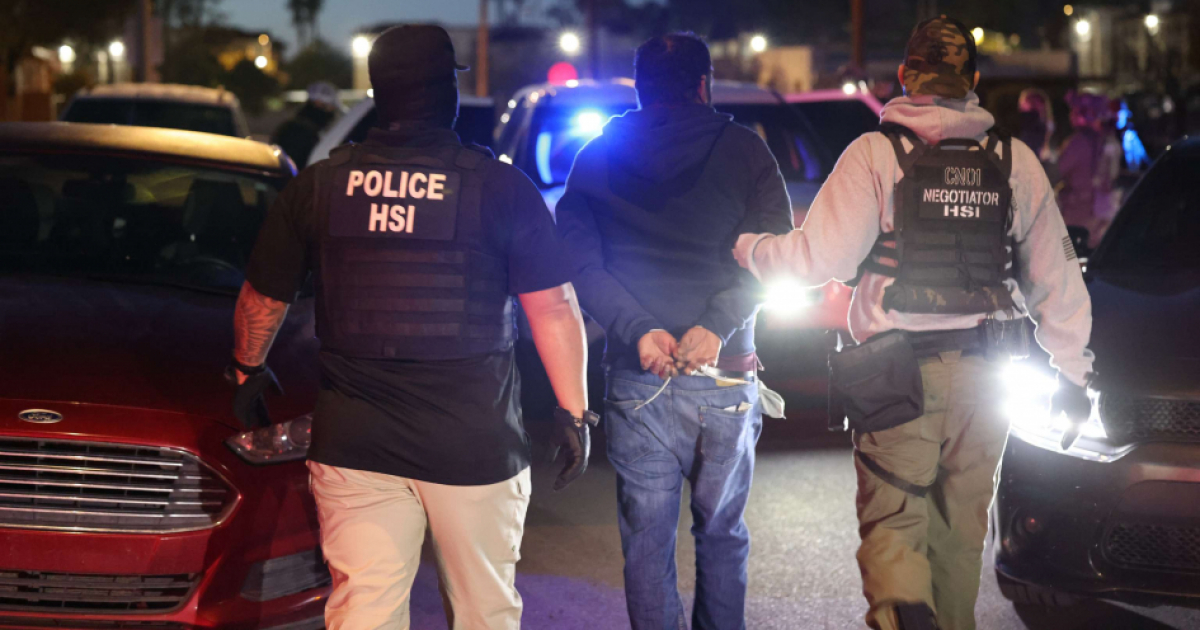
A federal judge in California blocked the Immigration and Customs Enforcement (ICE) from re-arresting immigrants during their routine check-in appointments, in a decision that does not directly protect Cubans in Florida but marks a growing legal stance against that tactic.
In parallel, a class action lawsuit filed in Georgia is progressing within the same federal circuit that covers Florida and could, if successful, compel ICE to change its behavior in that state as well.
Judge Dana M. Sabraw of the Southern District of California certified the class action suit Fanfan et al. v. Noem et al. and ordered that ICE cannot re-detain individuals who have already been released with open court cases during their check-in appointments without first conducting an individual assessment that demonstrates a significant change in circumstances.
The order applies only to San Diego and Imperial counties.
The case was brought forward by the Center for Human Rights and Constitutional Law and the UCLA School of Law.
"ICE was drawing those people in for check-ins or ICE appointments and detaining them without reason," said Monika Langarica, legal director of that organization.
Las redetenciones de ICE en citas de control y sus implicaciones legales para cubanos en Florida forman parte de un panorama migratorio en constante cambio. Sigue los últimos desarrollos en nuestra sección de
This is not the first order of its kind: in December 2025, Judge Sabraw had already granted a temporary restriction in the case, and a court in San Francisco blocked the same practice for Northern California.
Georgia's Lawsuit: Why It Matters to Florida
The most significant legal front for Cubans in Florida opened on November 12 in the Northern District of Georgia.
The ACLU of Georgia, North Carolina, and South Carolina, along with the law firm Foley Hoag, filed a class action lawsuit against the Department of Homeland Security, Secretary Markwayne Mullin, Acting ICE Director David Venturella, and the Acting ICE Office Director in Atlanta, Kristen Sullivan.
The lawsuit challenges the "re-detention policy" that DHS adopted around May 2025, when it abandoned the "change of circumstances policy" that the ICE office in Atlanta had followed for over four decades.
Under that previous policy, ICE could not arrest someone who had been released again without first determining that their circumstances had materially changed.
"Our clients have complied with the rules imposed by the government. They have appeared at court hearings, attended check-in appointments, and adhered to the conditions of their release," said Corina Scott, attorney for the ACLU of North Carolina.
The key for Florida is that Georgia is part of the 11th Circuit, the same one that covers Florida and Alabama. If the lawsuit succeeds and goes to appeal, a ruling from that court would be binding throughout the circuit.
At the close of this edition, the court has not yet issued a decision on the suspension and class certification motions filed on November 17.
What changes —and what doesn't— for Cubans in Miramar
Thousands of Cubans with the I-220A form periodically visit the ICE office in Miramar, in South Florida, where arrests have been documented during these appointments and alleged abuses that led to a federal complaint filed by the SPLC and Americans for Immigrant Justice.
None of the judicial decisions from California or Georgia have any direct effect in Florida today.
However, the legal line they outline—requiring individual evaluation before re-detaining—is already being used by lawyers in habeas corpus petitions in the Southern District of Florida, where more than 97,000 detainees have resorted to this route since Trump’s return.
The legal landscape for Cubans with I-220A is mixed: last May, the 11th Circuit recognized the right to bail hearings for detainees within the country, but on November 17, that same court ruled that the I-220A is not equivalent to the parole required by the Cuban Adjustment Act, closing that path to residency for many.
While the courts determine the extent of these protections, experts advise continuing to attend appointments in Miramar: failing to appear increases the risk of detention. It is recommended to always have an immigration lawyer readily available before any appointment with ICE.
Related videos:
Filed under: