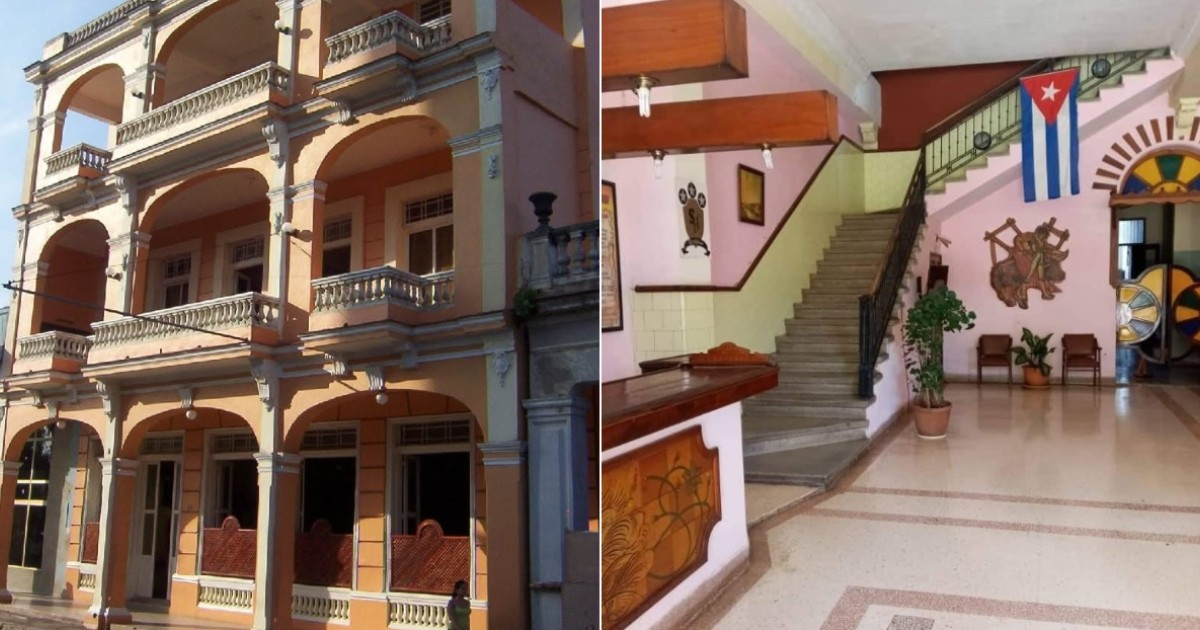
The Provincial Accommodation Company of Ciego de Ávila announced a bidding process for the Hotel Sevilla, one of the most iconic hotel establishments in the historic center of the city, with the aim of handing over its management to private actors.
According to the announcement shared on social media, the process started on Sunday, November 23, and the deadline for submitting bids closes on December 8, 2026, which is also when the files will be opened.
Interested parties can collect the bidding documents directly at the headquarters of the Provincial Accommodation Company and obtain additional information by calling 52 85 6 4 26.
The Hotel Sevilla holds a prominent place in the history of Ciego de Ávila: its origins date back to 1910, when Spanish emigrants —including the Asturian businessman Alejandro Suero Balbín— spearheaded the construction of the first building on the boulevard of Independencia Street, the main pedestrian artery of the historic center.
The current building, in eclectic style with interiors reminiscent of Andalusia, was inaugurated on January 1, 1930, and for decades served as a meeting point for the local society and distinguished visitors in the heart of the city.
What distinguishes this tender is its scope: while previous processes in the hotel sector were limited to leasing specific spaces—bars, restaurants, terraces—within existing facilities, here the management of the hotel as a complete unit is at stake, making it one of the first cases of its kind in a Cuban provincial capital.
The measure is part of a trend that the regime has accelerated throughout 2026: handing over state establishments to micro, small and medium-sized enterprises (mipymes), cooperatives, and self-employed workers, while keeping ownership of the property in the hands of the State.
In Ciego de Ávila, six warehouses had already been tendered in August to transform them into "Neighborhood Markets." On a national level, Islazul put bars, restaurants, and other spaces up for bid in ten tourist facilities in Santiago de Cuba in September, and EXPOHOLGÍN called for bids in October for spaces in the Hotel Turquino, Hotel Don José, and Villa Cristal, among others.
The backdrop of these measures is the unprecedented crisis facing Cuban tourism. Cuba received only 507,083 international visitors between January and October 2026, a 65.7% decrease compared to the same period in 2025, and the regime only fulfilled 28.8% of its annual tourism plan.
Seven international hotel chains —including Meliá, Iberostar, and Barceló— left the island following U.S. sanctions against GAESA and the Ministry of Tourism, and at the end of July, Prime Minister Manuel Marrero Cruz acknowledged that 73% of hotel facilities were closed.
In the face of that void, the government approved in June a package of 176 economic reforms that included the private management of hotels, and Miguel Díaz-Canel publicly called on the diaspora to participate: "Cubans who want to invest and who want to manage hotels. We are open to that", he stated in an interview with the Spanish media elDiario.es.
As of today, none of these measures have succeeded in reversing the decline of the sector, which lost approximately 20,000 workers in 2026 and is experiencing the worst tourism performance in decades.
Related videos:
Filed under: