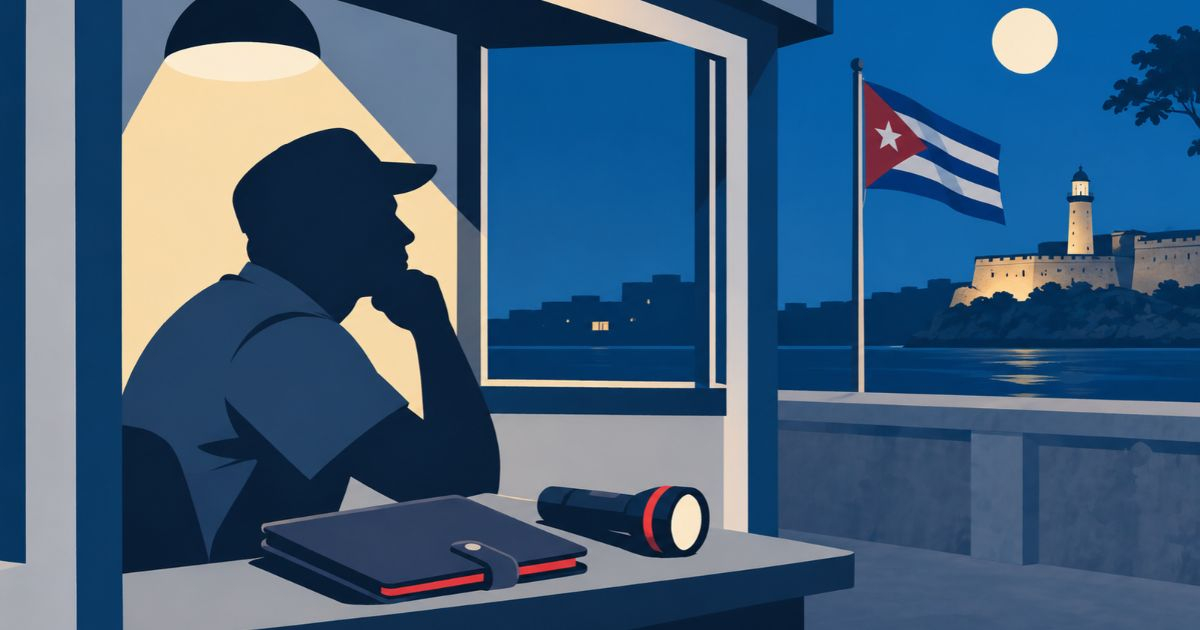
Roberto Suárez, photojournalist for the official newspaper Juventud Rebelde, published on his Facebook profile a reflection that sparked debate on social media: his astonishment upon learning that a high-level professional is forced to work nights as a member of the Vigilance and Protection Corps (CVP) because his salary is insufficient to cover basic expenses.
"It pained me to learn firsthand about the story of a great professional who is forced to work night shifts as a CVP because his salary is not enough to live on. It's unbelievable!" wrote Suárez in the post, which has been circulating since this week.
What the photojournalist described as something that left him speechless, his followers immediately recognized as an everyday reality. "That's the reality for almost all professionals in this country, what's the surprise?" replied one internet user. Another added, "Almost all professionals are in this situation just to afford at least the basics to live, pay for transportation, and buy medications."
Among the most revealing comments was one from someone who identified as a retired journalist with over two decades of experience: "After about 20 years as a press professional, I retired and continue working as a sound engineer. The hardest part is that the combination of the pension and salary is not enough to cover essential expenses such as hygiene, food, and medications."
An internet user with multiple university degrees recounted that while working at three universities, she had to sell coffee packages on weekends to make ends meet. Another commenter was more blunt: "We also have to sell books in order to eat."
The irony did not go unnoticed: several users questioned whether the work of a night watchman even addresses the problem. "And how does CVP cover it financially?" asked one internet user. "I doubt it," replied another.
The numbers explain the despair. In 2026, the state salaries of Cuban professionals range between 4,000 and 9,400 pesos per month, while the economist Javier Pérez Capdevila estimated the monthly cost of basic needs for a single person at 96,060 pesos, of which more than 70,000 are exclusively for food.
The average state salary reached 7,354 pesos in August, equivalent to about eight euros at the informal exchange rate. The Prime Minister himself, Manuel Marrero Cruz, acknowledged in July that the new minimum wage of 3,210 pesos "remains inadequate." The year-on-year inflation for food and non-alcoholic beverages reached 50.72% in October 2026, further widening the gap.
The phenomenon of forced moonlighting among Cuban professionals is neither new nor exceptional. A doctor from the Pediatric Hospital of Las Tunas stated a few days ago that for the past three years he has been selling food in addition to practicing medicine because his salary does not allow him to adequately support his family.
A doctor stated in May that, even while working more than five shifts a month, she never earned 10,000 pesos and ended up leaving the profession. Similar cases are occurring, with various circumstances, across different professions.
It is not the first time that Suárez, despite working for a state media outlet, has used his social media to highlight contradictions within the system. In April, he reported that a pizza and a malt beverage cost 600 pesos together, equivalent to 13% of a monthly salary of 4,600 pesos. On the 21st, heproposed that Etecsa sell part of its shares due to the lack of improvements in service quality.
A commentator succinctly summarized what many think: "In Cuba, it seems almost utopian to expect that one day the salary will fulfill its function and work will increasingly resemble a condition of slavery."
Related videos:
Filed under: