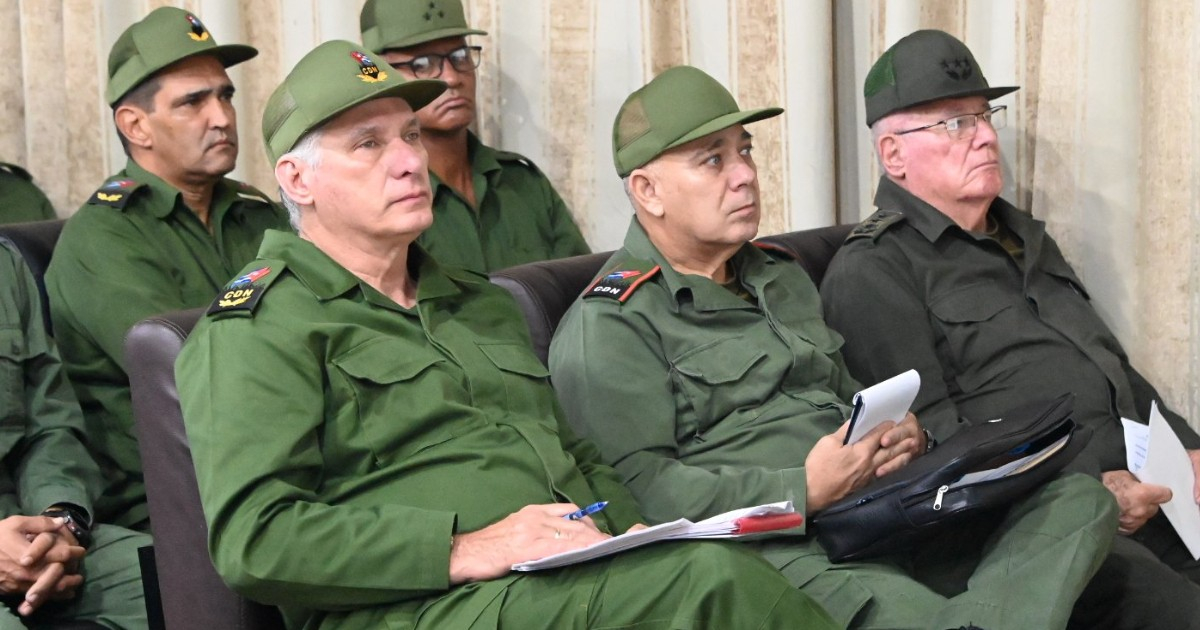
Surrounded by generals and high-ranking officials of the Communist Party, Miguel Díaz-Canel visited the Rocafort Defense Council (CDZ) this Friday, in the Havana municipality of San Miguel del Padrón, during National Defense Day, to observe how a structure designed for wartime is now managing water, waste, and food for more than 23,000 residents.
The official site of the Cuban Presidency described the visit as an opportunity to appreciate "the working system of a structure for wartime that has become central to the search for solutions to the problems of the population since peacetime."
The phrase, presented as an achievement, unwittingly summarizes the state of Cuba: the regime needs to mobilize military brigades to try to resolve what operates as ordinary public service in any other country.
The president of CDZ Rocafort, Gabriel Martínez Acevedo, presented to Díaz-Canel the council's activities: ensuring the supply of energy, providing water, solid waste collection, and food self-sufficiency through gardens, organoponics, backyards, and plots.
The area operates with 20 production and defense brigades made up of residents and workers from state and private entities, and has conducted four warning and protection drills so that the population can recognize the different types of alarms.
The paradox is hard to ignore: San Miguel del Padrón is one of the municipalities in Havana where the collapse of basic services has been most evident in 2026.
Residents of the municipality have reported periods of up to 70 days without receiving water, clashes among residents when only one water truck arrived for the entire area, and municipal trucks dumping garbage in front of a pre-university school.
While the regime touts the progress of having military structures manage water and waste, the Food Monitor Program estimated that 96.91% of the Cuban population lacked adequate access to food in 2026, and nearly one in three households reported that someone in their family went to bed hungry.
This scenario is neither new nor accidental: at the beginning of November, Díaz-Canel had already requested that defense structures remain active in times of peace to address everyday issues such as blackouts, water supply, and garbage collection, implicitly acknowledging that the ordinary state is unable to handle these problems.
The visit this Friday occurs against the backdrop of a rhetorical escalation that the regime has maintained throughout the year, with the Moncada 2026 Strategic Exercise held earlier this month and the call from the Western Army to citizens to monitor and report activities of the "enemy," which was disseminated on the same day as the visit.
Díaz-Canel was accompanied by Roberto Morales Ojeda, Secretary of Organization of the Central Committee; Generals Álvaro López Miera (Minister of the Armed Forces) and Lázaro Alberto Álvarez Casas (Minister of the Interior); General Amado Ricardo Guerra, Secretary of the Council of Ministers; and General Ernest Feijóo Eiró, Chief of the Western Army, among others.
The visit of Díaz-Canel to Boyeros in the middle of the month followed the same pattern: a tour of a defense zone, rhetoric about sovereignty, and silence regarding the misery surrounding the more than 23,000 inhabitants of Rocafort, who face power outages, water shortages, and hunger while the military and party leadership explain to them how to prepare for a war.
Related videos:
Filed under: