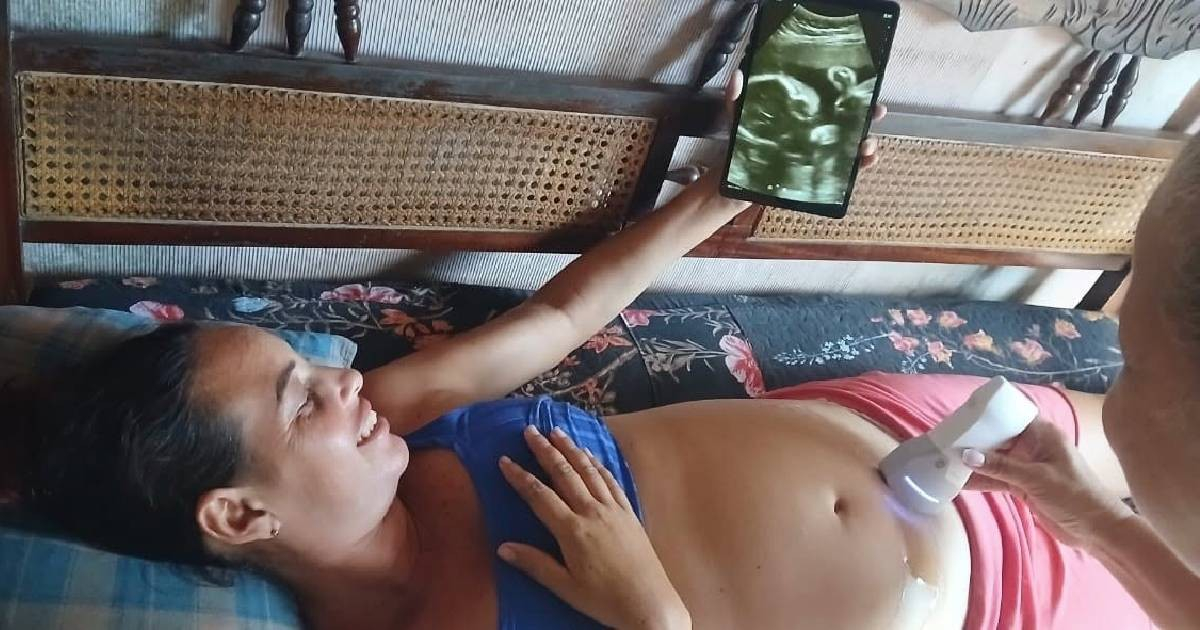
A Christian ministry conducted an ultrasound day for pregnant women in Cuba, in a solidarity initiative that allowed many of them to see their babies for the first time, as reported on Facebook by the page Radio Evangelística Internacional El Pozo de Jacob.
The publication describes the event as taking place "at the Embassy of Christ in Cuba, The Well of Jacob," and attributes the initiative to the Ministry of Heart to Heart.
"Moments of joy and emotion that remind us of the value of life and love," states the text, which expresses gratitude to those who are part of "this ministry that provides hope and love to the women and families who need it."
The images released show women reclining on stretchers or beds while undergoing ultrasounds, some holding phones or tablets to view images of their babies.
The environment appears to be homey or informal, distant from a conventional hospital. The publication does not specify the exact location, the number of women attended to, or whether the service was free.
The scene contrasts sharply with the serious crisis facing prenatal care in Cuba. The regime itself acknowledged that around 34,000 pregnant women were not receiving all the necessary prenatal ultrasounds, a figure mentioned by Díaz-Canel in August 2026 and reiterated weeks later by the Minister of Health, José Ángel Portal Miranda, who publicly admitted significant failures in hospitals, including a shortage of medical equipment, reagents, and disposable materials.
The blackouts of up to 20 hours a day have rendered diagnostic equipment in hospitals across the country inoperative, including obstetric ultrasound machines.
At least one hospital reported having only one piece of equipment of this type for the entire facility. Additionally, over 32,000 pregnant women were facing additional risks due to the lack of fuel for emergency transfers, according to data from the Ministry of Public Health from February 2026.
In that void, religious organizations have taken on an increasingly prominent role. The PassionLife ministry and its Cuban network "Soplo de Vida" — founded by Dr. Annia González-Cruz — have been conducting ultrasounds for years using portable ultrasound machines connected to mobile devices in the homes of Cuban women, with a declared presence in at least 22 teams or centers on the island.
However, these initiatives do not always find a clear path. In June 2026, the regime halted the breakfast program that a church in Las Tunas was providing to pregnant women in a state maternity home, requiring authorization from the Communist Party for each day. The tension between the humanitarian work of the churches and the State's control over social assistance is an underlying element that accompanies initiatives like that of El Pozo de Jacob.
Maternal mortality in Cuba rose to 44.1 deaths per 100,000 live births in 2025, compared to 40.6 the previous year, while infant mortality ended that same year at 9.9 deaths per 1,000 live births, well above the island's historical records.
These figures illustrate the human cost of a collapsing healthcare system, turning what should be routine into something extraordinary: that a mother can see her baby before birth.
Related videos:
Filed under: