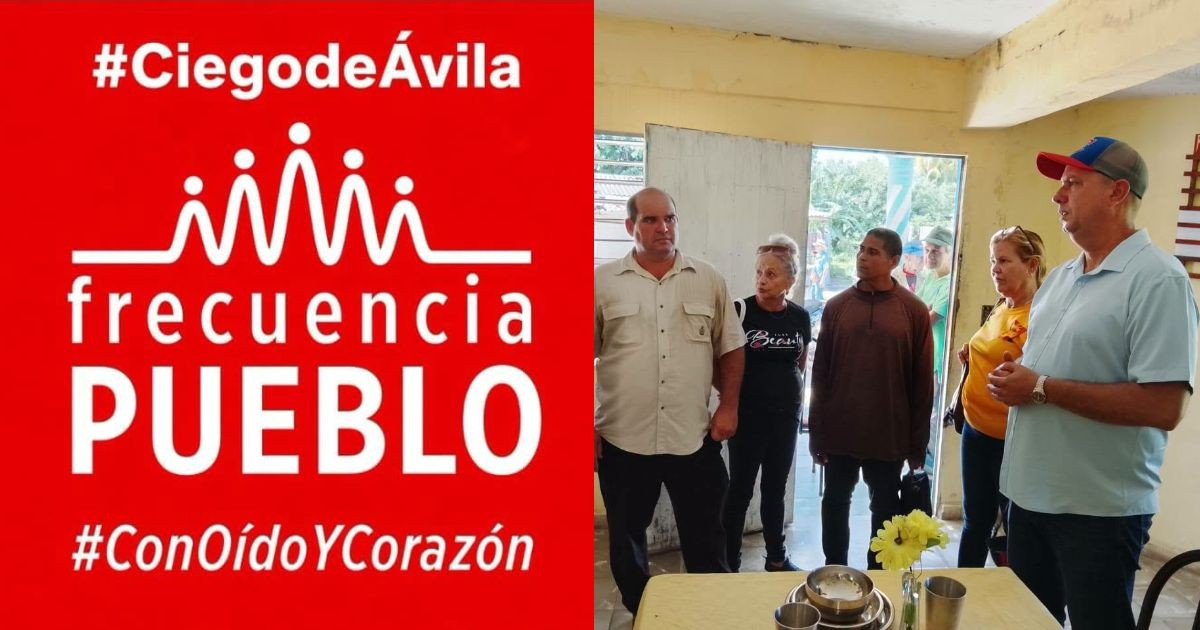
The First Secretary of the Communist Party of Cuba (PCC) in Ciego de Ávila, Julio Gómez Casanova, announced this Friday the launch of "Frecuencia Pueblo," a new radio program that will debut this Saturday, November 28, at 11:00 a.m. on Radio Surco, the provincial station in Avila, airing province-wide and simultaneously streaming on the Facebook page @Frecuencia Pueblo.
The program, whose slogan is "With Ear and Heart," is presented as "a radio program for dialogue and problem-solving that affects the people," according to Gómez Casanova's own words on his Facebook profile. Citizens can call the phone number 33225471 to express their concerns during the broadcast.
The chosen theme for the debut is not coincidental—or perhaps it is too much so: the water supply to the population across the province, described by the leader as "the issue that most concerns the people of Avila today." A province that has spent years without resolving its water crisis is launching a radio program to discuss water. The irony speaks for itself.
"Frecuencia Pueblo" is not an original concept from Ciego de Ávila: it is the sixth link in a chain of radio spaces modeled after the program "Criterio Compartido," which the ruling Miguel Díaz-Canel launched on Radio Rebelde on September 23, 2026. Before the people of Ciego de Ávila, the same format was adopted in Matanzas ("Diálogo Abierto", Radio 26, November 7), Artemisa ("Punto de Encuentro", November 11), Pinar del Río ("Entre todos", Radio Guamá, November 12); Santiago de Cuba ("En Confianza," CMKC, November 13) and Sancti Spíritus ("Micrófono Abierto", Radio Sancti Spíritus, November 25).
The leader of Artemisa, Gladys Martínez Verdecia, at least had the honesty to admit that her program was created at the express direction of the president. An internet user summed it up with a single question: "What was that, an orientation from the Central Committee?"
The results of Díaz-Canel's original program do not exactly inspire optimism: in its fifth broadcast, out of 46 cases reviewed —41 complaints and five opinions— only 20 had been resolved and 13 remained pending due to a lack of resources. That is the model that Ciego de Ávila is eagerly set to replicate.
The underlying paradox is hard to overlook. Ciego de Ávila is facing a severe and prolonged water crisis: the water distribution cycle has extended up to nine days. To make matters worse, more than 85% of the Cuban water supply system relies on the electrical grid, and the province has experienced blackouts lasting up to 30 hours.
In April 2026, a resident of Ciego de Ávila reported that her community was unable to store water for 36 days due to a combination of irregular cycles, low pressure, and power outages.
The very internet users who commented on the program's announcement pointed out the contradiction with a precision that no official could match on air. "What we need is radio signal so we can listen to it," wrote one. Another was more explicit: "With the power outages we have, how can we hear it on the radio and call this number without electricity? We have no phone service. How do we solve that problem?" A third voice chose to use raw irony: "Will anything be resolved? I’ll leave that as your homework."
A Cuban retiree who had already responded to Díaz-Canel regarding the format of these programs stated plainly: "the idea of putting officials on the mic for self-criticism is pure demagoguery and opportunism [...] with the purpose of evading responsibilities and blaming others for the disasters."
Meanwhile, Gómez Casanova calls on the people of Avila to participate because, according to him, "the participation of the people is essential to find solutions and transform our reality." It remains to be seen whether that reality includes water from the taps or if, at the very least, there will be electricity to turn on the radio.
Related videos:
Filed under: