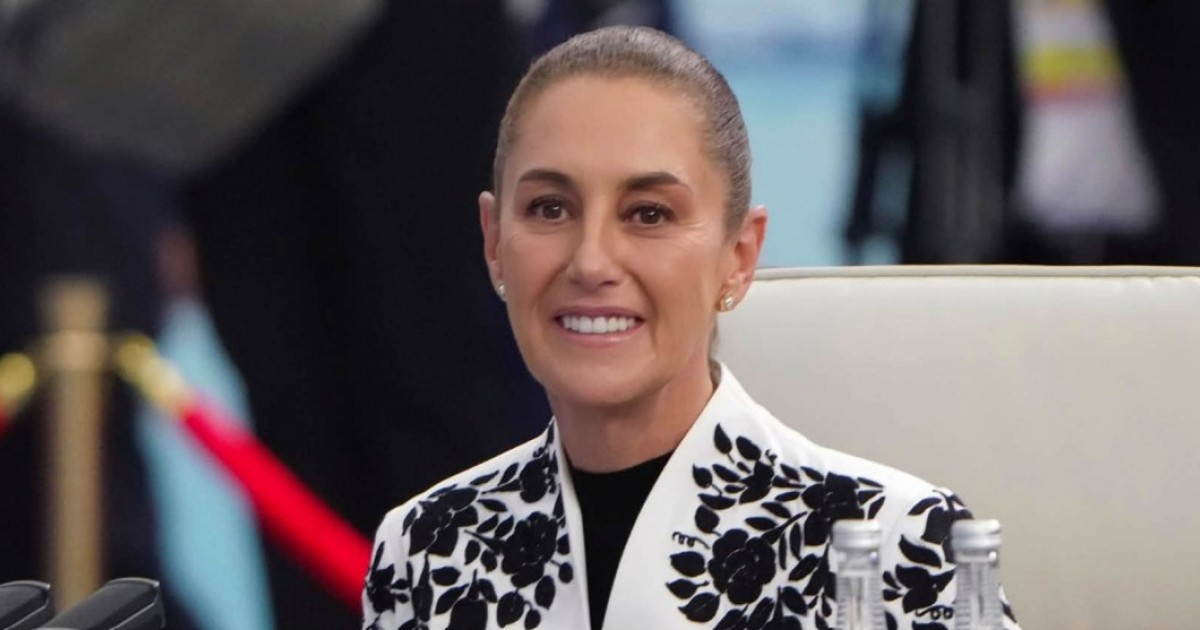
The Mexican president Claudia Sheinbaum announced at a press conference that the Mexican Agency for International Cooperation for Development (Amexcid) recently opened an office in Havana to facilitate the sending of food and medical supplies to Cuba, marking the agency's first permanent headquarters outside Mexican territory.
The inauguration took place on November 20 in Havana, led by Alejandra del Moral Vela, executive director of Amexcid, and by the Cuban vice prime minister Óscar Pérez-Oliva Fraga.
"We continue sending medical supplies. Recently, Amexcid opened its doors in Havana to facilitate the humanitarian transfer of food and other supplies. We are in close contact through the government of Mexico and also with Amexcid," stated the leader.
The Amexcid office in Havana is, so far, the only permanent headquarters that this agency has outside of Mexico, making Cuba the only country in the world with a stable representation of Mexican cooperation.
Its declared functions are to coordinate humanitarian aid, monitor the Sembrando Vida agricultural program, and facilitate bilateral technical exchange. However, the official Mexican statements do not specify through which Cuban channels the products are distributed once they arrive at the port of Havana.
According to research by the magazine El Estornudo, the Ministry of Foreign Trade and Foreign Investment acts as a governing and intermediary entity to authorize the entry of international donations to Cuba, without a public traceability system leading to the final beneficiary.
The question of whether aid reaches Cuban families or gets trapped in state channels linked to the regime remains officially unanswered.
The opening of the office institutionalizes a cooperative relationship that, in 2026, has mainly materialized through maritime shipments from the Mexican Navy. Since February, at least five operations have accumulated more than 4,800 tons of food, medicine, hygiene products, and solar panels. The largest individual shipment was from the vessel Asian Katra, which arrived in June with 1,700 tons from Mexico and Belize.
In parallel, the second phase of the Sembrando Vida program received a contribution of 588 million Mexican pesos (over 34 million dollars) and began operations in October in Ciego de Ávila, Holguín, and Las Tunas, with a target of 1,500 producers per province.
This growing cooperation contrasts with the suspension of Mexican oil supplies to Cuba. Under pressure from secondary tariffs imposed by the Trump administration, Pemex reduced its shipments from an average of 17,200 barrels per day in 2025 to just 900 in the first quarter of 2026, with no new sales recorded between April and June.
Sheinbaum defended her government's position by invoking the principle of self-determination: "The only ones who can decide the future of Cuba are the Cuban people, no one else."
He also rejected the U.S. embargo and energy restrictions: "We are against any trade blockade on the island and now the energy one, because there can be no policy against a people."
The claim that the Cuban people decide their destiny clashes with the reality that there are no free elections in Cuba and only one party exists. However, the Aztec leader dismissed the assertion that the Island is living under a dictatorship as a "right-wing opinion".
Related videos:
Filed under: