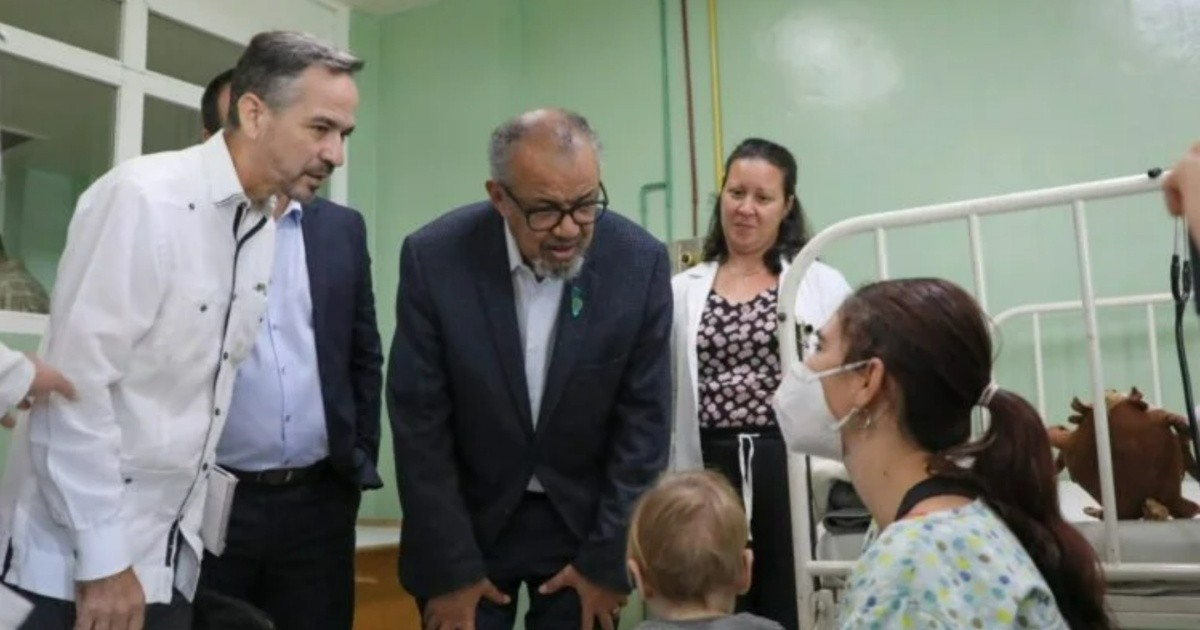
The Director-General of the World Health Organization (WHO), Tedros Adhanom Ghebreyesus, published a message on X this Saturday in which he stated that he returned from Cuba "saddened" by what he witnessed, and urged Washington to lift the sanctions against the island.
"I just returned from Cuba, saddened by what I saw. Hospital corridors filled with small hands holding great hopes. Healthcare workers giving all they have. Children should never pay for political disputes. I urge the U.S. to lift the sanctions, for their sake," wrote Tedros on his official account, accompanying the text with a photograph taken at the William Soler Pediatric University Hospital in Havana.
The official had visited Cuba from November 22 to 24, invited by the Minister of Public Health, José Ángel Portal Miranda. During this stay, he toured the William Soler and its cardiocenter — where he learned about the case of a one-year-old girl awaiting open-heart surgery — and met with health authorities and biotechnology research institutions.
It was his second visit to the island as head of the WHO; the first took place in April 2018.
The data presented by Tedros in Havana depicts a healthcare system in free fall. According to figures from the organization itself, life expectancy in Cuba dropped from 78.8 to 74.4 years between 2020 and 2025, a reduction of 4.4 years that marks the first decline since statistical records began on the island.
During that same period, infant mortality more than doubled, rising from four to 9.9 deaths per 1,000 live births, and the survival rate for children with cancer decreased by 20 percentage points, from 85% to 65%.
Tedros also noted that nearly 100,000 people were waiting for a surgical intervention, among them about 12,000 children, and that around 34,000 pregnant women were unable to access the prenatal care they needed.
The official attributed much of the collapse to U.S. sanctions and the fuel shortage. However, at the press conference in Havana, he introduced a nuance that went almost unnoticed: "There are issues in the health sector and in other sectors due to the well-known sanctions, but at the same time, it is good for the government to recognize that there are internal problems as well."
That statement contrasts with the discourse of the Cuban regime, which attributed the collapse solely to the "criminal blockade and energy siege imposed by the U.S.," without mentioning the medical missions abroad or the failed economic policies. Cuba maintains over 16,000 health collaborators deployed in about fifty countries while its internal system deteriorates, and between 2021 and 2024, more than 30,800 doctors left the island due to emigration.
Critical voices warned from the outset that Tedros would not truly understand the health situation in Cuba. Doctor Alberto Tejeda Illas, from Santiago de Cuba, sent him an open letter before the visit concluded: “It is said that you are visiting Cuba. Unfortunately, you will not be able to truly know Cuban health,” wrote Tejeda Illas, warning that the authorities would control every step of the official tour.
At the conclusion of the visit, the WHO announced a contribution of 2 million dollars to strengthen Cuba's national vaccination program, aimed at immunizing approximately 62,000 newborns, over 780,000 infants, and more than 110,000 individuals from other at-risk groups. This amount is added to over 14 million dollars mobilized between 2025 and 2026 through 14 projects on the island.
The Portal Miranda itself had described the Cuban healthcare system as "on the verge of collapse" in an interview with AP in February 2026, and acknowledged serious failures before the National Assembly in early November, including broken generators, malfunctioning elevators, deteriorated boilers, and a shortage of reagents.
Related videos:
Filed under: