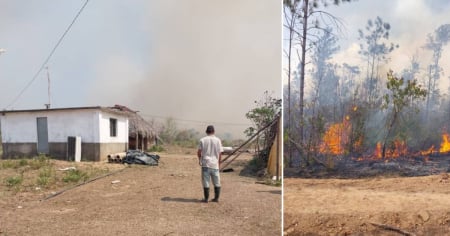
A large wildfire has been affecting the forested area of La Vigía, in the municipality of San Juan y Martínez, in the province of Pinar del Río, since the evening of April 18, and it has already devastated over 300 hectares of pine forest.
According to the local media Tele Pinar, the fire has been described as the most complex of the year in the country, due to several factors that have hindered containment efforts: strong gusts of wind between 35 and 45 kilometers per hour, challenging terrain, and a prolonged drought that has already lasted over 90 days without rain in the region.
In the operation to contain the fire, combined forces from the Forest Rangers and the Integrated Agroforestry Company of Pinar del Río are involved, totaling 28 personnel and utilizing technical resources such as bulldozers, trucks, a water tanker, a pickup truck, and a motorcycle.
The temporary groups of the Municipal Defense Council were also activated, responsible for coordinating urgent actions on the ground.
As part of the strategies, this Sunday the conditions were being assessed to implement tactics such as backburning and the construction of firebreaks using heavy machinery.
The fire is one of the 201 reported in Cuba since the beginning of 2025, and it is one of the 12 that remain active, nine of which are in Pinar del Río, a province that has faced significant environmental damage from similar events in recent years.
Authorities are investigating the causes of the incident and have reiterated their call to the public to take extra precautions, especially in light of the persistent adverse weather conditions.
According to the Cuban News Agency, the fire was officially classified as "very large" by the National Headquarters of the Forestry Corps and started at 9:30 p.m. on Friday, April 18.
The note also confirmed that, in addition to the forestry brigades and technical resources, two bulldozers were used to build firebreaks on both advancing fronts, and areas suitable for applying the backburn technique were identified.
This Sunday, authorities from Pinar del Río acknowledged that several wildfires remained active in the area and reported that more than 160 hectares had been burned over the course of a week.
The official local media Tele Pinar reported that the municipalities of Mantua and San Juan y Martínez are still dealing with the fires.
Just a few days ago, the official broadcaster Radio Guamá reported through Facebook that the province of Pinar del Río had recorded 43 wildfires so far this year, affecting more than 500 hectares, primarily of pine forests.
The figures, which already exceed those of the same period in 2024, emerge during a critical stage of the calendar, spanning from January to May, reported the digital portal.
Frequently Asked Questions about the Wildfire in Pinar del Río
How many hectares has the fire destroyed in Pinar del Río?
The fire has devastated more than 300 hectares of pine forest in the area of La Vigía, in the municipality of San Juan y Martínez, Pinar del Río province. This disaster is one of the largest and most complex of the year due to adverse weather conditions and the difficult access to the terrain.
What are the causes of the fire in Pinar del Río?
The specific causes of the fire are still under investigation, but prolonged drought conditions and strong winds have facilitated its spread. In general, in Pinar del Río, most wildfires have been caused by human actions, such as negligence or violations of safety regulations.
What measures are being taken to control the fire in Pinar del Río?
To combat the fire, bulldozers, trucks, and techniques such as backburning are being used. Combined forces from the Forest Service and the Integral Agroforestry Company of Pinar del Río are also participating. Temporary groups from the Municipal Defense Council have been activated to coordinate urgent actions.
What environmental impact have the fires in Pinar del Río had in 2025?
In 2025 so far, wildfires have affected more than 500 hectares in Pinar del Río, primarily of pine forests. This represents a significant increase compared to the same period in 2024 and underscores the urgent need to intensify prevention and awareness measures in the region.
Filed under: