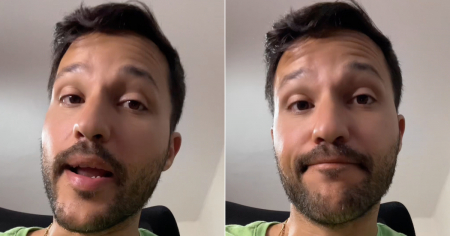
The Cuban youtuber Michel Crónicas, based in Mexico, reflected in a video on the reasons why, despite the profound economic and social crisis the country is undergoing, Cubans do not rebel. His argument, focused on indoctrination as a barrier to change, sparked a wide debate on social media among Cubans and Latin Americans.
"Why don't Cubans rebel? If things in Cuba are so bad, if there's so much scarcity in all sectors... then why don't Cubans rebel?" Michel asked in the video posted on his TikTok profile.
He clarified that he did not attribute it to cowardice or fear: “I don’t think so. It’s not a matter of cowardice; it’s about one word: indoctrination.” In his view, “the Cuban people are very indoctrinated, and they have been for decades.”
"Cubans have a cult of conformism, of apathy, of destruction," he stated, pointing out that from the outside, it is often hard to understand how, despite the crisis, people laugh, dance, or celebrate. "They say: 'things are bad, but we are already adapted.' There is a cult of adaptation, of poor adaptation," he emphasized.
In his view, that mindset blocks the possibility of transformation: "The system in Cuba is a failed system, and Cubans know it. But that indoctrination prevents them from making a change." He added that change will only come if there is a mental break: "As long as there is no change in consciousness, nothing will change in Cuba. Perhaps another generation is needed. Let’s hope not."
Divided reactions on social media
The video generated dozens of comments that ranged from support to criticism and comparison. "Wake up, Cuban brothers, no government is above the people," wrote one user. "That's right. They alienate them from a young age in school and through television programs," commented another.
From Mexico, some pointed out parallels: “Mexico is gradually going down that path, using the same Cuban methods.”
Other responses pointed more towards fear or repression. “It’s not indoctrination, it’s fear,” remarked one user. “If they were indoctrinated, they wouldn’t complain. They use that to their advantage,” said another. There were also those who sarcastically commented: “They don’t wake up early to work, so they’re certainly not going to rise up with arms.”
A content line focused on contrast
Michel Crónicas has developed a narrative on social media based on his personal experience after emigrating to Mexico. In several videos, he has contrasted his current life with the reality he lived in Cuba, addressing issues such as blackouts, food shortages, mobility, market prices, and access to basic services.
In one of them, he explained that he had not been able to stay in a hotel in Cuba until after emigrating. In another, he stated that he feels “like a millionaire Cuban in Mexico” for having hot water, yogurt, fruits, and, above all, freedom.
During a recent visit to the island, he documented daily blackouts, high prices for basic products, and the difficulty of finding food. In one of his videos, he showed his breakfast in Cuba: “I have neither cheese, nor coffee, nor fruits, nor yogurt. Just the bread from the store.” He concluded: “Here, you don’t buy what you want; you buy what’s available.”
Repression as an obstacle to change
Michel's ideas were added to a context of international denunciations regarding the repressive climate in Cuba. According to Cubalex, the regime has extended its repression to the families of opposition leaders and has even exploited minors as part of the political harassment.
This month, the Inter-American Commission on Human Rights (IACHR) once again included Cuba in its list of countries where serious human rights violations persist. The report emphasized the state control over the media, the lack of judicial independence, the repression of journalists and activists, and the inhumane conditions in prisons.
In the religious sphere, the Alliance of Christians in Cuba documented over 900 repressive acts against religious leaders and communities during 2024, denouncing legal restrictions, confiscations, and obstacles to pastoral activities.
Silence, self-censorship, and fear
Fear as a control mechanism has also been addressed in artistic expressions and testimonies from the island. In 2024, neurosurgeon Néstor Pulido Ríos composed the song "Speak Softly, Friend" following the protests in March, describing how many Cubans avoid speaking out loud for fear of reprisals. "They have always lied to us. And for speaking softly, look where we've ended up", one of the verses states.
Previously, film critic Gustavo Arcos pointed out that living in fear is one of the regime's greatest achievements: “After 60 years of revolution, people have to speak softly. You even have suspicions about yourself.”
Awareness as a starting point
Michel Crónicas, for his part, concluded his reflection with a call to break that mental cycle: "Until there is a change in consciousness, nothing will change in Cuba," he reiterated. "Perhaps another generation is needed... let's hope not. But without consciousness, there will be no transformation."
Frequently asked questions about the situation in Cuba and the adaptation of Cubans abroad
Why don't Cubans rebel against the regime?
The YouTuber Michel Crónicas claims that indoctrination is the main obstacle preventing Cubans from rebelling against the regime. According to him, the Cuban people have been indoctrinated for decades, which has created a culture of conformity and adaptation to difficulties, thus hindering the possibility of real change. This mentality must change for a transformation in Cuba to take place.
What role does fear play in the lack of rebellion in Cuba?
In addition to indoctrination, fear is a significant factor that prevents many Cubans from rising up against the regime. The repressive atmosphere and reports of human rights violations, such as state control over the media and the oppression of journalists and activists, create an environment where the fear of reprisals becomes a powerful mechanism of social control.
How does a Cuban adapt to life in Mexico?
The adaptation of Cubans in Mexico can be challenging due to cultural differences, despite the historical ties between both countries. Michel Crónicas emphasizes the importance of embracing the new culture, not imposing "cubaneo," but rather flowing and respecting local customs. Additionally, it has highlighted the opportunities that Mexico offers in comparison to the limitations in Cuba, such as access to basic goods and services.
What differences exist between living in Cuba and Mexico according to Michel Crónicas?
Michel Crónicas highlights that in Mexico, access to basic products and services that are considered luxuries in Cuba is available, such as staying in a hotel, buying a variety of foods, and enjoying efficient public services like transportation and electricity. These differences emphasize the lack of opportunities and resources in Cuba, contrasting with the possibilities for a more stable and dignified life in Mexico.
How do the repressive policies of the Cuban regime affect the population?
The repressive policies of the Cuban regime severely affect the population, limiting their freedoms and human rights. According to reports from the Inter-American Commission on Human Rights, state control over the media, repression of journalists and activists, and inhumane conditions in prisons are common practices that hinder any attempt at change or expression of dissent on the island.
Filed under: