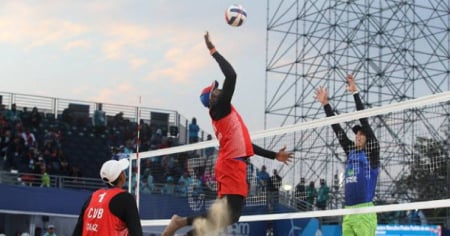
In the midst of blackouts, an energy crisis, and widespread shortages, Cuban sports authorities have announced as a “serious goal” the construction of a beach volleyball stadium in Varadero, one of the country's main tourist destinations.
The information was disclosed by the official newspaper Girón and confirmed during the first stop of the Beach Volleyball Circuit of the North, Central America and Caribbean Confederation (Norceca), which takes place in Varadero.
The three-time Olympic champion Mireya Luis, currently the vice president of the Cuban Volleyball Federation and the event's general director, boasted that the project has support from the local government, the Ministry of Tourism, and other entities related to sports.
"It is a serious goal. We have the project planned with all the necessary requirements," declared the former player, referring to the intention to build a permanent facility that would replace the current temporary structures used each year during the tournament.
The Barceló Solymar Arenas Blancas Hotel has been a regular venue for the event, but its temporary stands only allow for the attendance of a few dozen spectators.
According to Mireya Luis, a stadium with increased capacity would benefit not only the event itself but also the athletes' training and the prestige of the regional competition.
Mireya Luis herself celebrated the current performance of the Cuban pairs, with one of them ranked among the top ten in the world.
However, she acknowledged that beach volleyball requires stable conditions to grow: “We never stop dreaming about the growth of the competition,” expressed the former leader of the Morenas del Caribe, Olympic champions in Barcelona 1992, Atlanta 1996, and Sydney 2000.
According to the Norceca circuit plan, Varadero will not only host the inaugural event of 2025 but will also be the venue for the final phase in October.
Although the event internationally showcases Cuba as a sports and tourist destination, the construction of a new stadium during times of scarcity raises a new front of debate regarding government priorities and the use of public resources.
The decision contrasts with the serious situation of the national electrical system, which is affected by recurrent failures in thermoelectric plants, lack of maintenance, and a shortage of investments in critical infrastructure.
On social media, numerous users have questioned the initiative, arguing that government funds and attention should be directed towards addressing power outages, improving transportation, supplying hospitals, or ensuring food and medicine, rather than building a facility for an annual event.
Odalis Altamirano expressed, for example: “What is needed is for them to build a thermoelectric plant to provide service to the province of Matanzas, which does experience electricity outages. But of course, Varadero doesn't feel it, only during the few moments of energy collapse. They keep wasting money and don't think about the ordinary Cuban who can't even afford the luxury of going to Varadero.”
Greisy Rodríguez Delgado remarked sarcastically: “Odalis Altamirano will use what they raise in that stadium to invest in the SEN, just wait and see. That has been very effective, look at how well-stocked the points of sale and service centers are.”
The profound decline in housing construction in Cuba is a clear indicator of the economic and social crisis the country is experiencing: in 2024, fewer houses were built than in the worst years of the Special Period, highlighting the sustained collapse of the state's ability to meet one of the most basic needs of the population.
The data was revealed by Cuban economist Pedro Monreal in an analysis published on the social network X, based on the official report titled “Construction in Cuba. Selected Indicators. January-December 2024. May 2025 Edition”, issued by the National Office of Statistics and Information (ONEI).
According to official figures, investments in business services, real estate activities, and rentals reached 24.907 billion Cuban pesos (CUP) in 2024, making it the primary destination for capital expenditure in the country.
This is complemented by 11,936.5 million CUP allocated to hotels and restaurants, for a total exceeding 36.8 billion pesos invested in activities closely related to tourism.
These figures intensify the debate about the ongoing priority that the Cuban regime places on tourism, despite the prolonged stagnation of the sector and the serious shortages faced by the population in essential areas such as public health and food production.
In this same vein, in 2024, official data regarding investment in Cuba during the first half of that year reignited the debate about the allocation of resources on the island, particularly the Cuban regime's insistence on investing in the tourism sector to the detriment of essential areas such as health and social assistance.
According to the ONEI report, from January to June 2024, the regime directed nearly 40% of its investments towards tourism-related activities, while investment in Health and Social Assistance is 14 times lower, a fact that has been severely criticized by economic experts, such as Cuban economist Pedro Monreal.
Frequently Asked Questions about the Construction of the Beach Volleyball Stadium in Varadero
Why is the construction of a beach volleyball stadium proposed in Varadero?
The goal is to create a permanent installation that will replace the current removable structures, used during the annual Norceca Beach Volleyball Circuit tournament. The construction aims to increase capacity to enhance the spectacle, athlete preparation, and the prestige of the event. However, the decision has sparked controversy amid the energy and economic crisis that Cuba is experiencing.
What are the criticisms regarding the construction of the new stadium in Varadero?
Critics argue that resources should be allocated to address more urgent problems, such as power outages, the lack of maintenance for critical infrastructure, and the scarcity of food and medicines. Many question the government's priority in investing in a stadium during a time of severe economic and energy crisis.
How does the energy situation in Cuba affect this initiative?
The energy crisis in Cuba, characterized by blackouts and a lack of maintenance in thermal plants, makes the construction of a beach volleyball stadium seem like a questionable investment. The population suffers from prolonged electricity outages, while the government prioritizes projects that do not address basic infrastructure problems.
What impact does the economic crisis have on Varadero as a tourist destination?
Varadero, despite being one of the main tourist hubs in Cuba, is facing significant deterioration due to a lack of maintenance and investment. The economic crisis has led to a decrease in tourist arrivals, and the current conditions of the hotel infrastructure have been criticized, impacting the perception of Varadero as a quality destination.
Filed under: