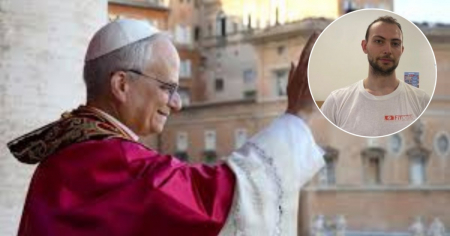
The Cuban regime sent a delegation to the Vatican this Sunday to attend the inaugural mass of Pope Leon XIV.
The regime's delegation was led by Vice President Salvador Valdés Mesa, who was briefly received by the pontiff, reported the Cuban News Agency (ACN).
Additionally, the delegation included Caridad Diego, head of the Office of Religious Affairs of the Central Committee of the Communist Party, and the Deputy Minister of Foreign Affairs, Elio Rodríguez.
Valdés Mesa reaffirmed to León XIV the commitment of his government to continue working to strengthen relations between Cuba and the Holy See, the information specifies.
Around 156 foreign delegations, including numerous heads of state and government, participated in the massive enthronement of León XIV in a St. Peter's Square filled with approximately 250,000 people.
During the inaugural mass of his pontificate, the Pope made a call for love, the unity of the church, and peace in the world.
The day began with the traditional ride of the Holy Father in his papamobile through the square, where he greeted thousands of worshippers.
At the beginning of this symbolic mass, León XIV received the symbols of his papacy from the hands of the cardinals.
Cardinal Mario Zenari bestowed the Pallium upon him, and Cardinal Luis Antonio Tagle presented him with the Ring of the Fisherman, in a ceremony where the Pope was seen visibly moved.
Then, the ceremony continued with the symbolic rite of "obedience," presented to the Pope by twelve representatives from all categories of the People of God, coming from various parts of the world.
During the subsequent homily, Leo XIV remembered his predecessor and called for the unity of the Church.
"I would like our first great wish to be a united Church, a sign of unity and communion, that becomes a leaven for a reconciled world," he said.
"In this time of ours, we still see too much discord, too many wounds caused by hatred, violence, prejudice, fear of difference, and an economic paradigm that exploits the Earth's resources and marginalizes the poorest," he added.
The supreme pontiff concluded with a call for love among all mankind.
"Brothers and sisters, this is the hour of love! (…) Together, as one people, all brothers, let us walk towards God and love one another," he concluded.
León XIV has first-hand knowledge of the Cuban reality
José Alberto Escobar, delegate of the Order of Saint Augustine on the island, assured that the new Pope Leo XIV “holds the Cuban people very close to his heart” and is well aware of their reality.
The religious figure explained that Prevost visited Cuba in April 2008 and in February 2011.
During his 2008 visit, the current Bishop of Rome, who served as the general prior of the Augustinians from 2001 to 2013, "spent a lot of time getting to know the communities in Chambas (Diocese of Ciego de Ávila) and in Puerto Padre (Diocese of Holguín)."
Three years later, in 2011, he focused "on presiding over the Assembly that we Augustinians hold annually where we evaluate and plan the main aspects related to our community and personal life in Cuba."
During the visits, Prevost "shared with the people of our parishes their joys, concerns, fears, and sleepless nights," and also "listened, visited, shared in their homes, and even stayed in their houses," said Escobar.
Escobar stated that the current Holy Father "has lived out his mission since his youth and has always been very humble and authentic in his personal relationships with those he interacts with" and "has remained interested in understanding the life of faith of the Church in Cuba and his Augustinian brothers."
The return of the Augustinians to Cuba
Recently, another religious figure in Cuba, Monsignor Emilio Aranguren Echeverría, the current Bishop of Holguín, recalled the "mark of simplicity" left by the visit to Cuba in 2008 of the then General Prior of the Augustinians.
Aranguren Echeverría reported that Prevost negotiated the return of the Augustinians to Cuba after they were expelled by Fidel Castro in 1961.
The current bishop of Holguín, accompanied by the late Cardinal Jaime Ortega, Archbishop of Havana, visited Prevost in Rome in 2005, where they requested the return of the Augustinians to Cuba.
The return of the order was finalized a year later, first in Ciego de Ávila, then in Puerto Padre (Holguín), and finally in Havana, the bishop explains.
Prevost arrived in 2008 to visit the Cuban Augustinians in the diocese of Holguín, particularly at the parish of Puerto Padre.
Since the rectory adjacent to the parish of Puerto Padre was under repair, Robert Francis Prevost was accommodated in a family home during the three days of his stay, Aranguren reports.
“Today, the joy of Mr. Manuel Miguel (who took him in), known to everyone as Manolín, is overflowing, and he shows everyone a simple diploma that Father Prevost gave him for his hospitality and the support he provided to the friars of the community,” he recounts.
From Puerto Padre, the then prior of the Augustinians moved to Holguín to meet with Aranguren and gain firsthand knowledge of the reality in eastern Cuba.
"Undoubtedly, today León XIV left a mark of simplicity, closeness, and joy in seeing how his brothers were evangelizing and serving the love of God in the midst of such a needy reality," he said.
The Pope and Cuba
Robert Francis Prevost, 69 years old, was elected in early May as the 267th Pope of the Catholic Church. He is the first American Pope and also holds Peruvian citizenship, having lived in that country for several years.
Former Cardinal Prevost has had a direct connection with Cuba, a country he visited several times before his appointment as Supreme Pontiff.
Shortly after his appointment, a photo of him surfaced on social media in Havana alongside the late dissident Harold Cepero Escalante in front of the Cathedral of Havana, capturing a moment of Christian fellowship that takes on new meaning today.
Cepero Escalante, a member of the Christian Liberation Movement, died at the age of 32 in Granma while riding in a car with Oswaldo Payá. The incident was classified as an "accident" by the government, but family, friends, and a report from the Human Rights Foundation in 2015 attribute it to a deliberate action by the regime.
Precisely, following the election of the new Pope, Raúl Castro and Miguel Díaz-Canel sent congratulatory messages, eager to present an image of harmony and continuity in relations with the Vatican.
Frequently Asked Questions about the Relationship between Pope Leo XIV and Cuba
Who led the Cuban delegation that attended the inaugural mass of Pope Leo XIV?
The Cuban delegation was led by Vice President Salvador Valdés Mesa, who was briefly received by Pope Leo XIV. The delegation also included Caridad Diego and Deputy Minister of Foreign Affairs Elio Rodríguez.
How has Pope Leo XIV been connected to Cuba prior to his election?
Pope Leo XIV visited Cuba on several occasions before his election, specifically in 2008 and 2011, when he was the Prior General of the Augustinians. During his visits, he focused on getting to know the communities and the Cuban reality firsthand, leaving a lasting impression of closeness and simplicity among the Cuban people.
What is Pope Leo XIV's stance on the relationship between the Church and Cuba?
Pope Leo XIV, who has a deep understanding of the Cuban reality, has maintained a constant interest in the life of faith in Cuba and in the relationship between the Church and the Cuban people. His selection presents an opportunity to strengthen the ties between the Vatican and Cuba, at a time when the island is facing significant social and economic challenges.
How has the Cuban government reacted to the election of Pope Leo XIV?
The Cuban government, led by Raúl Castro and Miguel Díaz-Canel, congratulated Pope Leo XIV following his election, expressing their intention to strengthen relations with the Holy See. Cuban authorities have shown interest in maintaining an image of continuity and harmony in their relations with the Vatican.
Filed under: