
Related videos:
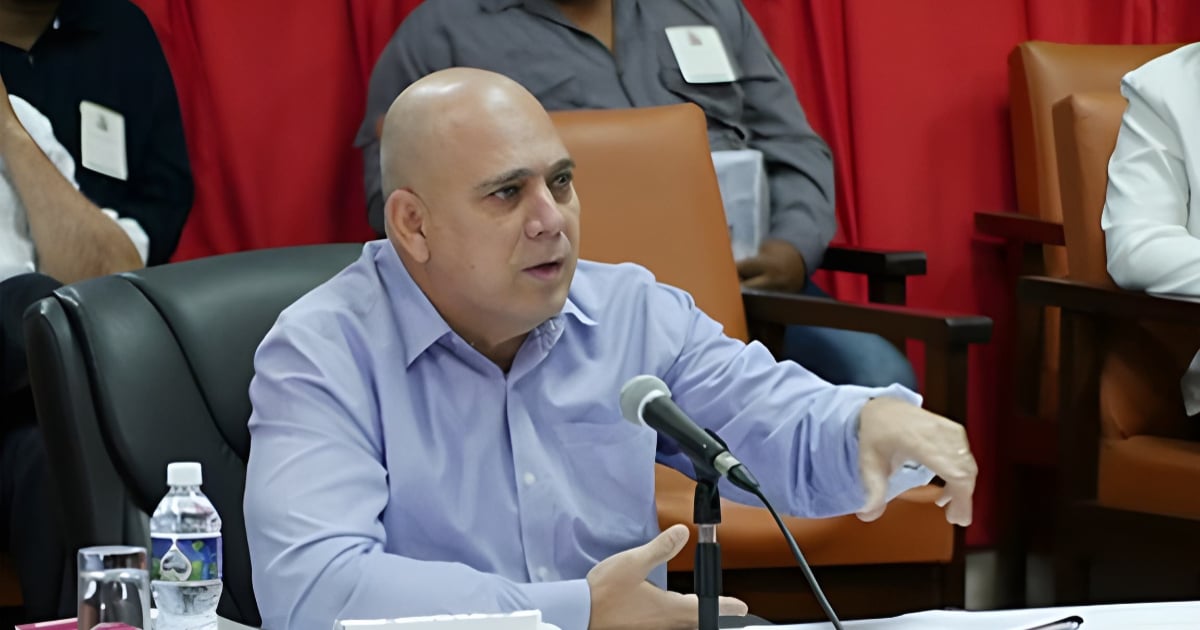
He has been seen everywhere. In the stands, at congresses, during walks through paralyzed factories, or at Party events where empty promises are repeated. Roberto Morales Ojeda dutifully accompanies the current Cuban dictator in every political activity. He supports him, accompanies him, and sometimes steps in for him during speeches.
He removes and appoints Provincial Secretaries of the Communist Party as if they were administrative pawns. His face is already familiar in the official press, where he appears not for his own charisma, but due to media insistence. Little by little, the apparatus is positioning him; they don’t announce it, but they imply it: Morales Ojeda is emerging as a possible successor to Miguel Díaz-Canel.
A medical professional, born in 1967, Morales Ojeda has meticulously climbed the ranks of the communist structure. From his years as an official in the Provincial Committee of the PCC in Cienfuegos—where he rose to the position of First Secretary—to his term as Minister of Public Health (2010-2018), his career has been characterized by obedience and functionality, rather than leadership.
In 2018, he was appointed Vice President of the State Council and later Vice Prime Minister. In 2021, he took on one of the most strategic positions of power: Secretary of Organization and Personnel Policy of the Central Committee of the PCC, responsible for shaping the pool of political leaders on the island. If anyone is well-positioned within the system, it is him.
Now, the Cuban Constitution of 2019, in its Article 127, states that to be elected President, one must be between 35 and 60 years old at the start of their first term. Morales Ojeda will turn 61 on June 15, 2028. However, if the National Assembly of People's Power conducts the presidential election—as would be logical—before that date (in April, marking five years of the current term), he would still fall within the age range permitted by the Constitution. In other words, there is a small legal window for his candidacy to be viable. Just enough to put him in the running.
Beyond constitutional technicalities, the underlying point is different: Is there anyone else capable of assuming that role? Castroism today faces one of its most severe leadership vacuums. Even among the younger members of the party apparatus, there are no figures capable of articulating a renewed narrative, generating empathy, or exerting real influence. The natural succession is hindered by distrust, verticalism, and the lack of legitimacy that erodes state institutions from within. There are no heirs, only survivors.
What Morales Ojeda represents, then, is not leadership, but continuity. His eventual rise to power would not be a decision to break away, nor an attempt to revive the project, but rather a maneuver to keep the empty shell of the system alive through a new compliant face. Another uninspiring bureaucrat, without popular support or vision, but with the approval of those who truly hold power.
In this context, the gamble is particularly dangerous. Cuba is experiencing one of the worst crises in its recent history: daily blackouts, food shortages, a collapse of public transportation, mass exodus, and rising repression. This is compounded by the increasing international discrediting of the regime and the sense of frustration that runs through the streets, even though it does not always manifest in visible protests.
The management of Miguel Díaz-Canel has been disastrous. It has deepened isolation, legitimized repression, and pushed hundreds of thousands of Cubans into exile. Instead of correcting the course, it has consolidated the collapse, but if there is one thing the regime seems less concerned about, it is the efficiency of its leaders: what matters is their loyalty. That is why Morales Ojeda fits perfectly into that mold: he is not a solution, but an extension.
As a biological rule, the historical faces of Castroism will begin to disappear one after another, gradually and inevitably. The dilemma will then not only be about succession but also about meaning: How to sustain a structure without a soul, without a narrative, and without reference points in front of a society that no longer believes? What kind of country will be left for Morales Ojeda —or whoever inherits it— when that time comes?
Castrism, which once was an ideological project, then a machine of power, and today a model of survival, remains clinging to continuity. The problem is that there is nothing left to continue.
Filed under:
Opinion article: Las declaraciones y opiniones expresadas en este artículo son de exclusiva responsabilidad de su autor y no representan necesariamente el punto de vista de CiberCuba.