
Related videos:
The opposition platform Council for Democratic Transition in Cuba (CTDC) expressed its support this Monday for a potential dialogue between Pope Leo XIV and the Cuban regime, in favor of the thousands of political prisoners and the citizens' demands for freedom and national reconciliation.
According to a report by the agency EFE, the opposition group issued a statement expressing its hope of receiving support from the new pontiff and being recognized as a legitimate political entity.
They also requested that León XIV "defend the dignity of Cubans seeking reconciliation and redress."
"This year, as the Church celebrates the Jubilee of Hope, we trust that we can count on the support of His Holiness, that he will acknowledge our existence as an opposition and defend the dignity of Cubans," stated the organization.
The CTDC expressed optimism regarding the role that the Pope could play in relation to the situation of political prisoners on the island and the demands for democratic openness.
"We recognize their commitment to just causes and to the most disadvantaged, which is why we view with optimism the dialogue they may have in favor of our political prisoners and demands for freedom," they added.
In its statement, the platform described Cuba as a collapsed country, steeped in a deep crisis marked by hunger, poverty, violence, and state repression.
This context, they pointed out, "has taken away hope from many and has caused the largest exodus in the country's history, which has shattered family unity and fragmented the nation."
The organization defined itself as "a group of Cubans united by their opposition to the political system on the island and their goal of establishing a democratic rule of law that ensures freedom as the supreme good, dignity, and justice."
However, while the Cuban opposition was appealing to the Pope for support of the freedom cause, the regime responded with congratulatory messages sent by the leader of the Communist Party, Raúl Castro, and the ruler Miguel Díaz-Canel, who expressed their desire to promote peace, dialogue, and the strengthening of relations between Cuba and the Holy See following the election of Leon XIV as the new Supreme Pontiff of the Catholic Church.
In an official statement issued by the Ministry of Foreign Affairs (MINREX), Raúl Castro welcomed the new Pope with diplomatic words and highlighted the role of the Papacy in promoting global stability
"Your Holiness: I extend my warm congratulations on your election as Supreme Pontiff. I trust that your Pontificate will make an essential contribution towards peace and dialogue. Cuba will continue to strengthen its positive relations with the Holy See. Please accept the testimony of my highest regard and esteem," concluded the message signed by Castro.
In this regard, the Cuban regime sent an official delegation to the Vatican this Sunday to attend the inaugural mass of the pontiff.
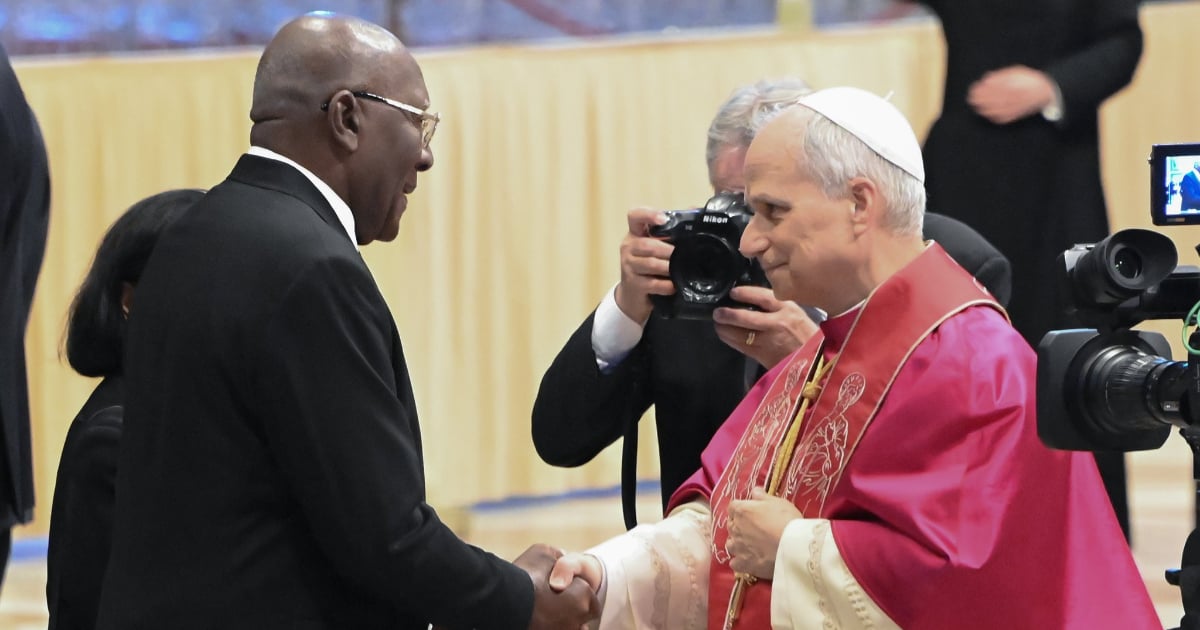
The Cuban government delegation was led by Vice President Salvador Valdés Mesa, who was briefly received by León XIV.
The delegation also included Caridad Diego, head of the Office for Religious Affairs of the Central Committee of the Communist Party, and the Deputy Minister of Foreign Affairs, Elio Rodríguez.
During the brief meeting, Valdés Mesa conveyed to the Pope the Cuban government's willingness to strengthen bilateral relations with the Holy See, according to the official version released by state media.
The Vatican has played a significant role in Cuban politics in recent decades, especially under the papacy of Francis (2013-2025).
The mediation of the Holy See was crucial in episodes such as the brief diplomatic thaw between Havana and Washington (2014-2017), as well as in the agreement for the release of prisoners in exchange for removing Cuba from the list of state sponsors of terrorism in 2025.
A Pope with Cuban roots and a close connection to the Island
The hopes of Cuban opponents rest on an unexpected connection between the new Pope and the Island.
A genealogical investigation published by the Spanish newspaper El Mundo revealed that Pope Leon XIV, born in the United States as Robert Francis Prevost, has Cuban roots.
One of his maternal ancestors, Manuel José Ramos, was born in Havana in 1760 and emigrated as a young man to New Orleans, which was then under Spanish rule.
The connection with Cuba is not just ancestral. León XIV has had a direct relationship with the country, which he visited in 2008 and 2011 as General Prior of the Order of St. Augustine, and in 2019 as a bishop, already serving as president of the Pontifical Commission for Latin America.
During his first visit, he toured communities in Chambas (Ciego de Ávila) and Puerto Padre (Holguín), where he interacted with Cuban families.
Reiniel Jiménez Gil, a nurse and witness to that meeting, recalled on social media how the then prior "ate white rice and picadillo" in the humble homes of the community, sitting at the table like one of them.
During his second visit in 2011, he presided over the annual assembly of the Augustinians in Cuba and once again engaged with parishioners in rural areas.
The Order's delegate on the Island, José Alberto Escobar, assured that he "holds the Cuban people deep in his heart" and knows their reality firsthand.
That same year, the bishop of Holguín, Emilio Aranguren, revealed that Prevost was instrumental in the return of the Augustinian friars to Cuba, after they had been expelled by the government in 1961. Thanks to his mediation, the order gradually returned to Chambas, Puerto Padre, and Old Havana.
The Periódico 26 also confirmed its presence in Las Tunas, where it stayed at the home of parishioners in Puerto Padre and signed a document of gratitude that is still kept as a memento.
His return to Cuba in 2019 included participation in the closing of the Jubilee Year celebrating the 500th anniversary of the Diocese of Havana, liturgical celebrations, and meetings with bishops at the San Carlos and San Ambrosio Seminary.
In this context, the Cuban opposition sees Pope Leo XIV as a figure who is approachable and sensitive to the realities of the country, not only because of his roots and his history of closeness with Cuban communities but also due to his commitment to just causes and his moral authority both within and outside the Church.
Frequently Asked Questions about Pope Leo XIV's Support for the Cuban Opposition and the Situation in Cuba
Why are Cuban opponents seeking the support of Pope Leo XIV?
Cuban opponents seek the support of Pope Leo XIV due to his commitment to just causes and his personal connection to Cuba, hoping that he can positively influence the situation of political prisoners and the demands for freedom and reconciliation on the island. The Pope has Cuban roots and has visited the country several times, which strengthens the hope that his intervention may lead to significant changes.
What is the stance of the Cuban regime regarding the new Pope Leo XIV?
The Cuban regime has expressed a diplomatic stance towards Pope Leo XIV, sending messages of congratulations and wishing to strengthen relations with the Holy See. Despite the serious political and social crisis on the island, the government seeks to project an image of continuity and dialogue with the Vatican.
What role has the Vatican played in recent Cuban politics?
The Vatican has acted as a mediator at several key moments in Cuban politics, including the diplomatic thaw with the United States and the release of political prisoners. Its influence has been seen in agreements such as the one that facilitated the release of detainees in exchange for improvements in Cuba's international relations.
How has international support for the release of political prisoners in Cuba been manifested?
International support has been expressed through campaigns and statements from various organizations and governments, calling for the immediate release of all political prisoners in Cuba. Entities such as Amnesty International and the European Union have urged for increased diplomatic pressure on the Cuban regime to end the repression.
Filed under: