
Related videos:
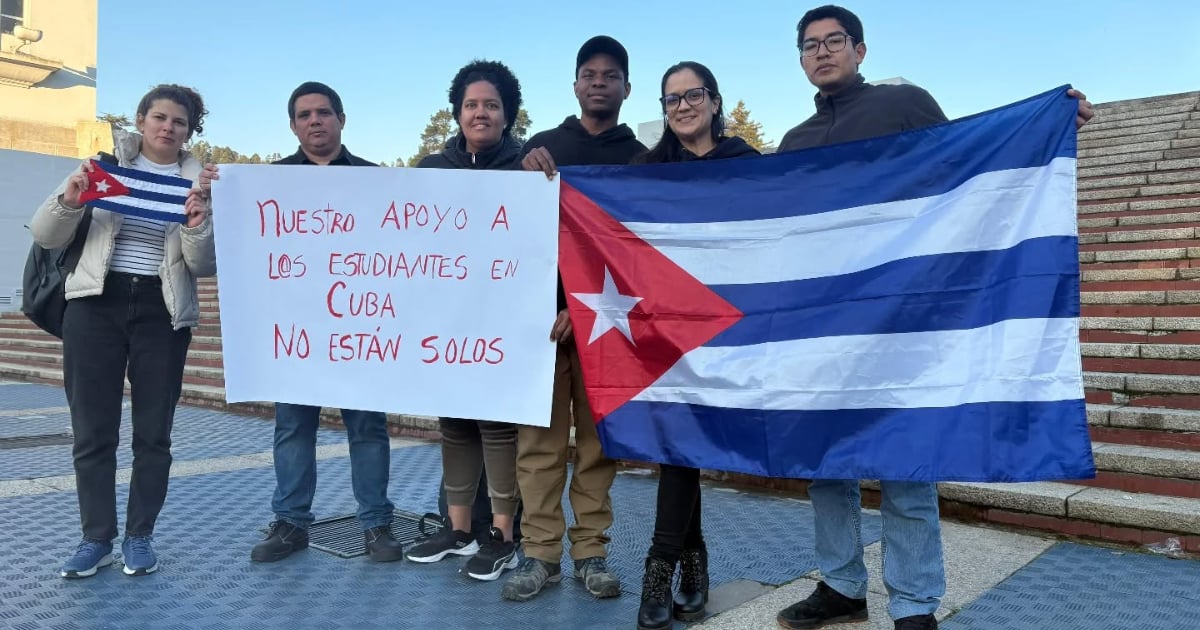
From the University of Concepción in Chile, a group of students has expressed their support for Cuban university students on the island who have voiced their opposition to the recent increase in rates imposed by the Cuban Telecommunications Company (ETECSA).
“We know we are far away, but at least, from this corner of the world, those who passed by read our sign and looked on in amazement, knew that in Cuba there are students saying no and being brave,” wrote the Cuban Dunielys Díaz Hernández on Facebook, accompanied by students from Mexico and Colombia who posed with a Cuban flag and a sign that read: “Our support for the students in Cuba. You are not alone”.
"In that gesture of visibility lies the essence of these seven individuals with a Cuban flag next to the Campanil. It’s our way of saying that they are not alone, thank you very much," the post concludes.
The symbolic action took place in front of the iconic bell tower of the University of Concepción and is part of a growing wave of solidarity with Cuban students, both inside and outside the country.
Solidarity in Cuba: artists, educators, and more students
One day earlier, a group of graduates from the Higher Institute of Art (ISA) in Havana also publicly expressed their support for the student movement. In a letter shared on social media, the alumni stated, “We want to be part of this. We want to support you. Where and how can we be more helpful?” They referred to the students as heirs of a new critical consciousness and encouraged them to continue raising their voices “for social justice, freedom of thought, and civic dignity.”
The gesture of the artists aligns with the statements from the faculty of the Department of Sociology and Social Work at the University of Havana, who openly rejected the rates imposed by ETECSA and questioned the lack of prior consultation with the public.
Since June 3, students from the Faculty of Mathematics and Computing (MATCOM) at the University of Havana have called for a teachers' strike in protest against ETECSA's measures. Meeting in an assembly with company executives, they reaffirmed their decision not to return to classes until satisfactory solutions are offered. “More than a commercial problem, this is a social problem,” declared one of the speakers, highlighting the impact of the rates in a country where the average monthly salary does not exceed 15 dollars.
Additionally, they demanded the removal of the monthly reloading cap of 360 Cuban pesos (CUP) and criticized the lack of institutional willingness to rectify the measure.
More powers are added and they distance themselves from the leadership of the FEU
The Faculty of Biology at the University of Havana also joined the call. In a statement read from a classroom, the Extended Council of the FEU of that faculty declared that the national president of the organization, Ricardo Rodríguez González —also a member of the Council of State— does not represent their voice. "Our voice is not funded, it is critical and legitimate," the young people emphasized.
They denounced the official attempts to delegitimize their positions and called for a direct dialogue with the Council of Ministers, as well as the establishment of a multidisciplinary team to analyze the crisis.
A movement with national resonance
The university protest has transcended the academic sphere to become a broad expression of citizen discontent. The increase in fees by ETECSA has been condemned by students, faculty, graduates, and ordinary citizens as an exclusionary and insensitive measure in the face of the economic crisis affecting Cuba.
Meanwhile, the gesture of support from Chile —and others that are continuing to multiply— confirms that, despite the isolation, Cuban students are not alone. The university voice, both from within and outside the country, demands change and rejects decisions imposed without consultation or social justice.
Frequently Asked Questions about the Student Protest and ETECSA's Measures in Cuba
Why are students in Cuba protesting against ETECSA?
The students are protesting against the rate increase imposed by ETECSA, as they believe that these measures negatively affect the Cuban population, deepening social inequalities and limiting access to information and education. Furthermore, the rates were implemented without prior consultation with the public, which has generated widespread social and academic discontent.
What actions have students taken in response to ETECSA's rate hike?
Students have called for academic strikes and have demanded transparent dialogue with ETECSA management and the Cuban government. They have held assemblies and issued statements rejecting the tariff measures and calling for solutions that are fair and accessible to the entire population. They have also requested the inclusion of student technical proposals in the decision-making process.
What support have Cuban students received in their protests?
Students have received support from various faculties, professors, artists, and alumni both inside and outside of Cuba. The Academic Freedom Observatory expressed its support for the students and warned about possible reprisals from the Cuban government. Additionally, students from other universities in Latin America, such as those from the University of Concepción in Chile, have shown their solidarity with the Cuban student movement.
How has the Cuban government responded to the student protests?
The Cuban government, through university authorities, has issued statements reaffirming its loyalty to the Communist Party of Cuba and has warned that it will not tolerate disruptions in the educational processes. However, it has not offered meaningful solutions addressing student demands, which has intensified discontent and mobilization within the universities.
Filed under: