
Related videos:
The growing university rebellion in Cuba has added a new chapter: the students of the Faculty of Biology at the University of Havana have officially distanced themselves from the national president of the University Student Federation (FEU), Ricardo Rodríguez González, and support the protests against the fees imposed by ETECSA.
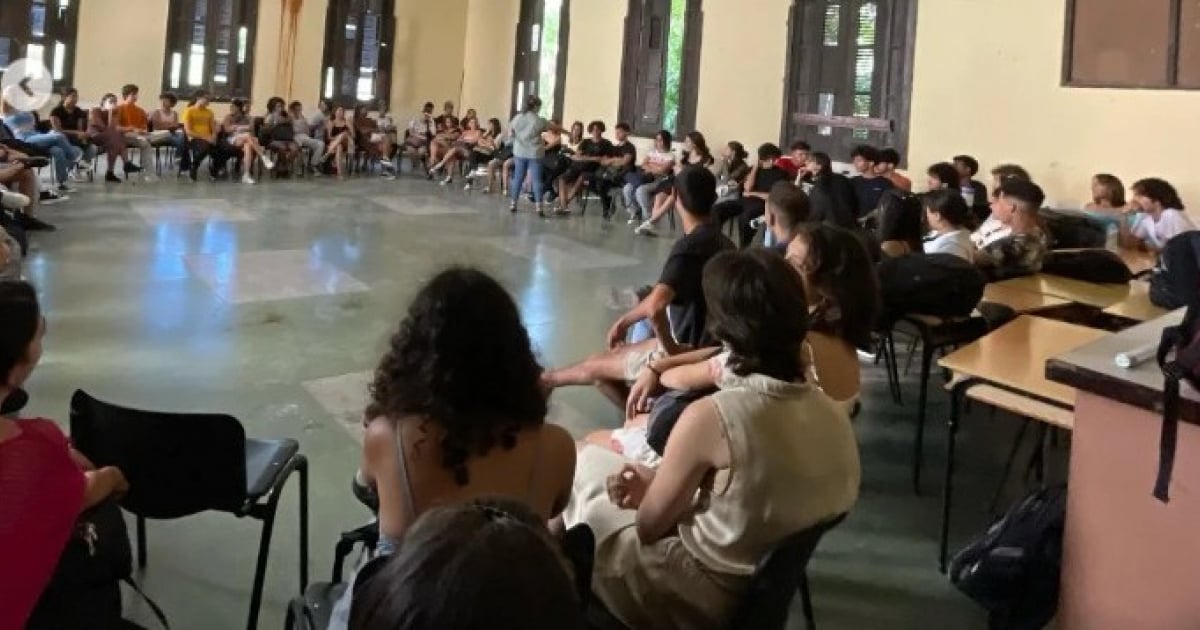
In a statement read from a classroom at the Faculty, the student representatives of Biology stated that the president of the FEU "does not accurately represent our opinions nor reflect the voice of our student community."
They also reaffirmed their support for the statements previously issued by the Faculty of Mathematics and Computer Science (MATCOM), which is on indefinite academic strike.
"We represent the genuine feelings of the people to whom we belong," the document emphasizes, in stark opposition to the official attempts to silence critical expressions within universities.
Biology against the official narrative
In their statement, the youths categorically refuted the accusations made by state-run media and by Rodríguez himself, who, during his intervention on Monday at the Mesa Redonda, attributed the protests to the alleged manipulation by "enemies of the revolution."
The Expanded Council rejected that speech, asserting that their positions "are not influenced or manipulated by external agents," and condemned the government's attempts to label their voices as false or funded from abroad.
"They constitute the genuine gathering of critical thoughts and the social commitment of students from each faculty," emphasizes the text.
Direct criticism of ETECSA: "No crisis justifies insensitivity"
Beyond the conflict within the FEU, the Biology statement firmly condemns the measures taken by ETECSA, stating that "they increase social gaps, limit fundamental rights such as communication, and affect students' and professionals' access to essential digital resources."
Students acknowledge the economic difficulties facing the country, but warn that "no crisis justifies insensitivity to the needs of the people," and accuse ETECSA of straying from the Martí principle of acting "with everyone and for the good of everyone."
Proposals from the classroom: dialogue with the Government and multidisciplinary team
The FEU Council in Biology did not limit itself to criticism. In their statement, they requested a direct dialogue with the Council of Ministers in search of "a constructive bilateral exchange" where students can be heard as legitimate actors in the development of solutions.
In addition, they supported the initiative of the rector of the University of Havana to create a multidisciplinary team composed of all the faculties, with the aim of analyzing the current crisis and proposing viable alternatives.
FULL TEXT OF THE DECLARATION OF THE FEU OF THE FACULTY OF BIOLOGY OF THE UNIVERSITY OF HAVANA
University of Havana
Faculty of Biology
Official Statement from the Expanded Council of the FEU – Faculty of Biology
Room 4, Faculty of Biology – June 4, 2025, 9:00 a.m.
After a comprehensive consultation with the students of our Faculty, the Extended Council of the University Student Federation (FEU) convened to convey the prevailing sentiments of our university youth.
We express our disagreement with the position taken by the national president of the FEU, who does not accurately represent our opinions nor reflect the voice of our student community.
We fully support the statement issued by the FEU of the Faculty of Mathematics and Computing (MATCOM) through its official Telegram channel, acknowledging that it represents the genuine feelings of its students. We reject any attempts to delegitimize or undermine their position through unfounded accusations that seek to silence the student voice.
We represent the genuine feelings of the people to whom we belong, with the University Student Federation being the platform from which we channel our commitment to the needs and aspirations of our society.
Our opinion arises from the University Student Federation of the Faculty of Biology and is not influenced or manipulated by external agents to our organization. Therefore, we denounce the statements spread in official media that label our communications as false or funded by foreign entities, as they represent the genuine assembly of critical thoughts and the social commitment of the students from each faculty.
We categorically reject ETECSA's measures as we consider them harmful to social justice, as they increase social inequalities, limit fundamental rights such as communication, and affect students and professionals' access to essential digital resources. While we understand the financial difficulties, no crisis justifies insensitivity to the needs of the people, contradicting our principle of acting "with everyone and for the good of everyone."
We request a direct bilateral exchange with a representation from the Council of Ministers, with the aim of establishing a constructive dialogue where we can convey our concerns. We need you to provide us with institutional support and, fundamentally, to listen to us as legitimate actors in building alternatives that benefit the entire society.
We support the proposal from the Rector of the University of Havana to create a multidisciplinary team involving all faculties to provide optimal solutions and jointly analyze the current situation of the country".
An institutional break or a breakdown of the institution
The Biology declaration exacerbates the legitimacy crisis facing the national leadership of the FEU. President Ricardo Rodríguez, who is also a member of the Council of State, has been harshly criticized for his passive response that aligns with the government regarding ETECSA's rate hike.
The leader accused independent media and "opinion puppets" of promoting "hatred" and "betrayal" in the university. "Here I am to continue making the Revolution for which our martyrs died," he said defiantly.
On Monday, during the Round Table discussion, he stated that the student claims have been exploited by external actors with "very bad intentions" to distort the legitimate stance of university students, who, he asserted, have maintained an attitude of respect and dialogue.
Rodríguez defended that the FEU has acted "within the revolution" and assured that there have been multiple avenues for dialogue between students, ETECSA officials, representatives of the Communist Party, and ministers to address grievances.
On Monday, the Faculty of Philosophy, History, Sociology, and Social Work (Humanities) issued a statement demanding the immediate resignation of the leader, as they considered him incapable of representing the interests of the student body during the current crisis.
In its statement, the FEU described its attitude towards the discontent caused by the new ETECSA rates, which deny the right to access the Internet to millions of Cubans who do not have dollars as "complacent, passive, and lacking in critique."
"Our student body chooses not to rely on symbolic and non-binding commitments... they choose to get involved, participate, and take action," says the text.
This unprecedented mobilization within Cuban universities is a response to the new restrictions imposed by ETECSA, which limit the service in Cuban pesos while offering broader plans in dollars.
In response to widespread outrage, ETECSA announced a partial measure: a supplementary package of 6 GB for 360 CUP, exclusively for university students, along with free access to over 40 educational sites.
But university students reject mobile data packages solely for themselves and emphasize that they are not seeking sectoral privileges, but rather social justice and equity in Internet access for all citizens.
In the midst of the rising tension at Cuban universities, the provincial coordination secretary of the FEU in Havana, José Alberto Almeida Cabrales, stated that the student movement will not lead to chaos.
In a statement, Almeida defended the path of consensus and structured debate within universities.
"We are revolutionaries. We want peaceful solutions and inclusion for all. The FEU will never allow petty disputes to be encouraged among its members," he declared, apparently in response to the rising student strikes and public statements from various faculties.
What began as a specific complaint about fees has turned into an unprecedented student uprising in post-revolutionary Cuba, highlighting not only the fight for internet access but also the crisis of representation and the urgent need for new university leadership.
Frequently Asked Questions About Student Protests and ETECSA Measures in Cuba
Why are students at the University of Havana protesting against ETECSA?
Students are protesting against the new fees imposed by ETECSA that limit top-ups to 360 CUP per month and require high prices for additional data. They believe that these measures restrict internet access, affecting their academic development and social equity.
What is the stance of the Faculty of Biology at the University of Havana regarding the president of the FEU?
The Faculty of Biology has distanced itself from the president of the FEU, Ricardo Rodríguez González, stating that he does not represent the opinions or the voice of its student community. The students have supported the protests against ETECSA's fees and have joined other faculties in their demands.
What proposals have the Biology students made to address the crisis with ETECSA?
They have requested a direct dialogue with the Council of Ministers to find constructive solutions and have supported the creation of a multidisciplinary team with full authority to analyze the crisis and propose viable alternatives.
What effect do the new ETECSA rates have on university students?
The new rates significantly limit internet access for students, affecting their ability to access educational platforms, communicate with teachers, and conduct research. This creates inequality in access to information and hampers academic development.
Filed under: